
Quiet compressors: the real decibels, family by family
The quietest compressor in the catalogue is not the one you would expect, and oil-free does not mean quiet: rotary tooth machines rank among the noisiest. Here are the levels measured model by model, and what a decibel really changes.
What a decibel means, before you compare
The A-weighted decibel, written dB(A), is a logarithmic scale corrected to follow the sensitivity of the human ear. The practical consequence is surprising: ten decibels more corresponds to a sound perceived as roughly twice as loud, and three decibels more corresponds to a doubling of the sound energy.
In other words, the gap between a machine at 62 dB(A) and one at 82 dB(A) is not 30%: to the ear, it is a factor of four. That is what separates a compressor you install in the workshop from one that has to be shut away.
A second caveat: a level only means something alongside its measuring distance. The values in the CEZIUM catalogue are measured at one metre in free field. In a tiled room, reverberation adds several decibels; in a cluttered workshop it weighs less, without ever bringing the level below the free-field value.
The levels measured across the catalogue
This table is computed from the models in the CEZIUM catalogue at every build, so it cannot drift out of step with the product data sheets.
| Family | Models | dB(A) range | Median |
|---|---|---|---|
| Oil-free scroll | 10 | 55 to 70 | 58 |
| Single-phase screw | 6 | 55 to 60 | 60 |
| 4-in-1 integrated | 16 | 60 to 65 | 62 |
| Fixed-speed screw | 32 | 60 to 85 | 68 |
| PM VSD screw | 32 | 60 to 85 | 68 |
| Oil-free water-injected screw | 36 | 58 to 80 | 69 |
| 3-in-1 integrated rotary vane | 5 | 62 to 70 | 69 |
| Rotary vane vacuum pump | 7 | 64 to 75 | 71 |
| Oil-free dry screw | 20 | 69 to 74 | 72 |
| Super Silent rotary vane | 11 | 68 to 76 | 72 |
| PM VSD rotary vane | 8 | 70 to 78 | 72 |
| Onboard compressor | 4 | 72 to 76 | 74 |
| Two-stage screw | 27 | 65 to 84 | 74 |
| Tank-mounted rotary vane | 4 | 72 to 76 | 74 |
| VSD rotary vane | 7 | 72 to 76 | 74 |
| Standard rotary vane | 11 | 72 to 82 | 79 |
| High-pressure piston | 18 | 65 to 90 | 80 |
| Portable diesel | 46 | 75 to 88 | 85 |
| Oil-free rotary tooth | 14 | 80 to 85 | 85 |
| Dual-motor rotary vane | 4 | 84 to 86 | 85 |
| Stationary diesel | 2 | 88 to 88 | 88 |
Values declared in the catalogue, measured at one metre in free field. A difference of 10 dB(A) corresponds to a noise perceived as roughly twice as loud.
The counter-intuitive result: oil-free does not mean quiet
Common intuition associates the oil-free machine with the cleanroom, and therefore with silence. The catalogue says the opposite: the rotary tooth compressor, one of the most advanced oil-free technologies, is among the noisiest families, while the lubricated screw compressor ranks among the quietest.
The reason is mechanical. In a lubricated compressor, the injected oil cushions the contact between the rotors and absorbs part of the acoustic energy, just as it absorbs heat. A dry machine has no such damper, and its rotors often turn faster to make up for the absence of a liquid seal.
The scroll compressor is the exception to this rule, like small water-injected screws: its continuous compression, with no pulsation and no valves, makes it the quietest oil-free machine, which explains its place in laboratories and dental practices.
If silence and oil-free air are both mandatory, the scroll is the answer. If only silence matters, an enclosed lubricated screw does better than most oil-free machines.
Installing without a plant room
The real question is almost never "which is the quietest compressor" but "can I put it where the air is needed". An acoustic enclosure, a position away from workstations and a correctly sized air network often count for more than a few decibels' difference between two machines.
- Moving the machine to twice the distance takes off about six decibels in free field
- An integrated acoustic enclosure avoids building a plant room, which often costs more than the machine
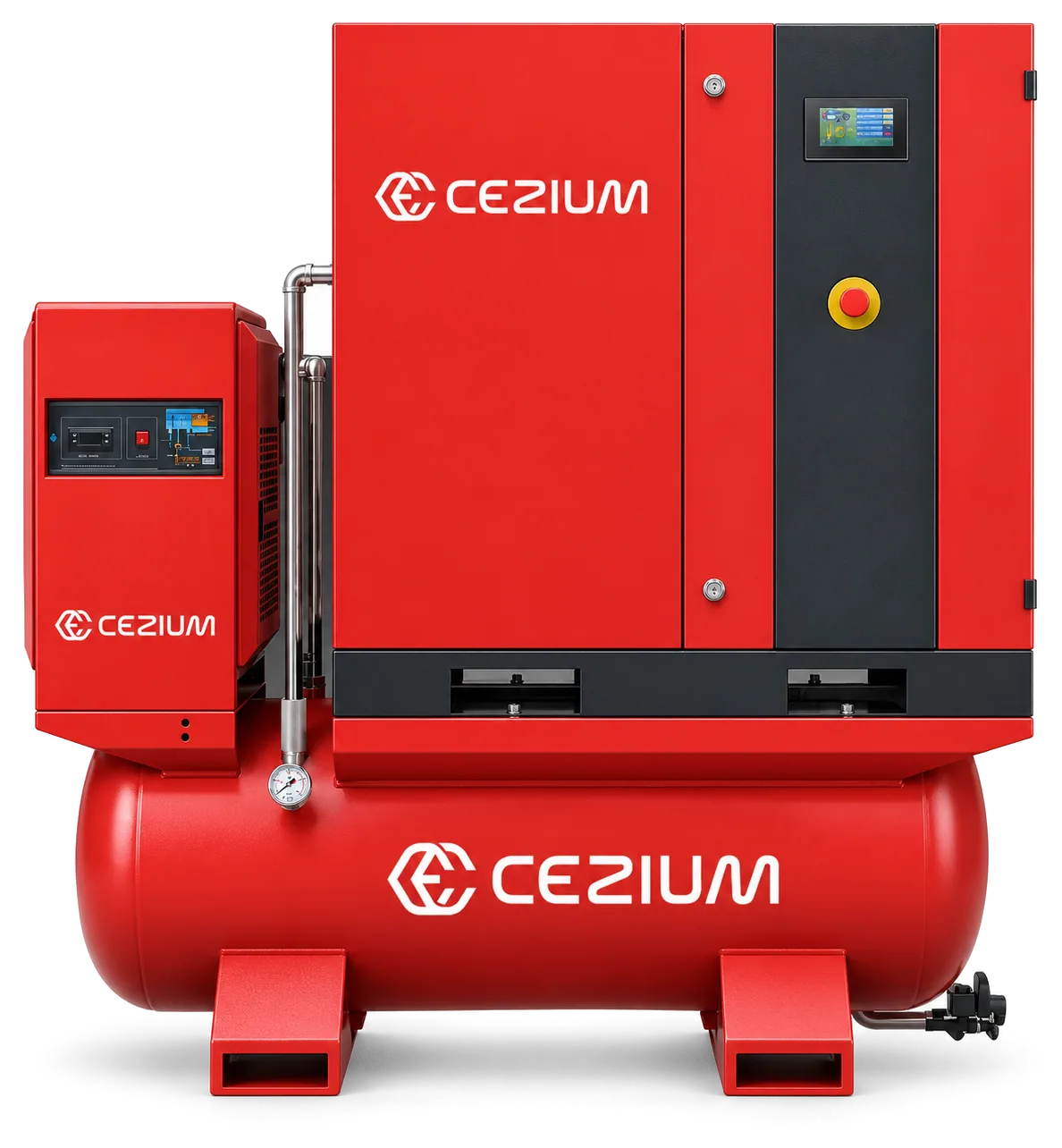
- All-in-one models combine compressor, dryer, filtration and air receiver in a single treated enclosure
- An undersized air network forces a higher pressure, which also increases noise
- Room ventilation matters: a compressor short of cool air runs hot, and its fan becomes the main source of noise
The questions we get asked
Which is the quietest compressor in the CEZIUM catalogue?
Can a compressor be installed in an occupied workshop?
Is an oil-free compressor quieter?
Recommended models for this topic
Selected by our technical team
Need precise sizing?
Our 5-question selector matches your profile against the models of the CEZIUM catalogue and suggests the best 3. An answer in 2 minutes.
How to size an air compressor: flow, pressure and storage
Sizing a compressor properly is not a matter of picking a power rating in kW: it means calculating the real flow, the right pressure and suitable storage. A 4-step method, with a worked example.
ComparisonLubricated screw or oil-free compressor: Class 0 describes the air, not the machine
Most comparisons set two machines against each other. The standard, however, judges the air at the point of use. A lubricated screw followed by a treatment chain can deliver oil-free air at the point of use, at a significantly lower purchase cost; class 0 itself remains that of an oil-free machine. Here is the order in which CEZIUM selects each technology.
StandardHow to calculate and reduce pressure drop in a compressed air network
A 1 bar pressure drop costs around 7% in energy across the whole compressed air installation. Here is how to calculate it, measure it and reduce it: pipe diameter, network layout, filters, dryer, fittings.