
Screw or piston compressor: the wrong question
The two are usually set against each other as two ways of doing the same job. In practice, they no longer cover the same ground: the screw has taken over the factory air network, and the piston holds the pressures no screw reaches: 30 to 60 bar for the dry piston, 300 and 500 bar at high pressure.
Two principles, two territories
A piston compressor works in cycles: the piston goes down and draws air in, then rises and discharges it through valves. The flow is pulsating, the machine heats up intermittently, and it copes poorly with prolonged continuous running. In return, it reaches pressures that no other industrial technology can sustain.
A screw compressor compresses continuously, between two helical rotors, with no valves and no pulsation. The flow is steady, the machine is designed to run thousands of hours a year, and its efficiency holds up under sustained load.
The usual comparison stops there and concludes "screw for industry, piston for the garage". That is true at low pressure, and wrong as soon as the pressure goes up.
What each family really covers in the catalogue
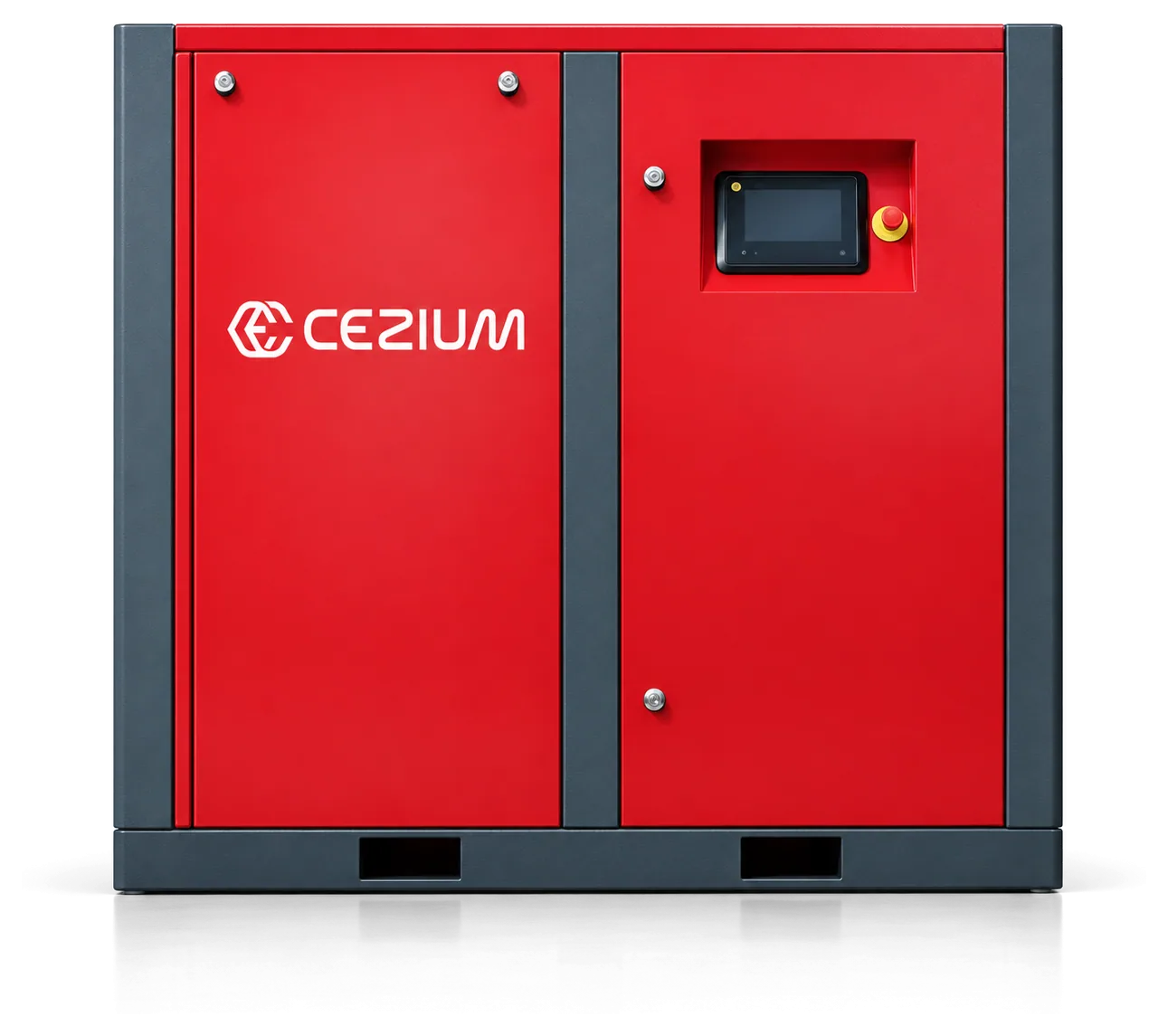
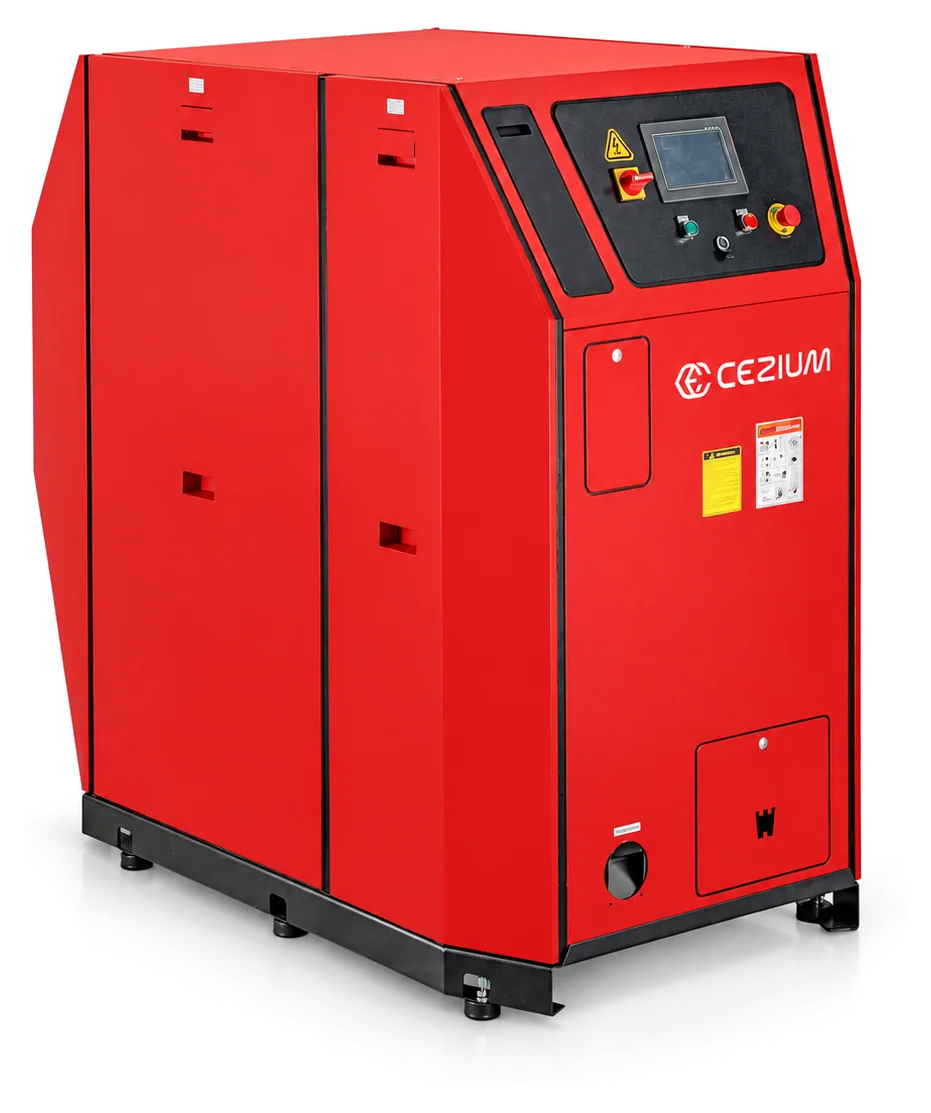
The CEZIUM catalogue does not offer low-pressure piston compressors for air networks, and that is not an oversight: on an installation that runs several hours a day, the screw does better on every criterion that counts in the long run. The pistons in the catalogue are medium- and high-pressure machines, a different trade altogether.
| Screw compressors | 3.7 to 250 kW, operating pressure from 3 to 20 bar depending on the range: the factory air network, continuous duty, instrument air |
|---|---|
| Dry pistons | 14 models from 7.5 to 30 kW, 30 to 60 bar, with no oil in the cylinders |
| High-pressure pistons | 38 models from 2.2 to 45 kW, pressure 300 to 500 bar: where the screw does not go |
| What decides | The required pressure first, then the annual running hours |
| Warranty | The same on both families: 3 years on the machine, 5 under SEENTINEL supervision, 10 years of parts availability |
The real threshold: hours, not power
If the required pressure stays within the industrial network range, the question becomes an economic one, and it is settled in annual running hours rather than in kilowatts.
Below a few hundred hours a year, the energy consumed stays modest and the purchase price dominates: a simple, less expensive machine holds its own. Beyond that, the cumulative electricity bill takes over, and the efficiency gap between technologies is the only thing that decides.
The tipping point has no universal value: it depends on your price per kilowatt-hour and your load profile. What is certain is that reasoning on purchase price stops being valid as soon as a machine runs every day.
Ask the questions in this order: what pressure, then how many hours a year. The technology follows from both, never from power alone.
When the piston is still the right answer
- The pressure exceeds the industrial network range: above twenty bar or so, the screw is no longer an option
- Use is genuinely intermittent, with long idle periods between two demands
- The need is occasional: testing, inflation, pressurisation, cylinder filling
- The installation must stay easy to repair on site, with few tools
The questions we get asked
Can a piston compressor supply a workshop air network?
Above what pressure do you need a piston compressor?
Is the warranty the same for both technologies?
Recommended models for this topic
Selected by our technical team
Compare models side by side
Performance, footprint, energy and 5-year TCO. Up to 3 models at once, shareable link.
How to size an air compressor: flow, pressure and storage
Sizing a compressor properly is not a matter of picking a power rating in kW: it means calculating the real flow, the right pressure and suitable storage. A 4-step method, with a worked example.
ComparisonLubricated screw or oil-free compressor: Class 0 describes the air, not the machine
Most comparisons set two machines against each other. The standard, however, judges the air at the point of use. A lubricated screw followed by a treatment chain can deliver oil-free air at the point of use, at a significantly lower purchase cost; class 0 itself remains that of an oil-free machine. Here is the order in which CEZIUM selects each technology.
Costs and energyWhat does your cubic metre of compressed air cost?
Compressed air is free at the intake and expensive at the outlet. The formula fits on one line, and the figure that drives it, specific power, varies by about 20% between two screws of the same power. Here is how to calculate it for your installation.