
Permanent magnet VSD: what the drive really saves
What a permanent magnet drive changes on a varying load: idle hours removed, and the annual gain to be worked out from your own load profile, across 6 typical power ratings.
Why a permanent magnet VSD
A fixed speed compressor always runs at full speed, even when your process only needs 30% of its air. It compensates by opening and closing the air intake, and that is costly: according to the US Department of Energy's Sourcebook, an unloaded screw compressor still draws 15 to 35% of its full-load power while producing nothing, and one controlled by inlet modulation still draws about 70% when its output is brought down to zero.
A permanent magnet VSD (variable speed drive) continuously adjusts the motor's rotational speed according to demand. The lower limit depends on the model: according to the same Sourcebook, some designs stop at around 20% speed, while others unload at 40 to 50%, and the selection guide of the Compressed Air and Gas Institute (CAGI), the US compressed air trade association (2022), puts the usual range between 100% and about 30% of capacity. The permanent magnet synchronous motor (NdFeB) reaches the highest efficiency classes and holds its efficiency better than an induction motor at low speed. At full load, the gap is counted in points: from 22 to 160 kW (4 poles), Regulation (EU) 2019/1781 requires 93.0 to 95.8% for IE3 and 94.5 to 96.6% for IE4, i.e. 0.8 to 1.5 points per class. Most of the saving therefore comes from variable speed, that is from the idle hours removed: the calculation follows.
Annual savings by power rating, in kilowatt hours
The assumptions, to be adjusted to your own: an average demand of 60% of the flow and 4,000 operating hours per year. The machine replaced is a fixed-speed screw with load/unload control: loaded 60% of the time at full power, unloaded the rest of the time, when it still draws 15 to 35% of its power (DOE Sourcebook). Its average power is therefore 66 to 74% of rated power. The drive is counted, in a simplified way, at 60%, in proportion to flow: in practice, the efficiency of the drive and of the motor at part load takes a few points off the gain.
The calculation: power × 4,000 h × 6 to 14%, that is 9 to 19% of the fixed-speed screw's consumption. The gain of about a third that is often quoted assumes a different starting machine: a screw controlled by inlet modulation, which still draws about 70% of its power at zero flow according to the same Sourcebook, uses about 88% of it at 60% flow when interpolating in a straight line, and the gap with the drive then approaches a third. The result is in kilowatt hours: multiply it by your own price per kWh, as ours would tell you nothing.
| 22 kW | ≈ 5,300 to 12,300 kWh saved per year |
|---|---|
| 37 kW | ≈ 8,900 to 20,700 kWh per year |
| 55 kW | ≈ 13,200 to 30,800 kWh per year |
| 75 kW | ≈ 18,000 to 42,000 kWh per year |
| 110 kW | ≈ 26,400 to 61,600 kWh per year |
| 160 kW | ≈ 38,400 to 89,600 kWh per year |
When a VSD is not the right choice
- Near-permanent constant load (24/7 industry at full output) → fixed speed or two-stage is the better fit
- Operating hours < 2,000/year → variable speed loses its point
- Sites with poor power quality → harmonics from the drive become a problem
- Very tight initial budget → fixed speed with load/unload control, the simplest
The three typical load profiles
Profile A, stable load at 80-100% (steelworks, cement plants, paper mills): a VSD brings little; a fixed speed two-stage compressor is more relevant.
Profile B, average load of 40-70% with peaks (mechanical engineering, plastics processing, workshops): this is the sweet spot for a permanent magnet VSD. Maximum savings.
Profile C, highly variable load of 10-90% (seasonal demand, staggered shifts): a VSD is essential. Without one, you pay for air you do not use.
To validate your case, ask for a free CEZIUM energy audit. We install a data logger on your existing compressor for 7 days and give you a precise calculation based on your actual load profile.
Recommended models for this topic
Selected by our technical team
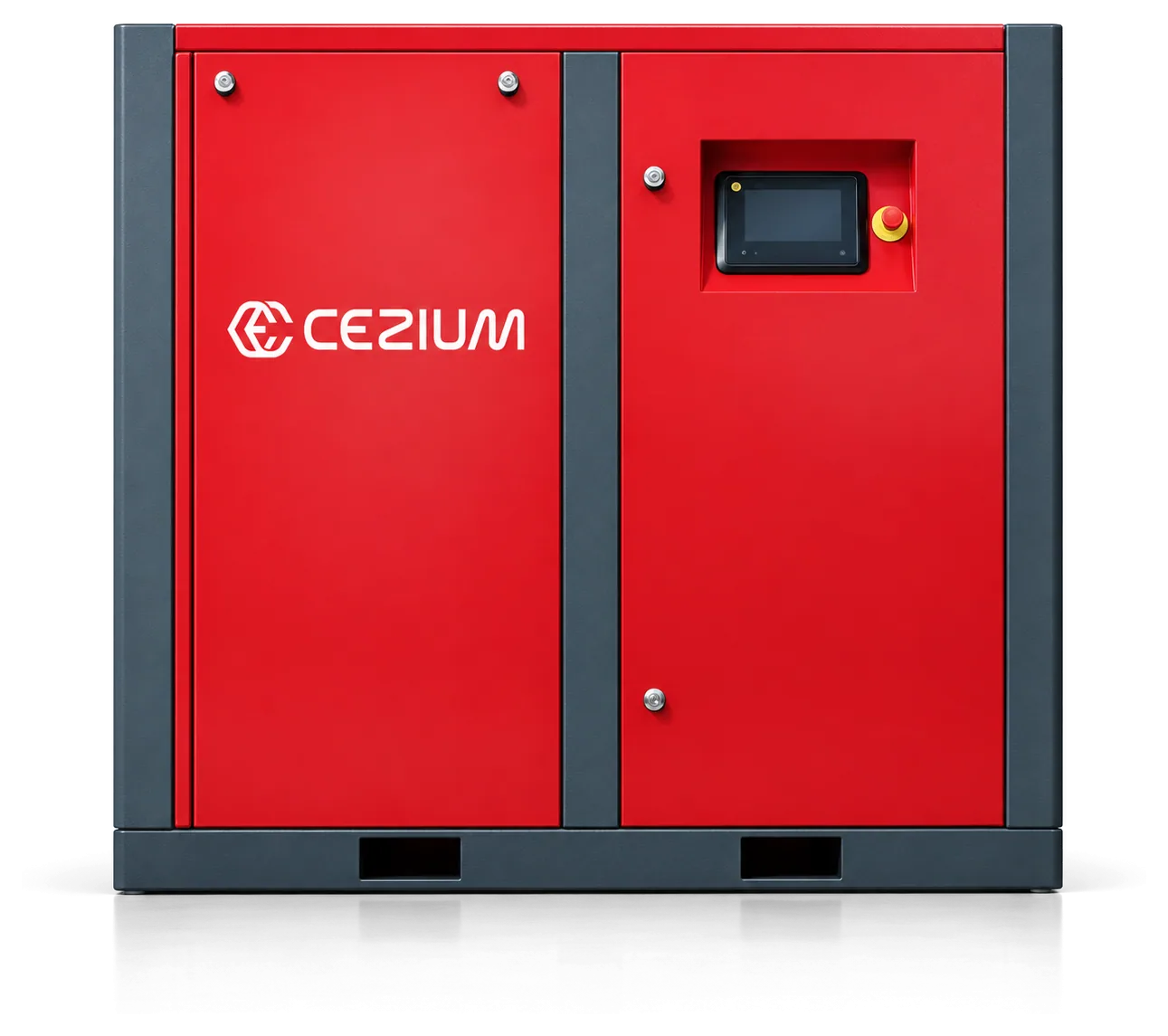
Compresseur VSD 11 kW (15 HP)
11 kW · 1,75 m³/min · 8-16 bar
Voir la fiche →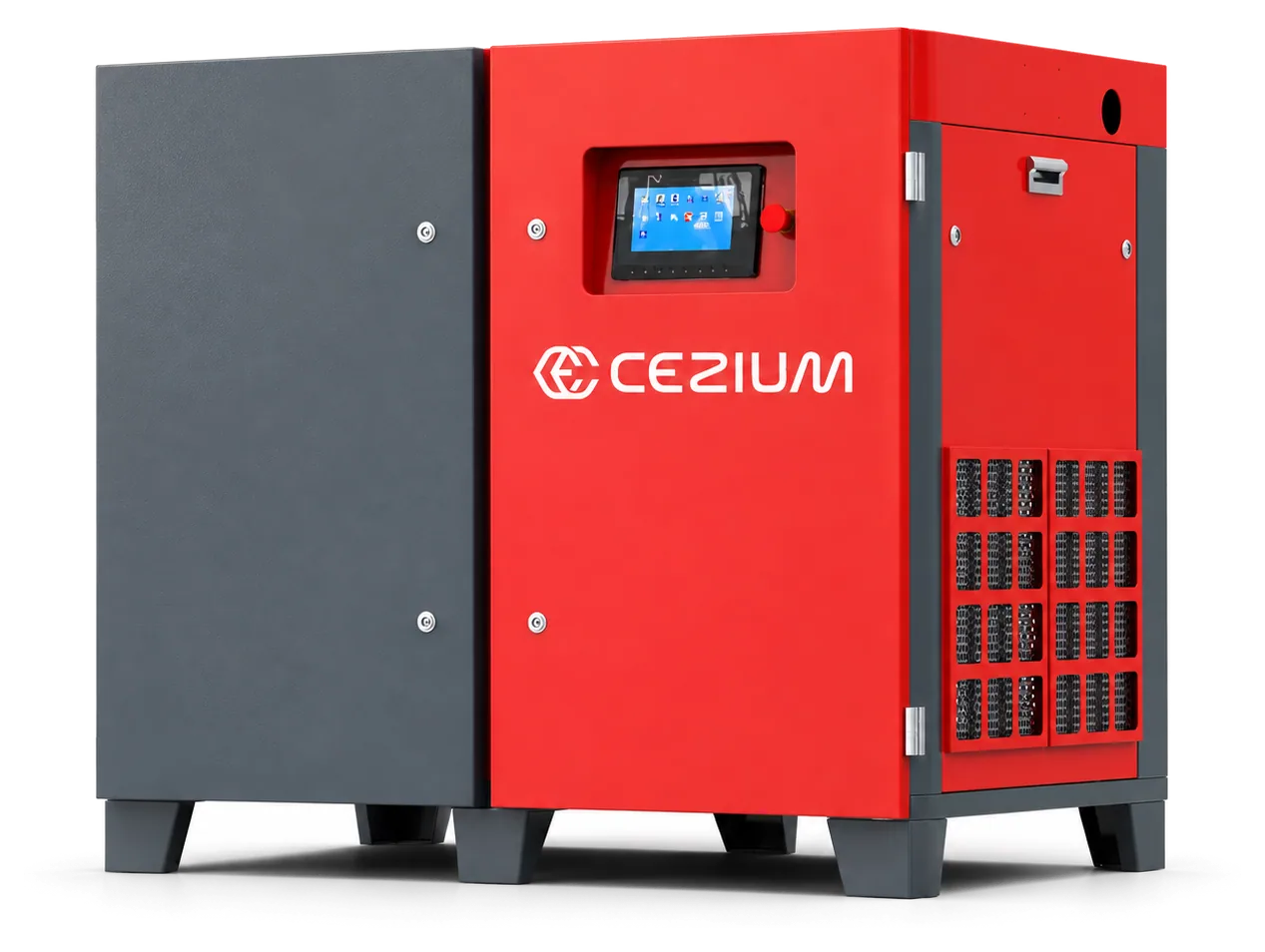
Compresseur VSD 22 kW (30 HP)
22 kW · 3,60 m³/min · 8-16 bar
Voir la fiche →Compresseur VSD 37 kW (50 HP)
37 kW · 6,30 m³/min · 8-16 bar
Voir la fiche →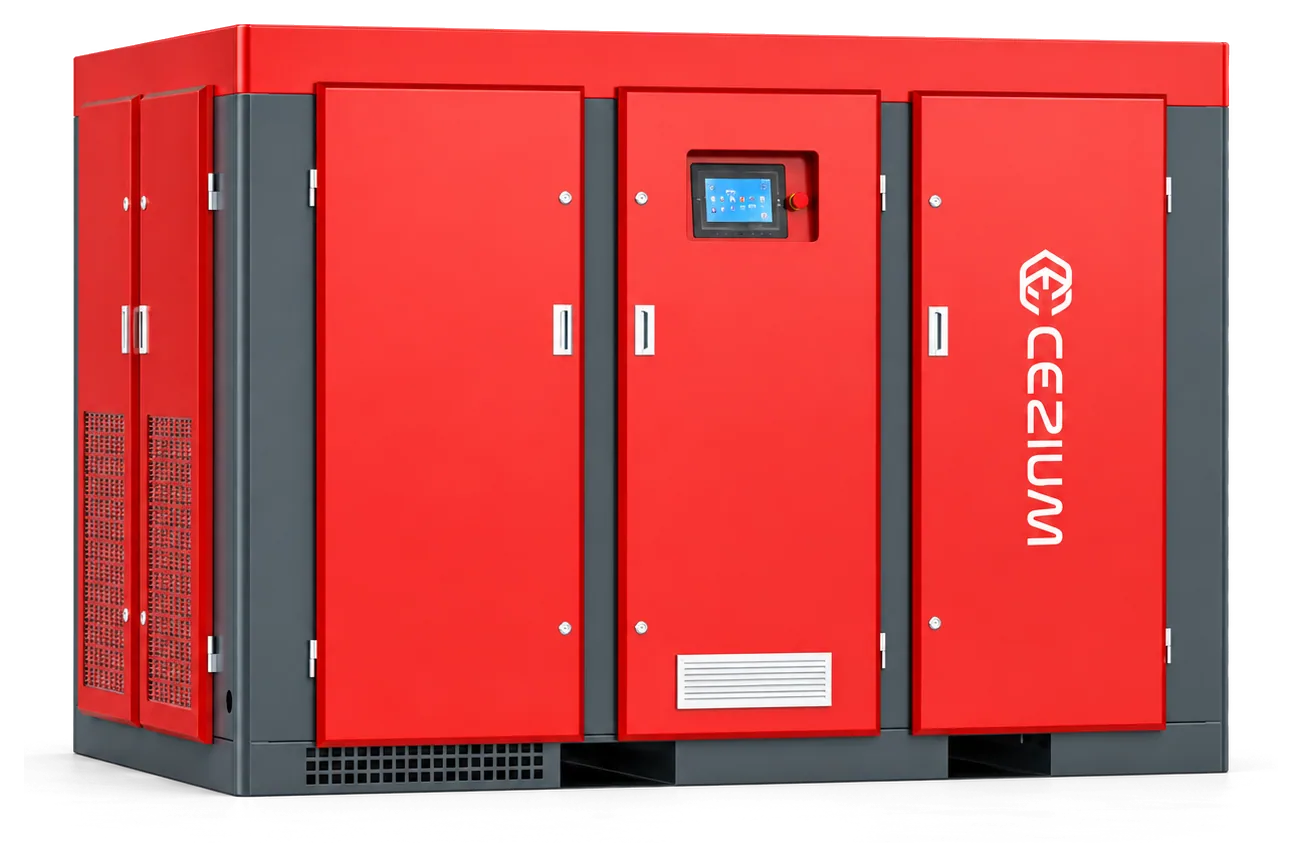
Compresseur PM VSD 110 kW (150 HP)
110 kW · 19,80 m³/min · 8-13 bar
Voir la fiche →Refine the calculation with your figures
Enter your power, your running hours and your kWh price. Annual saving, current bill and CO₂ avoided in 30 seconds.
How to size an air compressor: flow, pressure and storage
Sizing a compressor properly is not a matter of picking a power rating in kW: it means calculating the real flow, the right pressure and suitable storage. A 4-step method, with a worked example.
GuideTwo-stage screw compressor: around 10% less energy than a standard screw
A two-stage screw compressor compresses air in two steps with intercooling in between, close to the theoretical isothermal cycle. Around 10% less energy than a standard screw at constant load; with a permanent magnet drive, on a variable load, the two gains combine.
ComparisonLubricated screw or oil-free compressor: Class 0 describes the air, not the machine
Most comparisons set two machines against each other. The standard, however, judges the air at the point of use. A lubricated screw followed by a treatment chain can deliver oil-free air at the point of use, at a significantly lower purchase cost; class 0 itself remains that of an oil-free machine. Here is the order in which CEZIUM selects each technology.