
Vertical tank
Vertical hot-dip galvanised compressed-air tank - French manufacture, 50 to 10,000 L, 11 or 16 bar. Stabilises pressure and reduces compressor cycling. DESP / CODAP compliant.
19 models in the catalogue, pressure 11 - 16 bar.
How it works ↓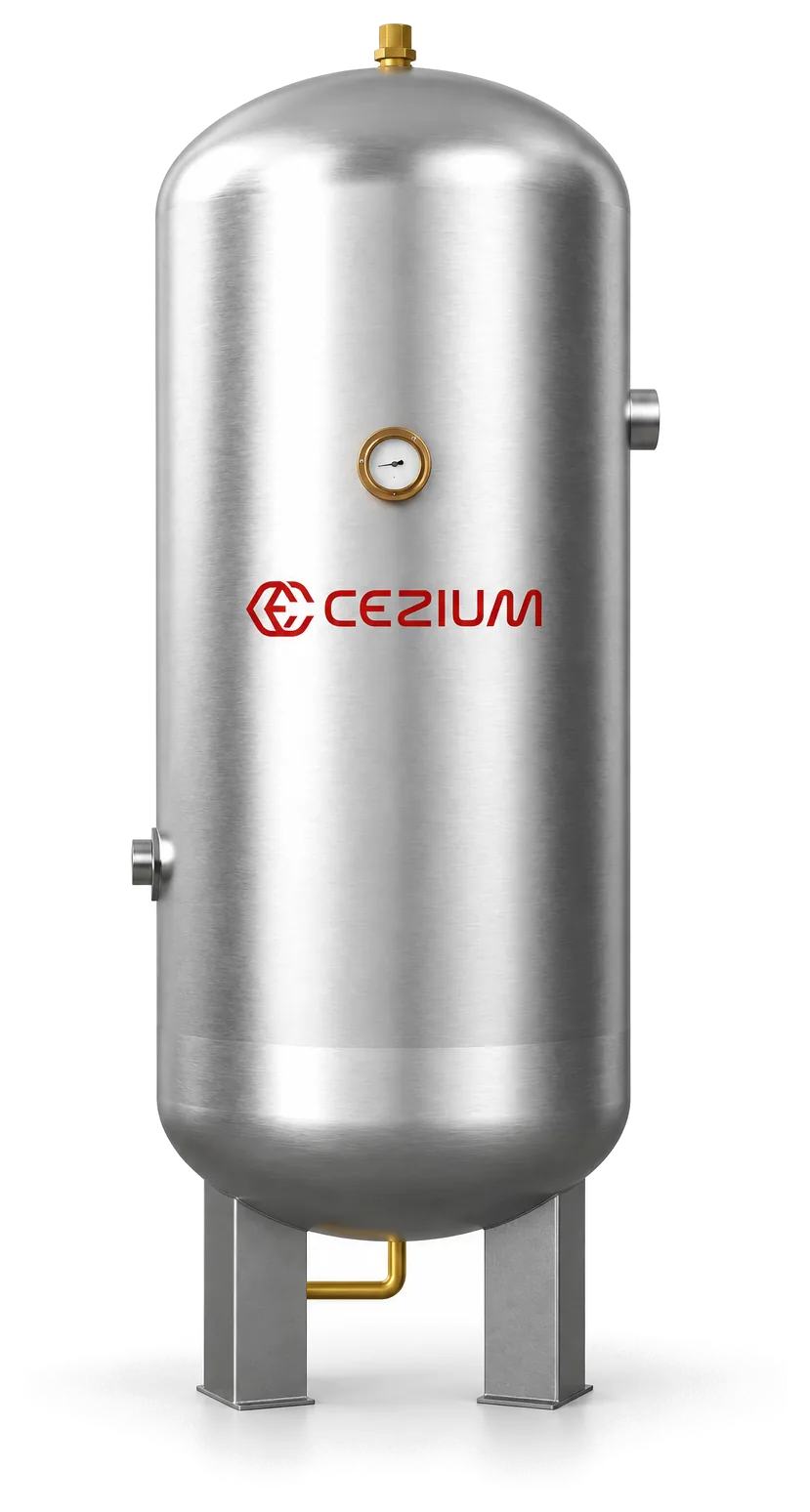
What is an air receiver for?
The receiver stores air, smooths out flow peaks and lets the compressor run in longer cycles: fewer starts, a more stable pressure. The vertical one is the usual format, on a small footprint; made in France, hot-dip galvanised steel.
Made for
- Every installation, from workshop to central station
- An 11 or 16 bar network
- Limited floor space
Not made for
- Not enough ceiling heightHorizontal tank
| Reference | Volume | Pressures | Outlet | Weight |
|---|---|---|---|---|
| CZ-TANK-V50 | 50 L | 11 | 1" | 25 kg |
| CZ-TANK-V100 | 100 L | 11 | 1" | 41 kg |
| CZ-TANK-V200 | 200 L | 11 | 1"1/4 | 51 kg |
| CZ-TANK-V300 | 300 L | 11 | 1"1/2 | 73 kg |
| CZ-TANK-V300-16 | 300 L | 16 | 1"1/2 | 108 kg |
| CZ-TANK-V500 | 500 L | 11 | 2" | 106 kg |
| CZ-TANK-V500-16 | 500 L | 16 | 2" | 137 kg |
| CZ-TANK-V750 | 750 L | 11 | 2" | 156 kg |
| CZ-TANK-V900 | 900 L | 11 | 2" | 167 kg |
| CZ-TANK-V1000 | 1,000 L | 11 | 2" | 222 kg |
| CZ-TANK-V1000-16 | 1,000 L | 16 | 2" | 315 kg |
| CZ-TANK-V1500 | 1,500 L | 11 | 2" | 330 kg |
| CZ-TANK-V2000 | 2,000 L | 11 | 2" | 402 kg |
| CZ-TANK-V3000 | 3,000 L | 11 | DN80 | 670 kg |
| CZ-TANK-V4000 | 4,000 L | 11 | DN80 | 832 kg |
| CZ-TANK-V5000 | 5,000 L | 11 | DN100 | 1,177 kg |
| CZ-TANK-V6000 | 6,000 L | 11 | DN100 | 1,391 kg |
| CZ-TANK-V8000 | 8,000 L | 11 | DN100 | 1,638 kg |
| CZ-TANK-V10000 | 10,000 L | 11 | DN100 | 1,962 kg |
Flows, pressures, noise levels and dimensions recorded model by model on the catalogue sheets.
The vertical receiver stores air, smooths flow demands and lets the compressor run in longer cycles: fewer starts, a more stable pressure. From 50 to 10,000 L, at 11 or 16 bar, on a small footprint.
A receiver is sized on the compressor flow and the demand profile; every compressor page suggests the capacity that fits it.
A compressed air receiver absorbs variations in demand, stabilises network pressure and lets condensate settle before distribution. By acting as a buffer, it greatly reduces the number of compressor starts: fewer cycles, less wear, and control that has room to breathe.
The vertical format takes up the minimum floor space, which makes it the default choice in a compressor room that is already full. It goes up to 10,000 litres, and it is the only format in the catalogue available at 16 bar.
Our air receivers are made in France, in steel hot-dip galvanised inside and out, and calculated to the CODAP code within the framework of the PED regulations, with the manufacturer's declaration supplied. The threaded bosses comply with standard NF E29-625.
Any compressed air installation, from workshop to air station: nineteen sizes from 50 to 10,000 litres, at 11 or 16 bar. The vertical format is chosen when floor space is short, or when the network works at 16 bar.
Made in France
The air receivers are made in France, to French design codes: CODAP for calculation, NF E29-625 for the threaded bosses.
From 50 to 10,000 litres
Nineteen sizes, from the workshop compressor to the industrial air station, with NF E29-625 threaded bosses.
16 bar is available here
The only format in the catalogue offered at 16 bar, for high-pressure networks; the horizontal stops at 11 bar.
Hot-dip galvanised
Inside and out: corrosion attacks a receiver from the inside, where condensate stagnates, and where nobody looks.
PED, CODAP code
Calculated to the CODAP code within the framework of the pressure equipment regulations, manufacturer's declaration supplied.
Worth reading on this technology
How to calculate and reduce pressure drop in a compressed air network
A 1 bar pressure drop costs around 7% in energy across the whole compressed air installation. Here is how to calculate it, measure it and reduce it: pipe diameter, network layout, filters, dryer, fittings.
How to size an air compressor: flow, pressure and storage
Sizing a compressor properly is not a matter of picking a power rating in kW: it means calculating the real flow, the right pressure and suitable storage. A 4-step method, with a worked example.