
CEE 2026-2030: financing a VSD compressor with France's energy savings certificates
The CEE scheme (France's energy savings certificates) funds part of the extra cost of a variable speed compressor. You still need to know the right operation sheet, how to calculate kWh cumac and how to choose the right délégataire (the intermediary who handles the claim). Full method, worked example on 75 kW.
The CEE scheme in two sentences
Certificats d'économies d'énergie (CEE), France's energy savings certificates, are a French regulatory scheme that requires energy sellers (electricity, gas, heat, cooling, motor fuels, heating oil: EDF, ENGIE, TotalEnergies, etc.) to generate energy savings among consumers, whether or not they are their customers, or face penalties. They meet the obligation by funding works, directly or through délégataires, the intermediaries who put the claims together, or by buying "certificates", and this is the money that funds your premium.
In practice: replacing a fixed-speed compressor with a variable speed drive (VSD) compressor is an eligible operation. The premium covers part of the additional investment cost, depending on the negotiated price per MWh cumac and on the quotation; it is paid by cheque or bank transfer once the claim has been validated.
The CEE programme runs in multi-year periods. The 5th period covered 2022-2025; the 6th runs from 1 January 2026 to 31 December 2030 (Decree No. 2025-1048 of 30 October 2025), with an obligation of 1,050 TWh cumac per year, up 27% on 2023-2025. The obligated parties therefore have more savings to fund over the period.
The IND-UT-102 and IND-UT-114 operation sheets
Every CEE operation is framed by a "fiche d'opération standardisée" (standardised operation sheet) published by the Ministère de la Transition écologique (France's Ministry for the Ecological Transition). For a variable speed air compressor, two sheets from the Industry sector apply depending on the motor: IND-UT-102 "Système de variation électronique de vitesse sur un moteur asynchrone" (electronic variable speed drive on an induction motor), and IND-UT-114 "Moto-variateur synchrone à aimants permanents ou à réluctance" (permanent magnet or reluctance synchronous motor-drive).
The sheet sets out precisely: the type of eligible equipment, the eligibility conditions, the supporting documents to provide, and the deemed savings amount in kWh cumac (kWh cumulated and discounted over the conventional lifetime).
| Official references | IND-UT-102 (drive on an existing or new induction motor, up to 3 MW) and IND-UT-114 (permanent magnet or reluctance synchronous motor-drive, up to 1 MW) |
|---|---|
| Operation type | Standardised: no on-site measurement required |
| Conventional lifetime | 15 years (IND-UT-102), 20 years (IND-UT-114) |
| Deemed amount | Per kW of rated power, by application: 11,900 kWh cumac/kW for an air compressor (IND-UT-102), 9,200 (IND-UT-114) |
| Exclusion (IND-UT-102) | IE2 motors bought since 1 January 2017 (0.75 to 375 kW) |
| Conditions and supporting documents | Proof of the funder's active and incentive role, no later than the commitment to the operation; invoice mentioning the drive or motor-drive (failing that, make and reference plus a manufacturer's document); sworn statement (attestation sur l'honneur); installation by a professional |
The operation is called "standardised": no prior energy audit or consumption measurement is needed. The deemed savings depend on the rated power on the nameplate and on the application, not on running hours. A simpler process than a specific operation (opération spécifique), whose amount is calculated case by case.
kWh cumac, demystified
The kWh cumac is the unit of measurement for CEE. It represents one kilowatt-hour of energy saved, cumulated over the conventional lifetime of the equipment and discounted at 4% a year: each year's saving is the previous year's divided by 1.04, the first year not being discounted. This is the unit the délégataire then values, at the price per MWh cumac negotiated at signature.
For a standardised operation, there is nothing to rebuild: the sheet publishes an amount in kWh cumac per kW directly, which already includes the lifetime and the discounting. Certificate volume (kWh cumac) = amount per kW for the application × rated power (kW).
| Power taken into account | Rated kW on the nameplate of the motor (IND-UT-102) or of the motor-drive (IND-UT-114), or failing that on a manufacturer's document |
|---|---|
| Running hours | Not taken into account: the amount is the same on one, two or three shifts |
| Amount for an air compressor | 11,900 kWh cumac/kW (IND-UT-102), 9,200 kWh cumac/kW (IND-UT-114) |
| Lifetime | 15 years (IND-UT-102), 20 years (IND-UT-114) |
| Cumulation discounted at 4% | 11.563 times the first-year saving over 15 years, 14.134 over 20 years |
| Price per MWh cumac | Negotiated with the délégataire, varies with the market and the volume |
For a 75 kW compressor, the deemed amount gives 892,500 kWh cumac under IND-UT-102 (11,900 × 75) and 690,000 kWh cumac under IND-UT-114 (9,200 × 75), whatever the running hours. Valued at the negotiated price, the gross premium covers part of the extra cost of a VSD over an equivalent fixed-speed machine: the exact share depends on the quotation and the délégataire chosen.
Full worked example: 75 kW compressor
Take the replacement of a 75 kW fixed-speed compressor with an equivalent 75 kW permanent magnet VSD machine, running 4,000 hours a year at an average load of 60%. The additional investment cost appears on the quotation; what follows is calculated without it.
| Annual energy savings | 18,000 to 42,000 kWh/year against a load/unload screw (6 to 14% of 75 kW × 4,000 h, DOE Sourcebook); 57,600 kWh/year against a screw under inlet modulation, the calculator's assumption (75 × 4,000 × 0.6 × 0.32) |
|---|---|
| To value at your own rate | These kilowatt-hours saved per year, to multiply by your price per kWh |
| CEE volume (IND-UT-114, permanent magnet motor) | 9,200 × 75 = 690,000 kWh cumac |
| Gross CEE premium | 690 MWh cumac × the price per MWh cumac negotiated with the délégataire |
| What the premium covers | A substantial share of the extra cost of a VSD over a fixed-speed machine, as set out in the quotation |
The deemed amount does not follow running hours, but the energy saving does: on a lightly used site the premium weighs more than the annual saving, and the reverse holds on a site running around the clock. The precise amount depends on the délégataire chosen and the timing of the signature.
Choosing your délégataire: the decision that changes the amount
The délégataire (or "mandataire", the appointed agent) is the intermediary that builds the file, checks the supporting documents and negotiates the cumac price with the obligés (the energy suppliers under the obligation). It takes a commission on the value of the CEE generated, at a rate stated in its offer, and it is the one that pays the premium: its soundness matters as much as its price.
For the same file, the premium varies with market timing and the délégataire's negotiating power. Always ask for 2 or 3 competing quotations.
- Check that the approval from the Pôle national des CEE (PNCEE, the national office that administers the scheme) is up to date
- Ask for the list of recent IND-UT operations handled and their payment rate
- Compare 2-3 competing quotations for the same file
- Prefer a "cession ferme avec versement à l'enrôlement" contract (firm transfer, paid when the certificates are registered) over a conditional promise
- Check the guarantee clause in the event of a PNCEE audit: who repays if the file is rejected?
- Read the commitment period and the penalties for withdrawal
The highest price per MWh cumac is not necessarily the best offer: compare the "net to the company after commission". The average transaction price, published every month by the national CEE registry (Emmy), gives a market benchmark, not the premium you will receive. Ask for the detailed calculation.
The process, step by step
- 1. Identify the eligible operation (IND-UT-102 or IND-UT-114 for a variable speed compressor) and estimate the premium with a simulator
- 2. Request a detailed quotation from the supplier (CEZIUM, your distributor, etc.)
- 3. Select a CEE délégataire and sign the agreement BEFORE the final order (critical point: the délégataire signature must come before the quotation is accepted)
- 4. Place the order, take delivery, install, commission
- 5. Put together the payment file: invoice mentioning the equipment, sworn statement, manufacturer's document if the invoice is not enough, installation photos
- 6. The délégataire submits the file to the PNCEE, which has two months to respond from receipt of a complete and compliant file
- 7. The délégataire pays the premium after PNCEE validation
The critical point is step 3: signing with the délégataire must come before committing to the order. If you buy first and look for a délégataire afterwards, you lose eligibility (retroactive claims are not allowed). So schedule the délégataire signature in the project timeline, ahead of the order.
Beyond the VSD: other operation sheets that stack
On a plant modernisation project, several CEE operation sheets can be combined for the same site. It is the most powerful and most under-used effect of the scheme.
- IND-UT-102 or IND-UT-114: variable speed on the compressor (covered above)
- IND-UT-103: heat recovery system on an air compressor (40 to 84% of the electricity drawn recoverable, see our dedicated article)
- IND-UT-134: system for measuring energy performance indicators (instrumentation)
- IND-UT-122: adsorption compressed air dryer using heat input for its regeneration
- IND-UT-102 or IND-UT-114: variable speed on an associated pump or fan
On a well-structured "VSD compressor + heat recovery + monitoring" project, each applicable sheet brings its own deemed amount: have the délégataire check the conditions for combining them. Always ask your installer whether they know IND-UT-103 and IND-UT-134.
Pitfalls to avoid
- Signing the supplier's quotation BEFORE the délégataire agreement: the file becomes ineligible.
- Choosing the délégataire with the highest cumac price without checking its financial soundness: risk of default before payment.
- Forgetting the manufacturer's document when the invoice does not specify the equipment: it must state that the equipment is an electronic variable speed drive (IND-UT-102) or a permanent magnet synchronous motor-drive, with its rated power (IND-UT-114). CEZIUM provides it free of charge on request.
- Confusing the CEE premium with other support (Bpifrance, the French public investment bank; ADEME, the French ecological transition agency; the Fonds Chaleur heat fund): they can sometimes be combined, sometimes not.
- Underestimating the payment lead time: it adds up putting the file together, review by the PNCEE (two months from a complete and compliant file) and payment as set in the délégataire's contract. Do not build the project's cash flow on the premium.
Two risks need covering: rejection of an incomplete or non-compliant file, and the delay. Treat the premium as a post-project cash bonus, not as part of the funding.
Recommended models for this topic
Selected by our technical team
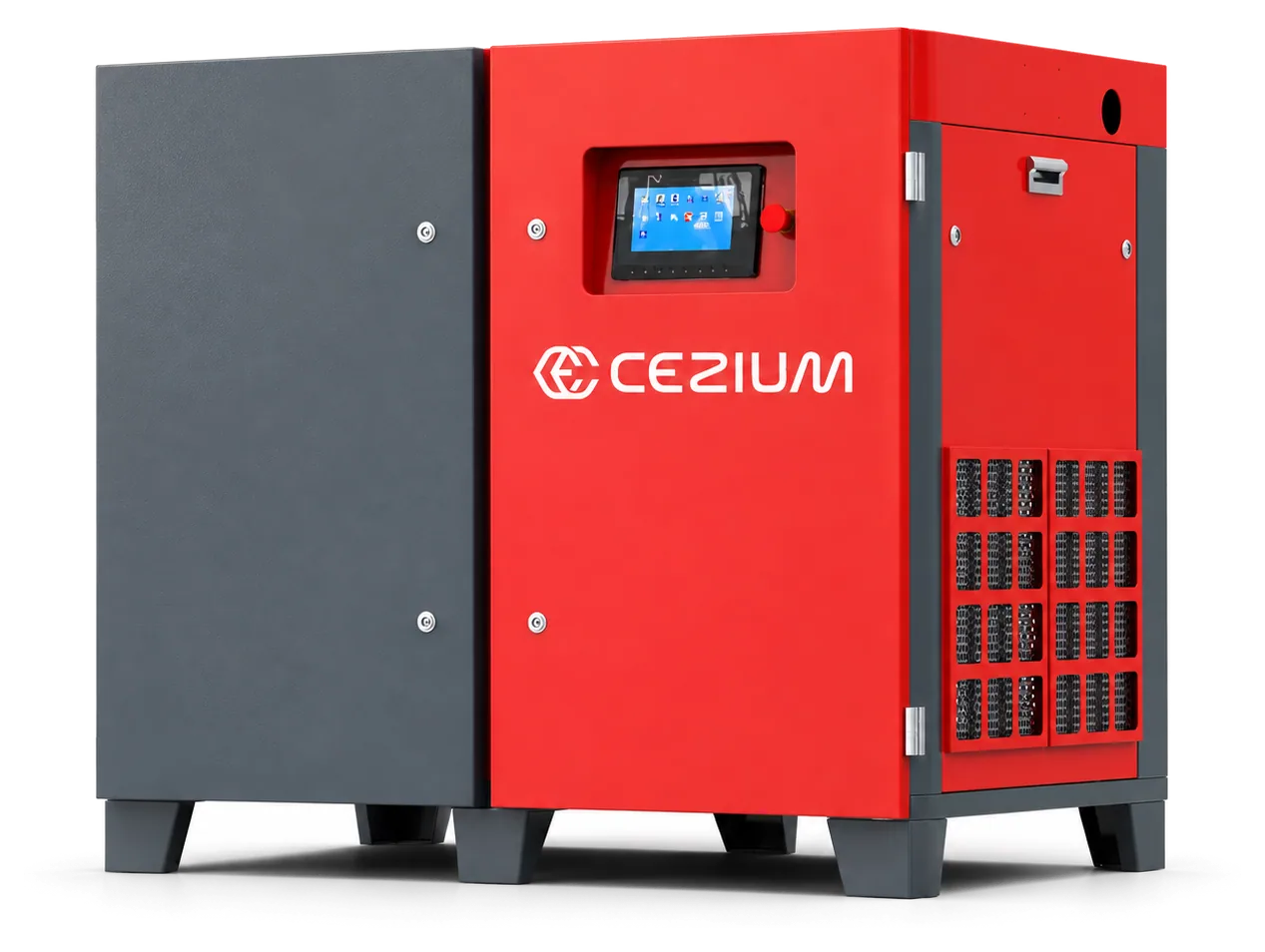
Compresseur VSD 22 kW (30 HP)
22 kW · 3.60 m³/min · 8-16 bar
Voir la fiche →Compresseur VSD 37 kW (50 HP)
37 kW · 6.30 m³/min · 8-16 bar
Voir la fiche →Compresseur PM VSD 75 kW (100 HP)
75 kW · 12.35 m³/min · 8-16 bar
Voir la fiche →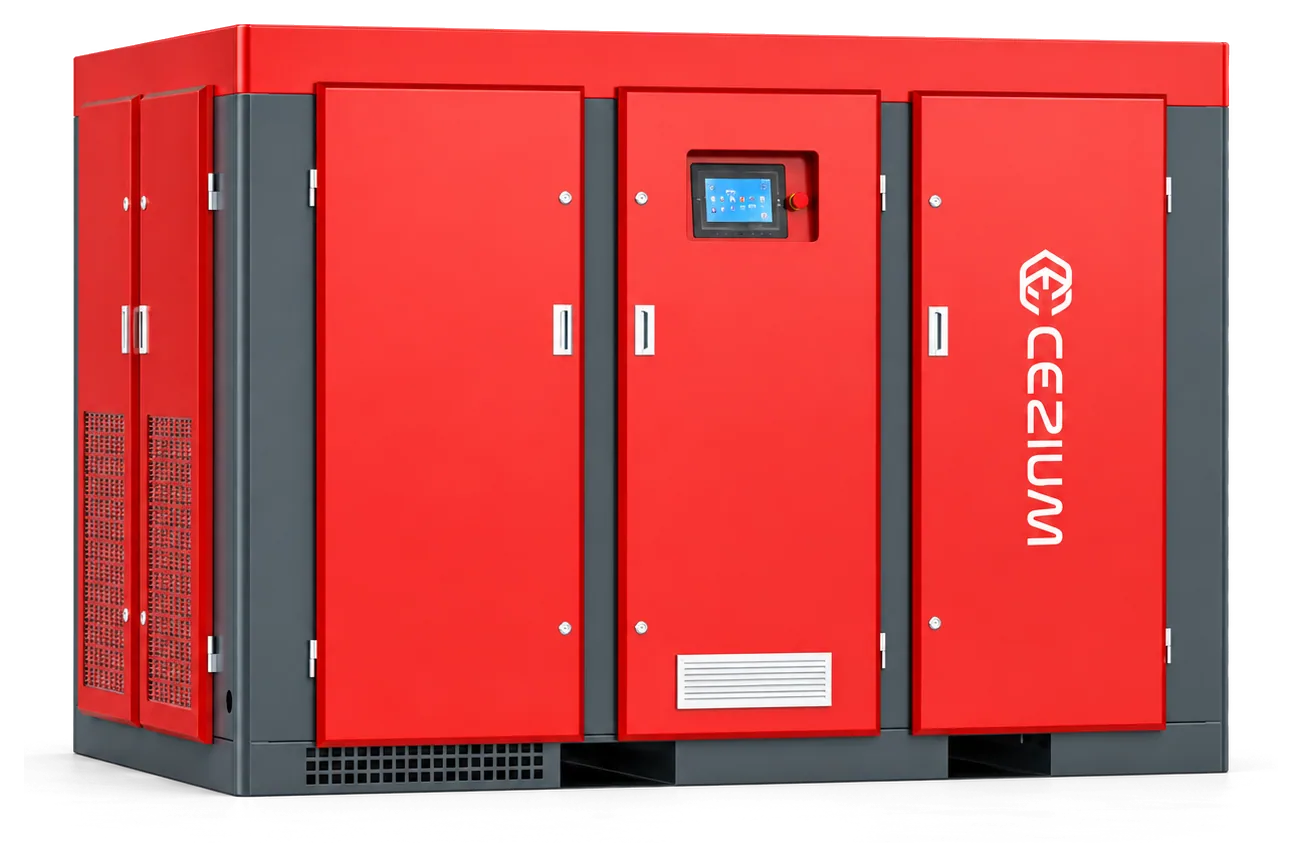
Compresseur PM VSD 110 kW (150 HP)
110 kW · 19.80 m³/min · 8-13 bar
Voir la fiche →Refine the calculation with your figures
Enter your power, your running hours and your kWh price. Annual saving, current bill and CO₂ avoided in 30 seconds.
Permanent magnet VSD: what the drive really saves
What a permanent magnet drive changes on a varying load: idle hours removed, and the annual gain to be worked out from your own load profile, across 6 typical power ratings.
Costs and energyCompressor heat recovery: up to 84% of the electricity can be reused
A screw compressor converts electricity into compressed air… and into heat. That heat accounts for 80 to 93% of the energy consumed, and 50 to 90% of that heat can be recovered to heat a building or a process. Method and calculation.
GuideTwo-stage screw compressor: around 10% less energy than a standard screw
A two-stage screw compressor compresses air in two steps with intercooling in between, close to the theoretical isothermal cycle. Around 10% less energy than a standard screw at constant load; with a permanent magnet drive, on a variable load, the two gains combine.