
Refrigerant dryer vs adsorption dryer: when should you switch to adsorption?
A refrigerant dryer covers most industrial applications with a +3 °C pressure dew point. Adsorption goes down to −40 or −70 °C but consumes compressed air. When should you switch?
The difference in one mental picture
A refrigerant dryer cools the compressed air down to +3 °C in a plate heat exchanger, which condenses most of the water vapour; the condensate is then discharged by an electronic condensate drain. It is simple, compact and light on energy, but the pressure dew point is capped at +3 °C, which is enough for most industrial processes but not for demanding ones.
An adsorption dryer passes the air through an adsorbent (activated alumina or molecular sieve). Two towers operate alternately: while one adsorbs, the other regenerates with a share of the dry air, 6% at most on the heatless models of the catalogue, or with the help of an electric heater, which brings that purge down to 3% at most. The result: a pressure dew point down to −70 °C.
When a refrigerant dryer is enough
| Pressure dew point delivered | +3 °C ± 1, stable |
|---|---|
| ISO 8573-1 humidity class | Class 4 (by default) |
| Compressed air consumption | None |
| Typical pressure drop | 0.2 to 0.4 bar |
| Common applications | Mechanical engineering, plastics processing, workshops, painting |
When to switch to adsorption
- Outdoor air network exposed to frost: pressure dew point of −10 / −20 °C minimum
- Pharmaceuticals, food with direct product contact: Class 2 (pressure dew point −40 °C) or 1 (−70 °C)
- Electronics, semiconductors, cleanrooms: Class 1 or 0 (−70 °C)
- Very low temperature processes (cryogenics, industrial cold rooms)
- Pneumatic conveying of hygroscopic powders (cement, milk powder)
The hidden cost of adsorption: purge air
A heatless adsorption dryer regenerates with a share of the air it has just dried: 6% at most on the catalogue models. On a 100 m³/h compressor, up to 6 m³/h never reach the network, along with the compression energy spent on them.
The heat-regenerated version uses an electric heater during regeneration to bring the purge down to 3% at most in the catalogue. It therefore consumes electricity where the heatless version consumes none: in the catalogue, heat-regenerated adsorption dryers carry a power rating of 0.8 to 8 kW, while heatless models carry none. The trade-off lies between that electricity consumption and the compressed air saved on the purge, and it tips all the faster the more hours a year the machine runs.
Put a figure on the purge before choosing: multiply the treated flow by the purge rate, by the specific power of your compressor, then by your annual running hours. The result is the kilowatt hours that regeneration consumes each year, to be compared with the electricity consumption of a heat-regenerated model.
Recommended models for this topic
Selected by our technical team
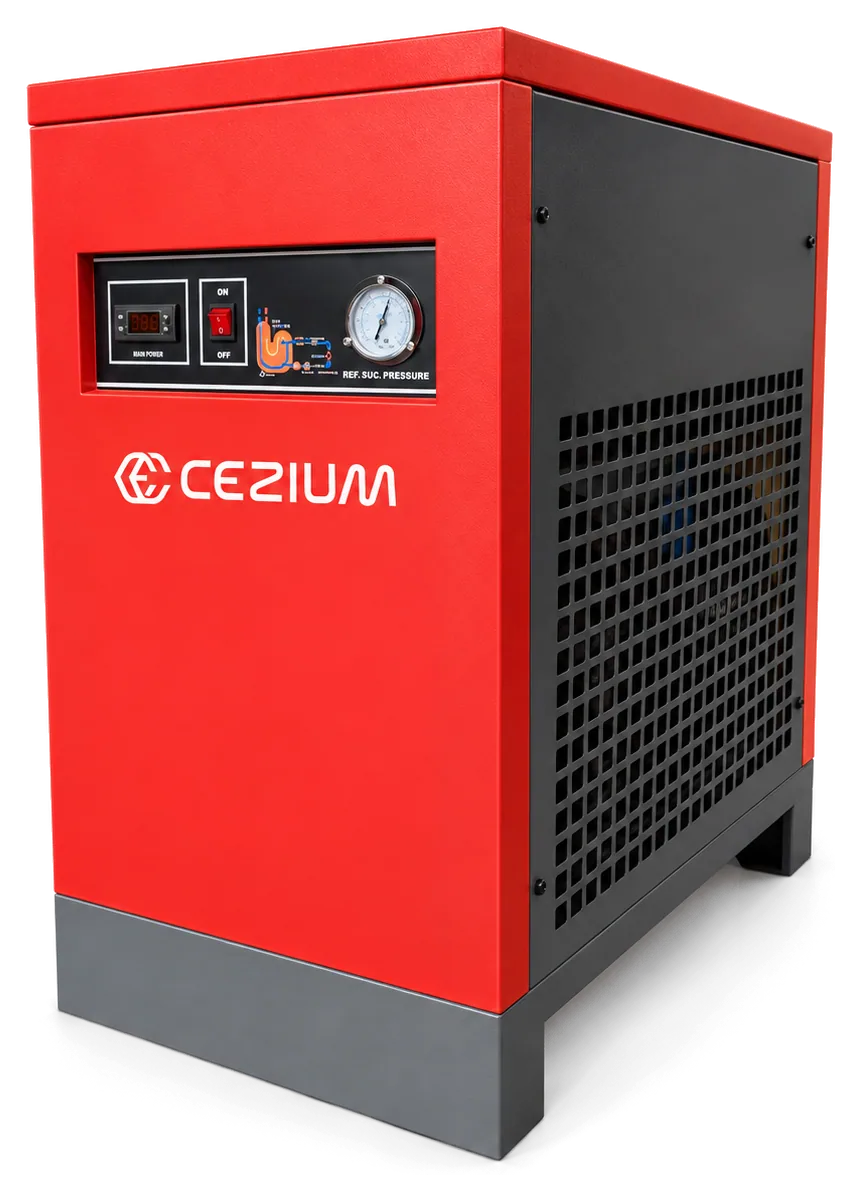
Sécheur frigorifique normal (air) 1.5 Nm³/min
1,50 m³/min · 6-10 bar
Voir la fiche →Sécheur frigorifique normal (air) 2.6 Nm³/min
2,60 m³/min · 6-10 bar
Voir la fiche →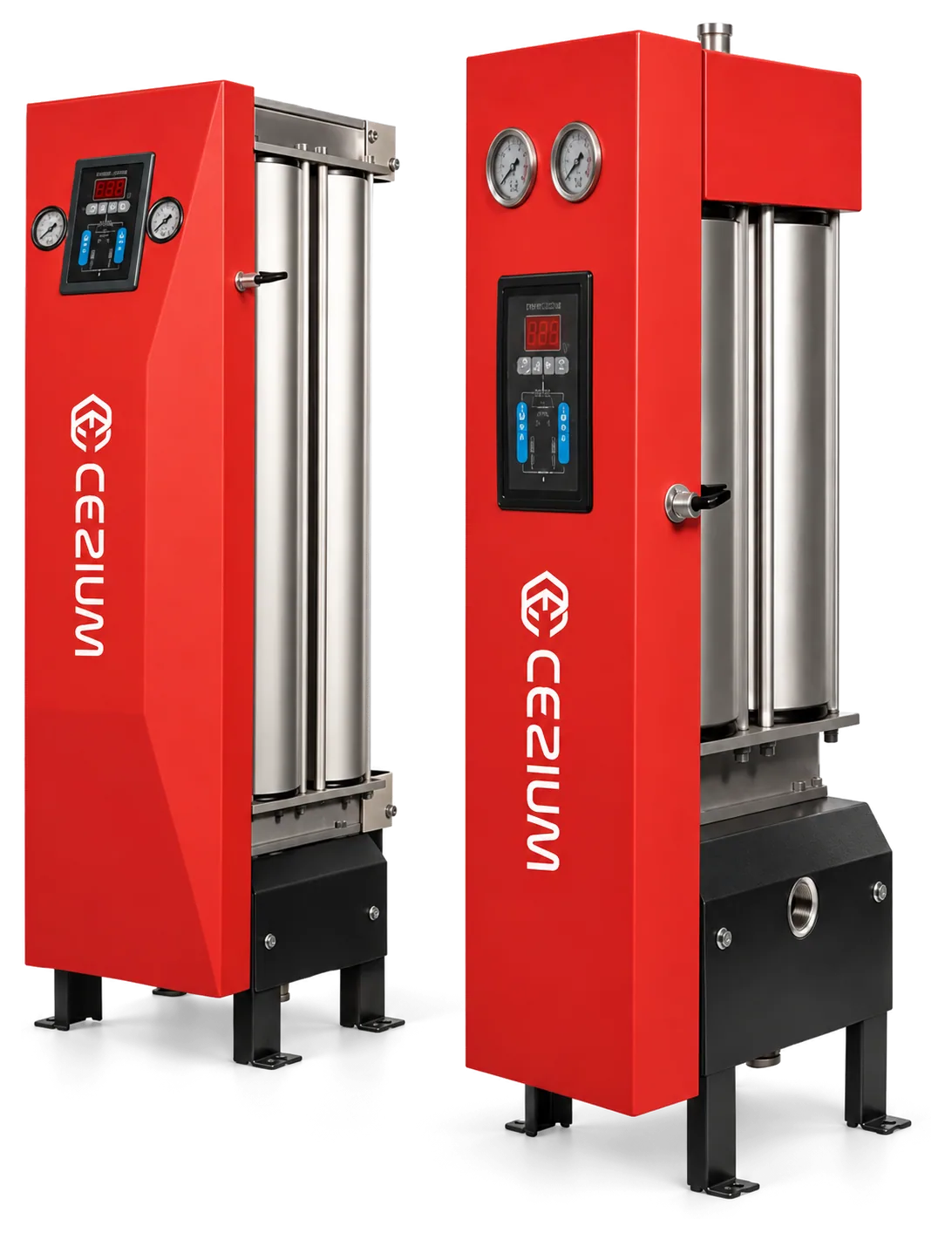
Sécheur adsorption compact (point d'usage) 1.56 m³/min
1,56 m³/min · 4.5-10 bar
Voir la fiche →Sécheur adsorption compact (point d'usage) 2.46 m³/min
2,46 m³/min · 4.5-10 bar
Voir la fiche →Compare models side by side
Performance, footprint, energy and 5-year TCO. Up to 3 models at once, shareable link.
Lubricated screw or oil-free compressor: Class 0 describes the air, not the machine
Most comparisons set two machines against each other. The standard, however, judges the air at the point of use. A lubricated screw followed by a treatment chain can deliver oil-free air at the point of use, at a significantly lower purchase cost; class 0 itself remains that of an oil-free machine. Here is the order in which CEZIUM selects each technology.
StandardISO 8573-1: the complete guide to compressed air quality classes
ISO 8573-1 grades compressed air quality against three criteria, particles, water and oil, each on its own scale starting at Class 0. Which class suits which application? Full table and examples.