
ISO 8573-1: the complete guide to compressed air quality classes
ISO 8573-1 grades compressed air quality against three criteria, particles, water and oil, each on its own scale starting at Class 0. Which class suits which application? Full table and examples.
The standard in 30 seconds
ISO 8573-1 is the international standard that classifies compressed air quality against three criteria: solid particles, water (dew point) and residual oil. For each criterion, the air is graded from Class 0 (the most stringent) to Class X (beyond the last limit), and the number of classes depends on the contaminant: 0 to 7 for particles, 0 to 9 for water, 0 to 4 for oil.
Air quality is always written in the form X-Y-Z, where X = particles, Y = water and Z = oil. For example, "ISO 8573-1 Class 1-2-1" means particles Class 1, moisture Class 2, oil Class 1.
Solid particles: ISO 8573-1 classes
| Class 0 | Better than Class 1 (agreed case by case) |
|---|---|
| Class 1 | ≤ 20,000 particles/m³ sized 0.1 to 0.5 µm, ≤ 400 sized 0.5 to 1 µm, ≤ 10 sized 1 to 5 µm |
| Class 2 | ≤ 400,000 particles/m³ sized 0.1 to 0.5 µm, ≤ 6,000 sized 0.5 to 1 µm, ≤ 100 sized 1 to 5 µm |
| Class 3 | ≤ 90,000 particles/m³ sized 0.5 to 1 µm, ≤ 1,000 sized 1 to 5 µm |
| Class 4 | ≤ 10,000 particles/m³ sized 1 to 5 µm |
| Class 5 | ≤ 100,000 particles/m³ sized 1 to 5 µm |
| Class 6 | Mass concentration ≤ 5 mg/m³ |
| Class 7 | Mass concentration > 5 and ≤ 10 mg/m³ |
Water: pressure dew point by class
| Class 0 | Better than −70 °C (specific cases) |
|---|---|
| Class 1 | Pressure dew point ≤ −70 °C |
| Class 2 | Pressure dew point ≤ −40 °C |
| Class 3 | Pressure dew point ≤ −20 °C |
| Class 4 | Pressure dew point ≤ +3 °C |
| Class 5 | Pressure dew point ≤ +7 °C |
| Class 6 | Pressure dew point ≤ +10 °C |
Residual oil: mass concentration
| Class 0 | Stricter than class 1, at the threshold set by the user or the supplier (oil-free machine) |
|---|---|
| Class 1 | ≤ 0.01 mg/m³ total (liquid + aerosol + vapour) |
| Class 2 | ≤ 0.1 mg/m³ |
| Class 3 | ≤ 1 mg/m³ |
| Class 4 | ≤ 5 mg/m³ |
Which class for which application?
- General engineering workshop: 4-4-4 (lubricated compressor + refrigerant dryer + 3 µm filter)
- Standard plastics processing: 3-4-3 (intermediate coalescing filtration)
- High-quality paint finishing: 2-4-2 (activated carbon filter)
- Pharmaceutical, indirect contact: 1-2-1 (oil-free + adsorption dryer at −40 °C)
- Pharmaceutical direct contact, food and beverage, electronics: water in class 2 (−40 °C) or 1 (−70 °C), oil in class 0 (oil-free machine), sterile filtration at the point of use
- Semiconductor cleanroom: strict 0-1-0 (HEPA H14 + activated carbon + UV)
On a pharmaceutical certification, do not undersize the chain: reworking an installation after an audit costs more than designing it right from the start.
A typical 0-1-0 filtration chain
- Stage 1: 3 µm coalescing filter (removes free water + coarse particles)
- Stage 2: 1 µm coalescing filter (removes 99.9% of oil aerosols)
- Stage 3: micro-heat adsorption dryer, −70 °C pressure dew point
- Stage 4: 0.01 µm high-efficiency filter (removes submicron particles)
- Stage 5: activated carbon filter (removes residual oil vapour to < 0.003 mg/m³)
- Stage 6: 0.01 µm hydrophobic sterile filter (removes bacteria and viruses)
Recommended models for this topic
Selected by our technical team
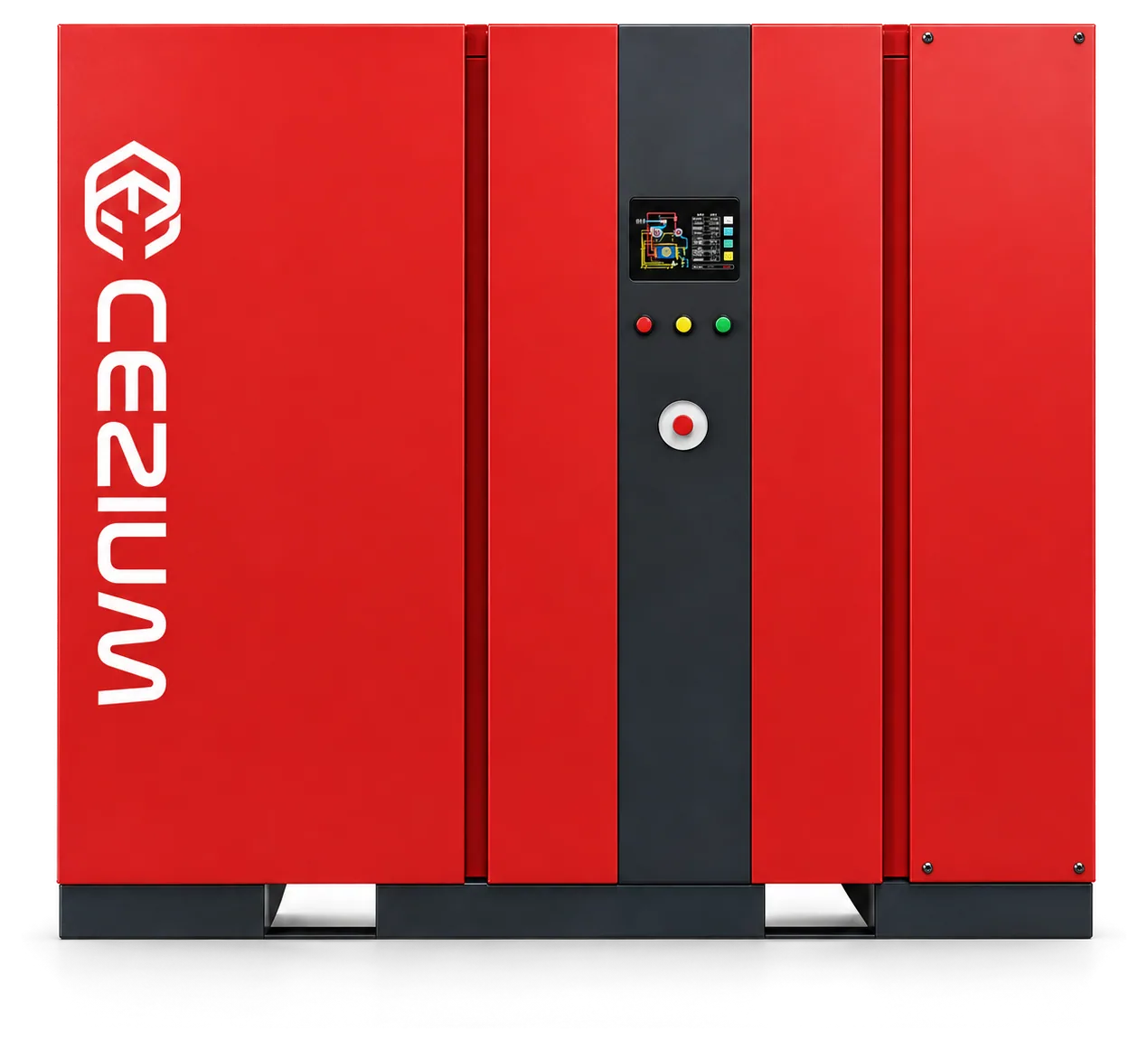
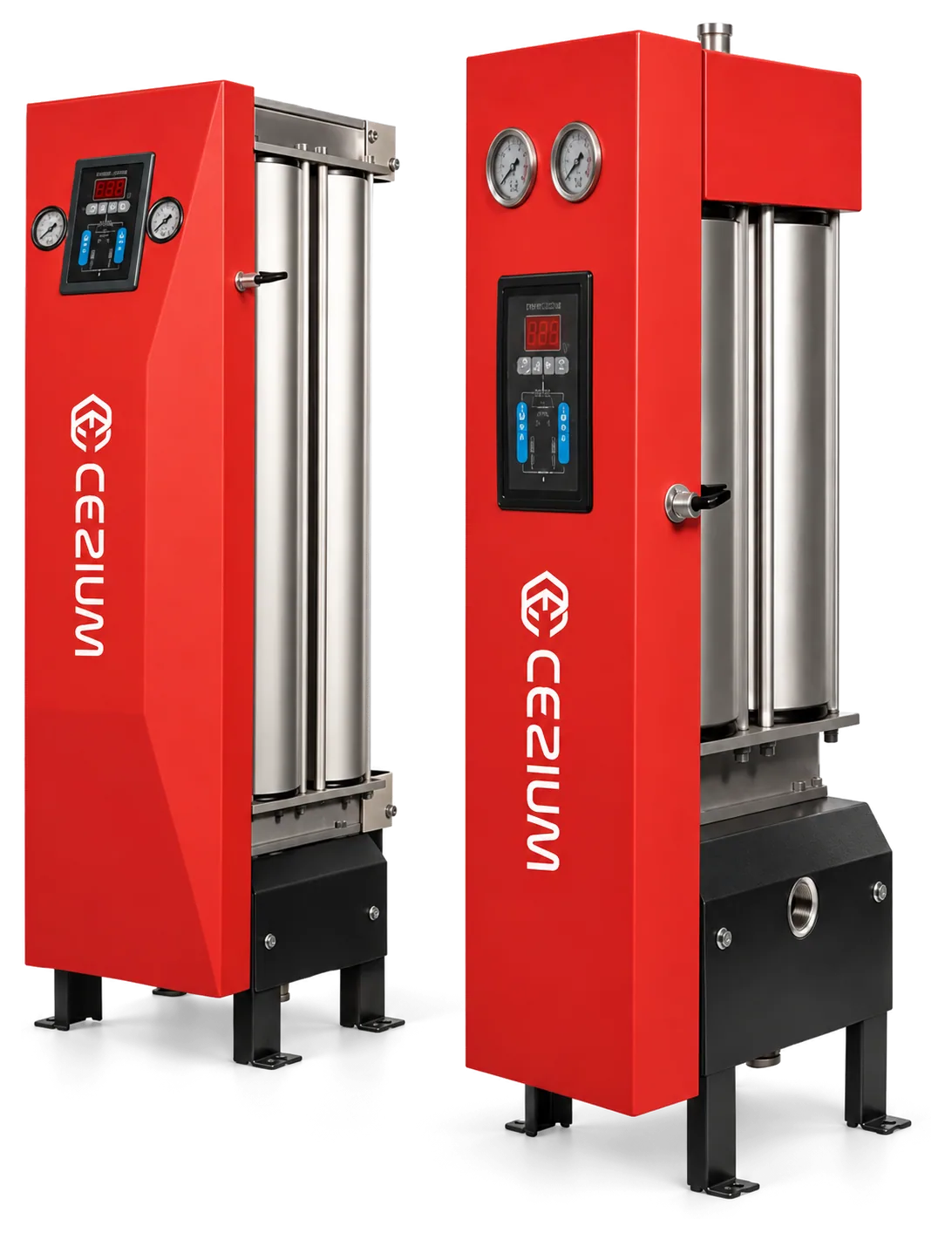
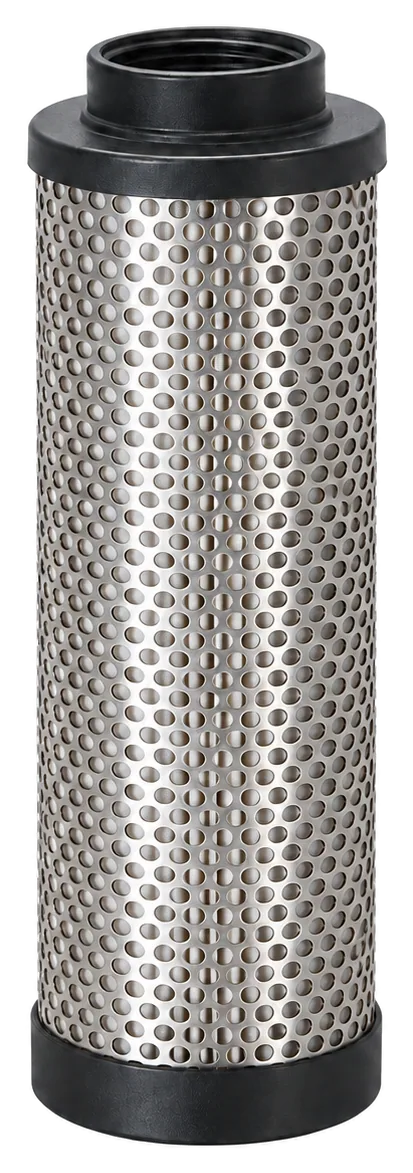
A compliance question?
Our technical team answers within one working day with a free preliminary study, sizing and a quotation.
Lubricated screw or oil-free compressor: Class 0 describes the air, not the machine
Most comparisons set two machines against each other. The standard, however, judges the air at the point of use. A lubricated screw followed by a treatment chain can deliver oil-free air at the point of use, at a significantly lower purchase cost; class 0 itself remains that of an oil-free machine. Here is the order in which CEZIUM selects each technology.
ComparisonRefrigerant dryer vs adsorption dryer: when should you switch to adsorption?
A refrigerant dryer covers most industrial applications with a +3 °C pressure dew point. Adsorption goes down to −40 or −70 °C but consumes compressed air. When should you switch?