
PSA nitrogen generator vs cylinders: at what volume should you switch?
Producing your nitrogen on site or having it delivered in cylinders: the cost items to compare, and how to find the switch-over point for your profile.
The three sources of industrial nitrogen
High-pressure cylinders: no installation, total flexibility, and the highest cost per cubic metre of the three. On top of that comes everything that never appears on the gas invoice: cylinder deposits, storage, handling and the time spent ordering.
Cryogenic liquid nitrogen tank: the cost per cubic metre falls sharply, but the vessel is rented, the product boils off continuously whether you use it or not, and tanker deliveries bring their own logistics.
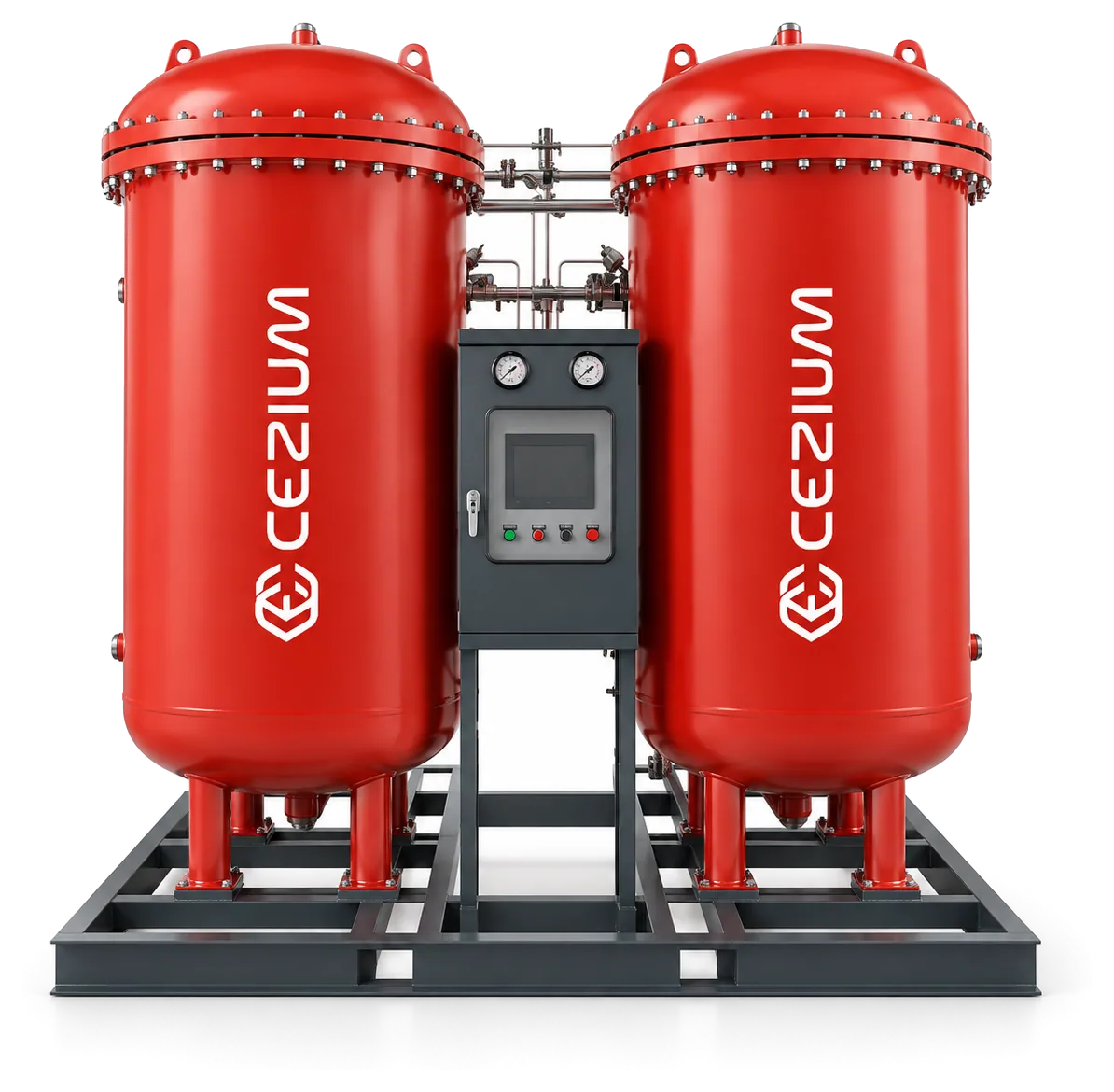
On-site generator: a capital investment, then a running cost dominated by the compressed air the generator consumes, and no external logistics at all. Purity is adjustable, which is both its advantage and the trap most installations fall into.
A fair comparison needs the cost per cubic metre that YOU pay today, deposits and handling included. It is the only figure that decides, and it is on your own invoices: ours would tell you nothing.
Where the switch-over point lies
The threshold cannot be read off a universal table: it depends on three variables that only you hold, and the direction of each one is unambiguous.
| Volume consumed | The higher it is, the more on-site production wins: the investment is spread over more cubic metres |
|---|---|
| Consistency of demand | Continuous consumption spreads the generator's cost over more cubic metres; intermittent, stop-start consumption favours cylinders |
| Purity actually required | Each extra step raises the compressed air consumed, non-linearly: this is the parameter that tips the calculation |
| In the CEZIUM catalogue | PSA nitrogen generators from 2 to 160 Nm³/h, 67 models; oxygen is handled through a project study |
Pull twelve months of invoices before running any simulation. A threshold calculated on assumed consumption is almost always wrong, and wrong in the direction that costs money.
Purity by application
- Crimping, tank inerting: 95-97% (more than enough)
- Brazing, steel heat treatment: 99.5%
- Food industry (modified atmosphere packaging, MAP): 99.5-99.9%
- Pharmaceuticals, laboratories: 99.9%
- Stainless steel welding, semiconductors: 99.99-99.999%
The classic mistake: over-specifying purity
Moving from 99.5% to 99.999% purity multiplies the generator's compressed air consumption by 2 to 3. Many plants over-specify "to be safe" and pay every year for the electricity of a compressor larger than necessary.
The pragmatic rule: start by measuring what your process actually requires (a nitrogen analyser at the outlet, product sampling). Often 99 or 99.5% is enough where the original documentation called for 99.9%.
One step up in purity does not cost just a little more: it forces you to size a larger compressor to feed the generator, and that expense comes back every year. Have the purity your process really needs measured before you specify it.
Steps to compare the two options
- Record your current consumption over 12 months (Nm³/year + €/year)
- Measure the purity actually required (often lower than the spec)
- Request 2 quotations: PSA generator + feed compressed air
- Estimate the annual PSA OPEX (energy + maintenance)
- Compare over ten years: investment minus residual value, plus energy and maintenance, against the cost of deliveries over the same period
- Check site compatibility: available space, electrical supply, ventilation
Recommended models for this topic
Selected by our technical team
Refine the calculation with your figures
Enter your power, your running hours and your kWh price. Annual saving, current bill and CO₂ avoided in 30 seconds.
Permanent magnet VSD: what the drive really saves
What a permanent magnet drive changes on a varying load: idle hours removed, and the annual gain to be worked out from your own load profile, across 6 typical power ratings.
StandardISO 8573-1: the complete guide to compressed air quality classes
ISO 8573-1 grades compressed air quality against three criteria, particles, water and oil, each on its own scale starting at Class 0. Which class suits which application? Full table and examples.