
Activated carbon tower
Activated-carbon adsorption tower - removes oil vapours and odours, residual content ≤ 0.003 ppm. Final stage for very high-quality air (pharma, food, electronics).
7 models in the catalogue, flow 1.2 - 12 m³/min, pressure 10 bar.
How it works ↓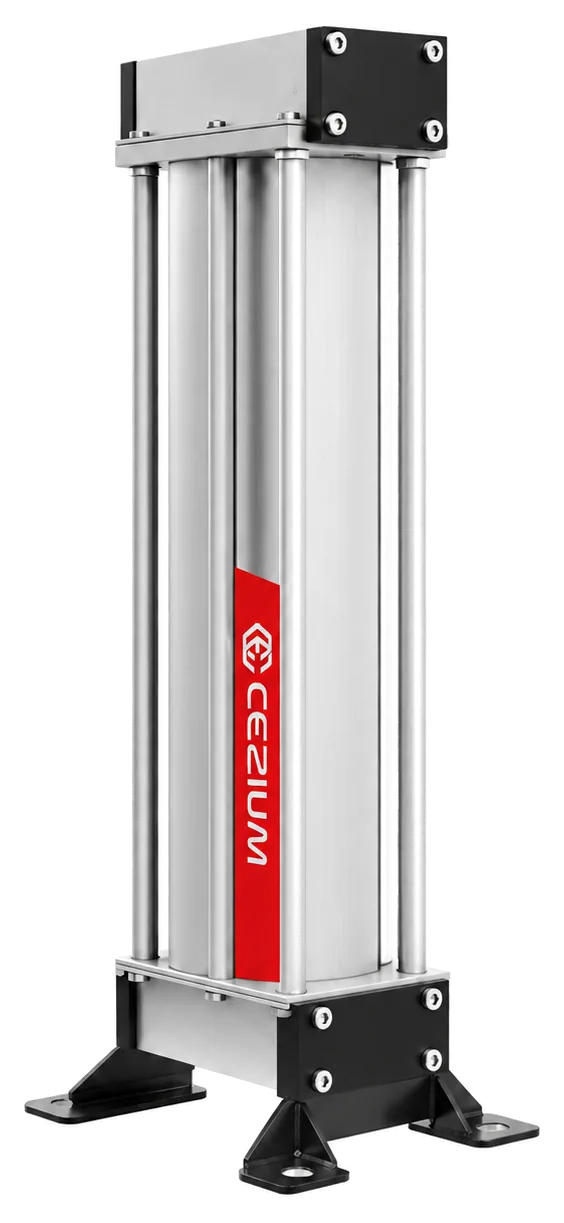
What is an activated carbon tower?
A column of activated carbon that retains the oil vapours and odours that coalescing filters let through. Placed after the dryer and the filters, never before, it gives class 1 for oil to a network fed by a lubricated screw.
Made for
- Food, packaging, painting
- Laboratories and cleanrooms
- Air from a lubricated machine that touches the product or the operator
Not made for
- A class 0 machine, with no oil in the chamberOil-free compressor
| Reference | m³/min | Pressures | Purity | Outlet | L × W × H (mm) |
|---|---|---|---|---|---|
| CZ-SCF-045 | 1.2 | 10 | ≤ 0.003 ppm | ZG1/2" | 208 × 170 × 725 |
| CZ-SCF-097 | 2.7 | 10 | ≤ 0.003 ppm | ZG1" | 308 × 170 × 725 |
| CZ-SCF-130 | 3.6 | 10 | ≤ 0.003 ppm | ZG1" | 308 × 170 × 845 |
| CZ-SCF-205 | 5.7 | 10 | ≤ 0.003 ppm | ZG1" | 308 × 170 × 1145 |
| CZ-SCF-268 | 7.5 | 10 | ≤ 0.003 ppm | ZG1-1/2" | 550 × 300 × 860 |
| CZ-SCF-320 | 9 | 10 | ≤ 0.003 ppm | ZG1-1/2" | 550 × 300 × 940 |
| CZ-SCF-396 | 12 | 10 | ≤ 0.003 ppm | ZG2" | 550 × 300 × 1160 |
Flows, pressures, noise levels and dimensions recorded model by model on the catalogue sheets.
The activated-carbon tower holds back the oil vapour and odours that coalescing filters let through: it is the stage that gives class 1 for oil to a network fed by a lubricated screw. From 1.2 to 12 m³/min, at 10 bar.
It goes after the dryer and the coalescing filters, never before: carbon saturates quickly on wet air or air loaded with aerosols.
Activated carbon does not filter, it adsorbs: oil vapour molecules and odorous compounds attach to the surface of the carbon, whose porosity offers a considerable developed surface area for a small volume.
It is the last stage of the cascade, and it does not tolerate a mistake in the order: a coalescing filter must always come before it. Liquid oil droplets flood the bed within a few days, whereas vapour alone loads it over a few thousand hours.
Saturated carbon gives no warning, it lets things through. It is therefore replaced by the hour, at around 4,000 operating hours, or as soon as a smell of oil appears downstream.
Air in contact with a product or with the operator: food processing, packaging, painting, laboratories, cleanrooms. Seven sizes, from 1.2 to 12 m³/min, 10 bar, in beds of one, two or four elements.
Vapours and odours
Adsorbs what no coalescing filter stops: oil that has remained as vapour, and the odours it carries.
Never first
A coalescing filter always comes before it. Without one, liquid oil floods the bed in a few days instead of a few thousand hours.
Replacement by the hour
Saturated carbon gives no warning: it is changed at around 4,000 hours, or as soon as a smell of oil returns downstream.
From 1.2 to 12 m³/min
Seven sizes, bed of one, two or four elements depending on the flow to be treated, 10 bar working pressure.
Worth reading on this technology
ISO 8573-1: the complete guide to compressed air quality classes
ISO 8573-1 grades compressed air quality against three criteria, particles, water and oil, each on its own scale starting at Class 0. Which class suits which application? Full table and examples.
Refrigerant dryer vs adsorption dryer: when should you switch to adsorption?
A refrigerant dryer covers most industrial applications with a +3 °C pressure dew point. Adsorption goes down to −40 or −70 °C but consumes compressed air. When should you switch?