
Filter elements
Replacement filter elements (cartridges) - grades C/T/A/F/H, cross-compatible with HIROSS, Atlas Copco, Domnick Hunter, Zander. A cost-effective alternative to OEM cartridges.
11 models in the catalogue, flow 1.5 - 40 m³/min, pressure 16 bar.
How it works ↓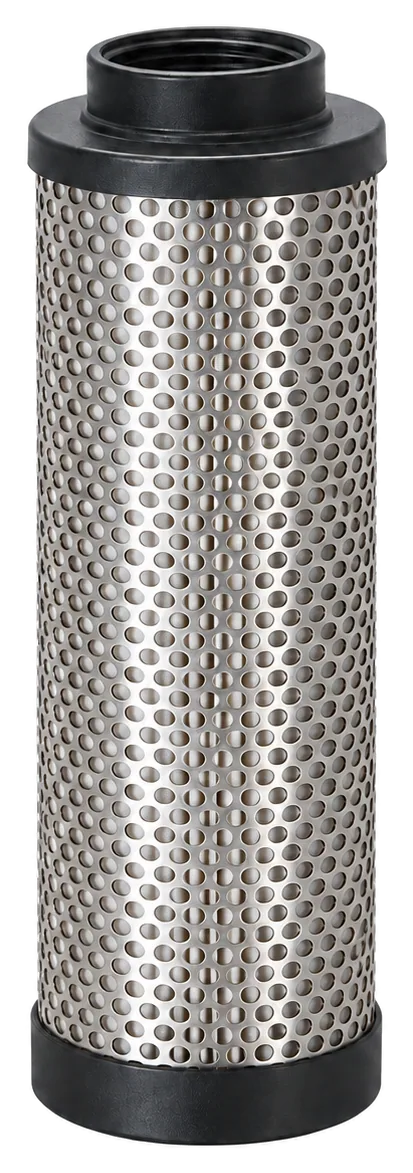
What is a filter element?
The cartridge that does the work inside a filter housing: it is replaced when it is loaded. A saturated element raises the pressure drop, and every bar the compressor has to make up costs about 7% in energy.
Made for
- Maintenance of any filtered network
- Refitting another make's housing without replacing it
- A choice by grade and by actual flow
Not made for
- A network above 16 barHigh-pressure filter 40 bar
| Reference | m³/min | Pressures | Purity |
|---|---|---|---|
| CZ-ELEM-015 | 1.5 | 16 | 0,001 - 5 ppm |
| CZ-ELEM-025 | 2.5 | 16 | 0,001 - 5 ppm |
| CZ-ELEM-038 | 3.8 | 16 | 0,001 - 5 ppm |
| CZ-ELEM-060 | 6 | 16 | 0,001 - 5 ppm |
| CZ-ELEM-085 | 8.5 | 16 | 0,001 - 5 ppm |
| CZ-ELEM-120 | 12.3 | 16 | 0,001 - 5 ppm |
| CZ-ELEM-150 | 15.2 | 16 | 0,001 - 5 ppm |
| CZ-ELEM-200 | 20 | 16 | 0,001 - 5 ppm |
| CZ-ELEM-250 | 25 | 16 | 0,001 - 5 ppm |
| CZ-ELEM-300 | 30.5 | 16 | 0,001 - 5 ppm |
| CZ-ELEM-400 | 40.2 | 16 | 0,001 - 5 ppm |
Flows, pressures, noise levels and dimensions recorded model by model on the catalogue sheets.
You have the reference of another make's element? Compatible filter elements →
Replacement filter elements, by grade and by flow, from 1.5 to 40 m³/min: filtration maintenance is decided here. A saturated element raises the pressure drop, and every bar the compressor has to make up costs about 7% of the energy.
Each element's page gives the flow it treats; choose it on the real network flow, not on the compressor's power.
A compressed air filter does not wear out: it is its cartridge that loads up. The element holds back what passes through it, its pressure drop rises as it fills, and the compressor pays for that loss in pressure, and therefore in electricity, every day the change is put off.
The grades state what the element stops. C holds back particles at 3 µm and brings oil down to 5 ppm, T goes down to 1 µm and 1 ppm, A to 0.01 µm and 0.01 ppm, F to 0.001 ppm, H is an activated carbon element at 0.003 ppm. They are fitted in cascade, from coarsest to finest: a fine element placed first saturates within a few weeks.
The media is a multi-layer borosilicate fibre, chosen to hold a lot while resisting little, and the fluorocarbon seal holds from -20 to +280 °C.
The consumable of any filtered network, eleven sizes from 1.5 to 40.2 m³/min. A differential pressure gauge shows when the element is loaded; without one, replacement follows the calendar. The references are cross-matched with HIROSS, Atlas Copco, Domnick Hunter and Zander cartridges: a housing of another brand is refitted without being replaced.
Five grades
C, T, A, F and H: from 3 µm and 5 ppm of oil down to 0.001 ppm, chosen on the ISO 8573-1 class targeted at the point of use.
Borosilicate media
Multi-layer borosilicate glass fibre: high retention capacity for a low pressure drop, and therefore less pressure lost.
Seal -20 to +280 °C
Fluorocarbon seal: it stays tight on hot air at the compressor outlet as well as on an outdoor network in winter.
Four brands cross-matched
Published equivalences with HIROSS, Atlas Copco, Domnick Hunter and Zander: you change the element, not the housing.
Worth reading on this technology
ISO 8573-1: the complete guide to compressed air quality classes
ISO 8573-1 grades compressed air quality against three criteria, particles, water and oil, each on its own scale starting at Class 0. Which class suits which application? Full table and examples.
Refrigerant dryer vs adsorption dryer: when should you switch to adsorption?
A refrigerant dryer covers most industrial applications with a +3 °C pressure dew point. Adsorption goes down to −40 or −70 °C but consumes compressed air. When should you switch?