
Oil-water separator
Oil-water condensate separators, in three series from 3.4 to 71 m³/min. OWS: below 5 ppm of oil at installation, carbon-free filter changed every 4,000 hours. OWSE: the same vessel with an active agent, for the emulsified condensate a passive filter lets through. GS, the entry-level series: three pre-separation tanks then fibre and activated carbon, 15 mg/L or less. The admissible discharge value is set by your own discharge permit.
18 models in the catalogue, flow 3.4 - 71 m³/min, pressure 16 bar.
How it works ↓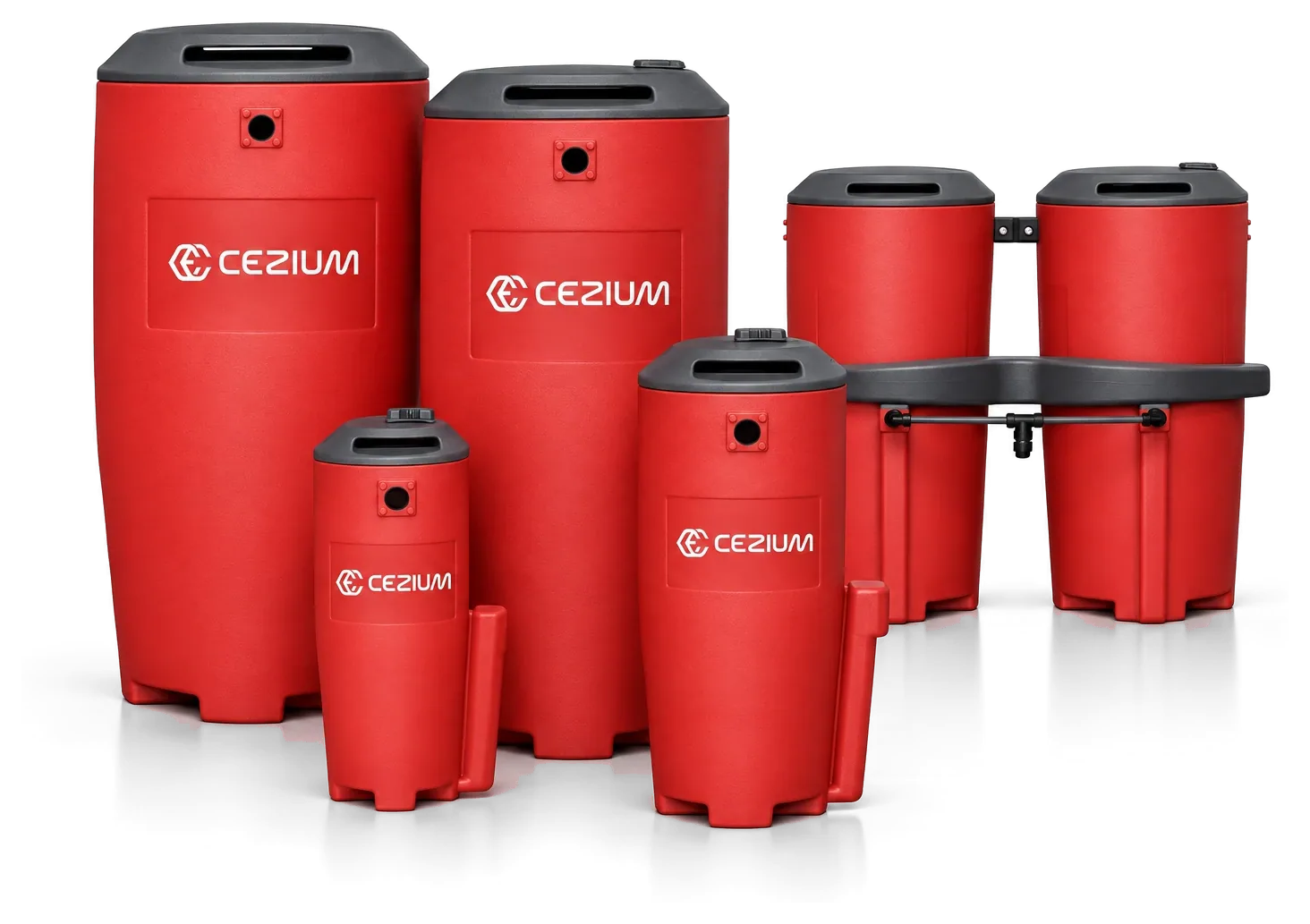
What is an oil-water separator?
It treats the condensate from the compressor, the dryer and the filters before discharge: the oil is retained, the water goes to the sewer, at the content set by your permit or discharge agreement. It is sized on the compressor's flow, and its series on the nature of the condensate.
Made for
- Any lubricated compressor whose drains reach the waste water
- A strict discharge: below 5 ppm of oil
- Emulsified condensate that will not settle
Not made for
- An oil-free compressor, if nothing else on the network carries oilOil-free compressor
| Reference | m³/min | Pressures | Purity | Outlet | L × W × H (mm) | Weight |
|---|---|---|---|---|---|---|
| CZ-OWS-120 | 3.4 | < 5 ppm | 1/2" | 215 × 257 × 500 | 3 kg | |
| CZ-OWSE-120 | 3.4 | < 5 ppm | 1/2" | 215 × 257 × 500 | 4 kg | |
| CZ-GS130 | 4.2 | 16 | ≤ 15 mg/L huile | G1/2" | 455 × 390 × 780 | 14 kg |
| CZ-GS260 | 8.3 | 16 | ≤ 15 mg/L huile | G1/2" | 455 × 390 × 780 | 21 kg |
| CZ-OWS-360 | 10.2 | < 5 ppm | 3/4" | 345 × 282 × 654 | 4 kg | |
| CZ-OWSE-360 | 10.2 | < 5 ppm | 3/4" | 345 × 282 × 654 | 5 kg | |
| CZ-GS520 | 15.8 | 16 | ≤ 15 mg/L huile | DN25 | 1145 × 430 × 904 | 43 kg |
| CZ-OWS-900 | 25.5 | < 5 ppm | 3/4" | 432 × 495 × 989 | 15 kg | |
| CZ-OWSE-900 | 25.5 | < 5 ppm | 3/4" | 432 × 495 × 989 | 20 kg | |
| CZ-GS1000 | 30.6 | 16 | ≤ 15 mg/L huile | DN25 | 1145 × 430 × 1040 | 55 kg |
| CZ-OWS-1250 | 35.4 | < 5 ppm | 3/4" | 485 × 495 × 1015 | 20 kg | |
| CZ-OWSE-1250 | 35.4 | < 5 ppm | 3/4" | 485 × 495 × 1015 | 35 kg | |
| CZ-GS1580 | 47.2 | 16 | ≤ 15 mg/L huile | DN32 | 1340 × 510 × 1150 | 73 kg |
| CZ-OWS-1800 | 51 | < 5 ppm | 3/4" | 990 × 520 × 989 | 31 kg | |
| CZ-OWSE-1800 | 51 | < 5 ppm | 3/4" | 990 × 520 × 989 | 41 kg | |
| CZ-OWS-2500 | 70.8 | < 5 ppm | 3/4" | 1098 × 550 × 1015 | 44 kg | |
| CZ-OWSE-2500 | 70.8 | < 5 ppm | 3/4" | 1098 × 550 × 1015 | 57 kg | |
| CZ-GS2360 | 71.2 | 16 | ≤ 15 mg/L huile | DN32 | 1340 × 510 × 1300 | 92 kg |
Flows, pressures, noise levels and dimensions recorded model by model on the catalogue sheets.
The oil-water separator treats the condensate of the compressor, the dryer and the filters before discharge: oil is held back, water goes to the drain. Sized on the compressor flow, from 3.4 to 71 m³/min.
The condensate picks the series. Dispersed, the usual case: OWS, below 5 ppm of oil, or GS, the entry-level series, 15 mg/L. Emulsified, milky, that will not settle: OWSE, the only one to treat it. With a PAG oil, which dissolves in water, count on half the nominal flow only.
An oil-free compressor dispenses with it, provided nothing else on the network carries oil.
Condensate from a lubricated compressor is not water: it is an emulsion of water and oil, produced continuously and discharged at every drain cycle. It cannot go to the sewer as it is.
The OWS series receives it in a pre-filter where the compressed air expands and the free oil, solids and sludge are held back, then passes it through an oleophilic filter without activated carbon. The water comes out below 5 ppm of oil at installation, and stays under 20 ppm at the end of the filter's life. The GS series, the entry level, goes through three gravity pre-separation tanks, then a fibre cartridge and an activated carbon bed, and returns 15 mg/L or less. The value accepted for discharge, however, is set by your local discharge permit: that is the one that counts.
Some condensates stay emulsified: milky, they do not settle, and no passive filter separates them, whether carbon, polypropylene or zeolite. The OWSE series takes the OWS vessel with a digestion kit holding an active biological agent, which breaks down the emulsified oil and returns clear water.
As soon as a lubricated compressor runs and its drains join the waste water network: workshops, industry, food processing. Each series is sized on the compressor flow, from 3.4 to 71 m³/min; with a PAG oil, which dissolves in water, count on half the nominal flow only.
Below 5 ppm
Oil content of the water discharged by the OWS series at installation, under 20 ppm at the end of the filter's life. A test kit is supplied to check it.
Emulsions too
The OWSE series treats what passive filters let through, with the same vessel and the same servicing.
Nothing to adjust
No moving part, no oil overflow to set, no oil tank to empty: the oil stays in the filters, changed from the top without tools.
Dated servicing
OWS filter every 4,000 hours, OWSE kit every 2,000 hours; an indicator fitted at commissioning shows when it is due.
Worth reading on this technology
ISO 8573-1: the complete guide to compressed air quality classes
ISO 8573-1 grades compressed air quality against three criteria, particles, water and oil, each on its own scale starting at Class 0. Which class suits which application? Full table and examples.
Refrigerant dryer vs adsorption dryer: when should you switch to adsorption?
A refrigerant dryer covers most industrial applications with a +3 °C pressure dew point. Adsorption goes down to −40 or −70 °C but consumes compressed air. When should you switch?