
Centrifugal turbo
Oil-free centrifugal turbo compressor, very high flow - 48 to 3,000 m³/min, major industrial applications, ISO Class 0 quality.
11 models in the catalogue, flow 48 - 3,000 m³/min, pressure 0.6 - 30 bar.
How it works ↓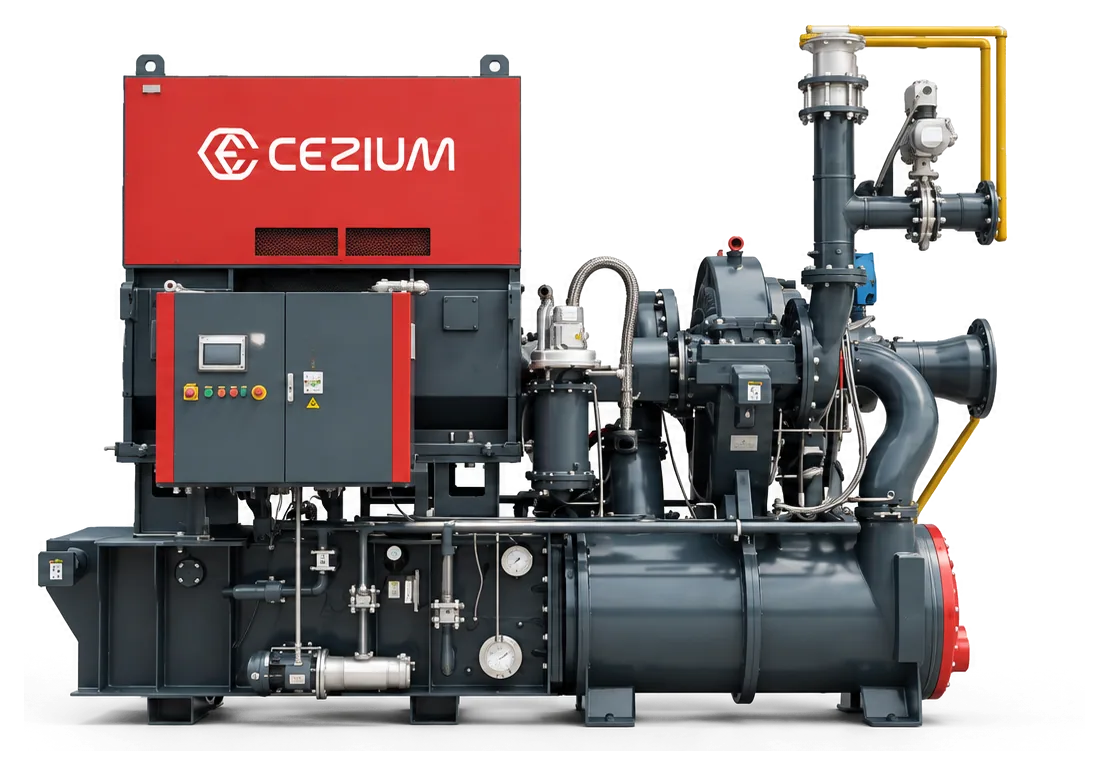
What is a centrifugal compressor?
The air is not trapped and squeezed: an impeller turning at very high speed accelerates it, then a diffuser slows it down, and that slowing down is what compresses it. With no contact and no oil in the air stream, it is the machine for very large flows in continuous duty, for plant-wide air stations.
Swipe to see the whole drawing
Made for
- Steel, heavy chemicals, glassmaking
- Large-scale water treatment, gas separation
- A plant air station running continuously
Not made for
- A dental practice or a small workshopOil-free scroll
- Below 48 m³/min, or a load that varies a lotOil-free dry screw
| Reference | kW | m³/min | Pressures | L × W × H (mm) | Weight |
|---|---|---|---|---|---|
| CZ-SLT300 | 197.5 | 48 | 0.6-9 | 2750 × 1550 × 1820 | 3,800 kg |
| CZ-SLT600 | 349 | 82 | 0.6-12 | 3280 × 1850 × 2200 | 6,300 kg |
| CZ-SLT900 | 520 | 122 | 0.6-12 | 3800 × 2000 × 2250 | 8,160 kg |
| CZ-SLT1200 | 715 | 150 | 0.6-12 | 4200 × 2150 × 2350 | 11,500 kg |
| CZ-SLT1500 | 1,030 | 228 | 0.6-16 | 4200 × 2150 × 2350 | 12,000 kg |
| CZ-SLT2000 | 1,290 | 310 | 0.6-16 | 4600 × 2200 × 2500 | 17,200 kg |
| CZ-SLT3000 | 1,815 | 438 | 0.6-16 | 5300 × 2300 × 2970 | 21,500 kg |
| CZ-SLT4000 | 2,325 | 550 | 0.6-25 | 6000 × 4500 × 3350 | 40,000 kg |
| CZ-SLT6500 | 3,600 | 920 | 0.6-25 | 8500 × 4200 × 4420 | 45,000 kg |
| CZ-SLT10000 | 6,005 | 1,660 | 0.6-30 | 12000 × 5000 × 5300 | 65,000 kg |
| CZ-SLT20000 | 12,055 | 3,000 | 0.6-30 | 15000 × 6200 × 6000 | 80,000 kg |
Flows, pressures, noise levels and dimensions recorded model by model on the catalogue sheets.
The centrifugal compresses through the speed of an impeller, without contact and without oil in the flow: it is the machine of very large flows, from 48 to 3,000 m³/min, for plant and site air stations.
It does not like partial loads or small networks: below 48 m³/min, the oil-free screw does better.
A centrifugal compressor belongs to the turbomachine family: instead of trapping a volume of air to compress it (positive displacement compression), it accelerates the air to very high speed by means of one or more bladed rotors (impellers), then converts this kinetic energy into pressure in a diffuser.
Compression generally takes place in several stages with intercooling. The air never comes into contact with oil: the machine is inherently oil-free, ISO Class 0 quality, and delivers considerable flows continuously.
Very large flows in continuous operation: steelmaking, heavy chemicals, large-scale water treatment, the glass industry, gas separation. The domain of major installations where screws and rotary vanes are no longer enough.
From 48 to 3,000 m³/min
Multi-stage dynamic compression, for the flows of large air stations that positive displacement machines cannot reach.
Oil-free by design
The air never meets oil during compression: Class 0 under ISO 8573-1 by the very design of the machine.
Made to run as base load
Its place is on base load, at sustained and continuous load, with positive displacement machines alongside to follow the variations.
Few parts in contact
Rotors on bearings, little friction: widely spaced maintenance stops on a machine that runs continuously.
Our order of preference for Class 0
When a specification says Class 0, CEZIUM quotes an oil-free machine, as the trade understands it: scroll compressor up to 5 m³/min, rotary tooth compressor from 2.3 to 8.6 m³/min, dry screw or centrifugal beyond that. We also point out the alternative few suppliers mention: a lubricated screw followed by a treatment chain delivers oil-free air for a markedly lower purchase price, without carrying the Class 0 label.
In this trade, Class 0 means an oil-free machine. That is the convention, and it is what a specification expects when it writes Class 0, so that is what we quote. Technically, ISO 8573-1 classifies air at the point of use rather than the compressor, so a lubricated screw followed by multi-stage filtration and an adsorption dryer delivers oil-free air measured on acceptance. That is a genuine alternative, cheaper to buy and far better at heat recovery, but it does not give you a Class 0 certified machine. Both are worth knowing; your own documents decide.
| Rank | Technology | Catalogue flow | Power | Class 0 | Recoverable heat | Purchase cost |
|---|---|---|---|---|---|---|
| 01 | Scroll compressor | 0.3 to 4.96 m³/min | 2.2 to 45 kW | Oil-free machine | Low | Moderate |
| 02 | Rotary tooth compressor | 2.3 to 8.6 m³/min | 15 to 55 kW | Oil-free machine | Low | High |
| 03 | Dry screw compressor | 6.8 to 43 m³/min | 45 to 250 kW | Oil-free machine | Limited | Very high |
| 04 | Centrifugal compressorthis page | 48 to 3,000 m³/min | 198 to 12,055 kW | Oil-free machine | High | Very high |
| 05 | Lubricated screw + treatment chain | 0.95 to 44 m³/min | 5.5 to 250 kW | Treated air, no label | High | Low |
Flow rates and power ratings taken from the CEZIUM catalogue, oil-free technologies and variable-speed lubricated screw. Purchase cost is given in relative ranks, at comparable flow.
- 01
Scroll compressor
Up to 5 m³/minThe first choice below 5 m³/min: oil-free by design, quiet, compact. The right format for a laboratory, a dental practice or a small production line.
See the 13 catalogue models - 02
Rotary tooth compressor
2.3 to 8.6 m³/minAbove the scroll range and up to 8.6 m³/min. The rotors never touch: no friction inside the chamber, minimal wear, TÜV-certified Class 0. Beyond that flow, several units run in parallel.
See the 14 catalogue models - 03
Dry screw compressor
7.8 to 46 m³/minThe answer at high flow when the specification says Class 0. We also state its downside: it costs a great deal to buy and lends itself poorly to heat recovery. If your documents ask for oil-free air rather than a certified machine, the previous step is worth quoting alongside.
See the 20 catalogue models - 04
Centrifugal compressor
From 48 m³/minReserved for the continuous base load of very large sites, where no screw compressor can carry the flow in a single machine.
See the 11 catalogue models - 05
Lubricated screw + treatment chain
Alternative, above 8.6 m³/minThe alternative, when your specification asks for oil-free air rather than a certified machine: multi-stage filtration and an adsorption dryer behind a lubricated screw, with acceptance measurement at the point of use. Markedly lower purchase price, and compression heat is recovered from the oil circuit, which a dry machine does poorly. Rule it out if your documents say Class 0.
See the 33 catalogue models
Worth reading on this technology
Two-stage screw compressor: around 10% less energy than a standard screw
A two-stage screw compressor compresses air in two steps with intercooling in between, close to the theoretical isothermal cycle. Around 10% less energy than a standard screw at constant load; with a permanent magnet drive, on a variable load, the two gains combine.
Compressor heat recovery: up to 84% of the electricity can be reused
A screw compressor converts electricity into compressed air… and into heat. That heat accounts for 80 to 93% of the energy consumed, and 50 to 90% of that heat can be recovered to heat a building or a process. Method and calculation.