
Gas membrane
Diaphragm compressor for gases, from 3 to 250 kW: the gas touches only the diaphragm, with no oil and no leak. Process, laboratory and research gases.
20 models in the catalogue, flow 4 - 2,115 Nm³/h, pressure 25 - 650 bar.
How it works ↓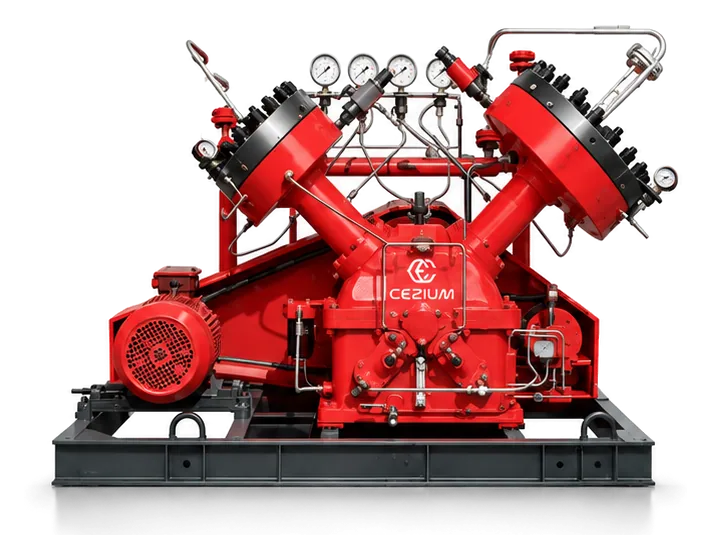
What is a diaphragm compressor?
A flexible diaphragm, moved by hydraulic fluid, compresses the gas: the gas touches only the diaphragm and the head, never a lubricated part. It is the compressor for process and laboratory gases, where no leak and no contamination can be tolerated.
Made for
- Hydrogen, rare gases, toxic or explosive gases
- Laboratory and research gases
- Total containment of the gas
Not made for
- Air, even at high pressureHigh-pressure piston
| Reference | kW | Nm³/h | Pressures |
|---|---|---|---|
| CZ-MEM-L | 3 | 4 | 220 |
| CZ-MEM-V | 3 | 5 | 350 |
| CZ-MEM-L1 | 4 | 10 | 150 |
| CZ-MEM-2V | 5.5 | 8 | 160 |
| CZ-MEM-Z | 7.5 | 50 | 25 |
| CZ-MEM-2.5Z | 11 | 50 | 200 |
| CZ-MEM-2.5V | 15 | 40 | 150 |
| CZ-MEM-2Z | 15 | 110 | 70 |
| CZ-MEM-3V | 18.5 | 950 | 80 |
| CZ-MEM-3Z | 22 | 100 | 650 |
| CZ-MEM-V3 | 22 | 60 | 74 |
| CZ-MEM-L2 | 30 | 100 | 200 |
| CZ-MEM-L3 | 45 | 100 | 250 |
| CZ-MEM-L4 | 55 | 2,115 | 35 |
| CZ-MEM-D | 75 | 1,450 | 25 |
| CZ-MEM-D2 | 90 | 570 | 38 |
| CZ-MEM-D3 | 110 | 580 | 180 |
| CZ-MEM-D4 | 160 | 650 | 200 |
| CZ-MEM-D5 | 185 | 550 | 135 |
| CZ-MEM-D6 | 250 | 1,100 | 210 |
Flows, pressures, noise levels and dimensions recorded model by model on the catalogue sheets.
The diaphragm compressor separates the gas from the mechanics: a diaphragm compresses, the oil stays on the other side, and the gas meets neither oil nor air. From 3 to 250 kW, from 25 to 1,000 bar, it is made for process and laboratory gases, not for workshop air.
For high-pressure air, the piston of the neighbouring family costs less and delivers more.
A diaphragm (or membrane) compressor compresses gas through the flexing of a flexible diaphragm, set in motion by a hydraulic fluid or a mechanism. The gas comes into contact only with the diaphragm and the head: no contact with lubricated parts.
This perfect seal (the diaphragm completely isolates the gas from the mechanism) makes it possible to compress pure, rare, toxic or flammable gases with no contamination and no leakage to the outside.
Gases requiring absolute purity or total containment: hydrogen, laboratory gases, toxic or explosive gases, rare gases, nuclear and research applications. Wherever no leakage or contamination can be tolerated.
The gas touches only the diaphragm
A diaphragm separates the gas from the drive mechanism: neither oil nor wear particles pass into the gas, and the gas does not escape through the drive.
From 25 to 1,000 bar
Depending on the configuration, discharge from 25 to 1,000 bar, for flows of 4 to 2,115 Nm³/h and powers of 3 to 250 kW.
For gases that cannot be lost
Hydrogen, rare gases, laboratory gases, toxic or flammable gases: those that must be neither contaminated nor allowed to leak.
Worth reading on this technology
PSA nitrogen generator vs cylinders: at what volume should you switch?
Producing your nitrogen on site or having it delivered in cylinders: the cost items to compare, and how to find the switch-over point for your profile.
How to size an air compressor: flow, pressure and storage
Sizing a compressor properly is not a matter of picking a power rating in kW: it means calculating the real flow, the right pressure and suitable storage. A 4-step method, with a worked example.