
Dual-motor rotary vane
Rotary vane compressor with two motors and two air-ends, from 60 to 110 kW: each motor can run on its own, so the air does not stop on a fault.
4 models in the catalogue, flow 11 - 21 m³/min, pressure 8 - 13 bar, noise level 84 - 86 dB(A).
How it works ↓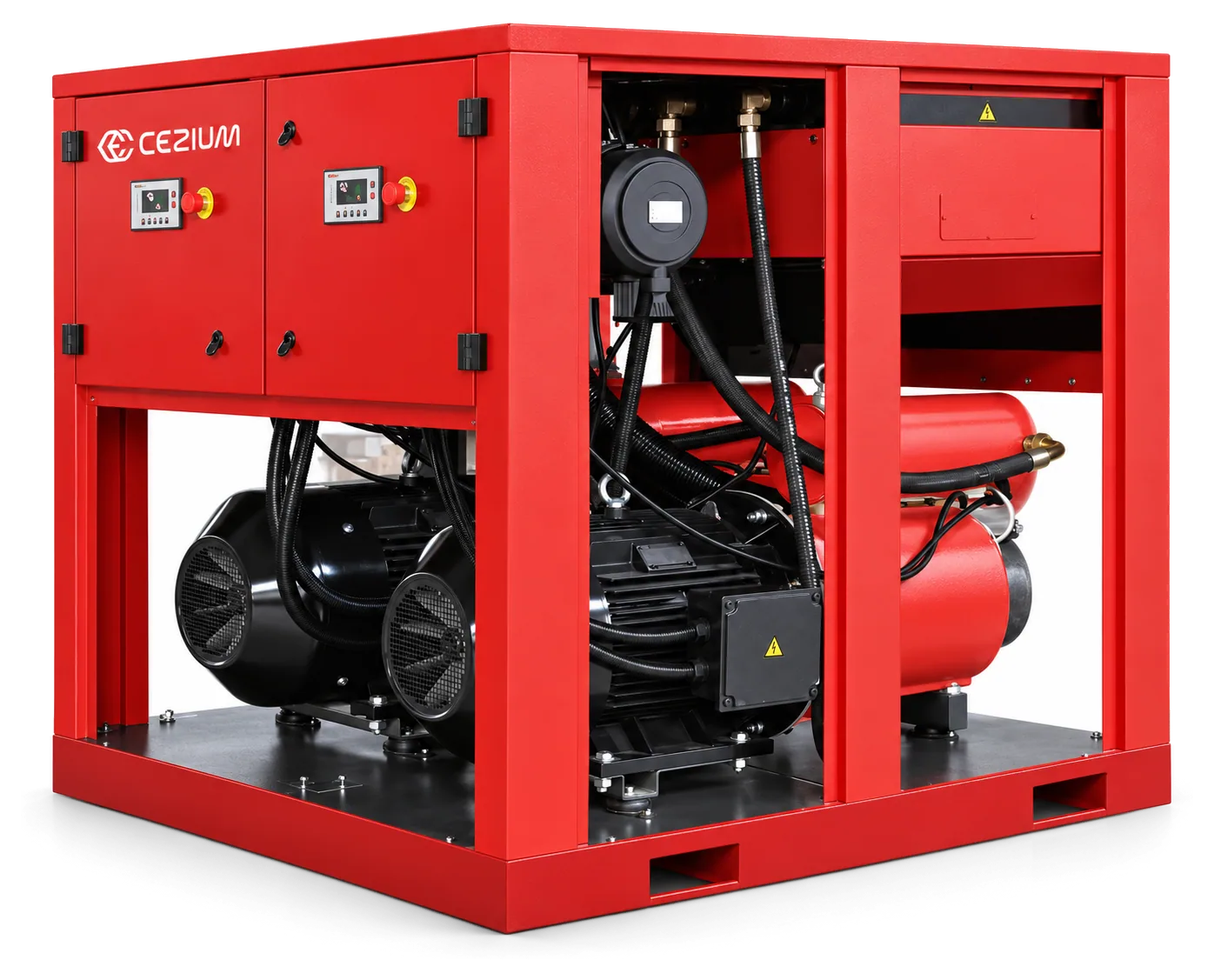
What is a dual-motor rotary vane compressor?
Two motors and two vane air-ends in one frame: the top of the rotary vane family, from 60 to 110 kW. Each motor can run on its own, which keeps air flowing if one side fails, without stopping production.
Swipe to see the whole drawing
Made for
- Production where a total stop is unacceptable
- Demand spread over a wide range
- Redundancy without installing two machines
Not made for
- Above 110 kWFixed-speed screw
| Reference | kW | Flow by pressure (m³/min) | dB(A) | Outlet | L × W × H (mm) | Weight |
|---|---|---|---|---|---|---|
| CZ-VANE-MD60 | 60 | 8 bar11.210 bar9.3113 bar7.32 | 84 | DN65 | 1800 × 1560 × 1720 | 1,400 kg |
| CZ-VANE-MD75 | 75 | 8 bar13.610 bar11.3213 bar9.4 | 84 | DN65 | ||
| CZ-VANE-MD90 | 90 | 8 bar16.510 bar1413 bar11.66 | 86 | DN65 | ||
| CZ-VANE-MD110 | 110 | 8 bar2110 bar17.813 bar14 | 86 | DN65 |
Flows, pressures, noise levels and dimensions recorded model by model on the catalogue sheets. Flows given at 8 bar.
Two motors and two vane airends in one frame, from 60 to 110 kW: the top of the rotary vane family, where a single rotor is no longer enough. Each motor can run alone, which gives a degraded mode without stopping production.
Beyond 110 kW, or for a single airend, the lubricated screw takes over.
This configuration carries two vane air-ends driven by two motors in the same frame. The two units can run together for maximum flow, or in alternation / cascade to adapt to demand.
Running a single unit at partial load, then starting the second when needed, makes it possible to match consumption while spreading the wear, and to provide redundancy: if one motor stops, the other keeps part of the production going.
Sites looking for flexibility and continuity of service: production where a total stoppage is unacceptable, demand spread over a wide range, a need for built-in redundancy without installing two separate machines.
Step modulation
One or two units depending on demand: flow adjusts in steps, avoiding running the full power at partial load.
Built-in redundancy
Two independent motors: if one stops, the other keeps production going. Continuity of service ensured.
Wear spread evenly
Alternating the two units balances the running hours and extends overall service life.
Rotary vane longevity
Two low-speed vane air-ends that accept frequent stops and restarts.
Worth reading on this technology
How to size an air compressor: flow, pressure and storage
Sizing a compressor properly is not a matter of picking a power rating in kW: it means calculating the real flow, the right pressure and suitable storage. A 4-step method, with a worked example.
ISO 8573-1: the complete guide to compressed air quality classes
ISO 8573-1 grades compressed air quality against three criteria, particles, water and oil, each on its own scale starting at Class 0. Which class suits which application? Full table and examples.