
Fixed-speed screw
Fixed-speed lubricated screw compressor - the proven solution for steady loads. 3rd-generation air-end, industrial robustness, standard Y-Δ start.
32 models in the catalogue, flow 1.1 - 44 m³/min, pressure 7 - 16 bar, noise level 60 - 85 dB(A).
How it works ↓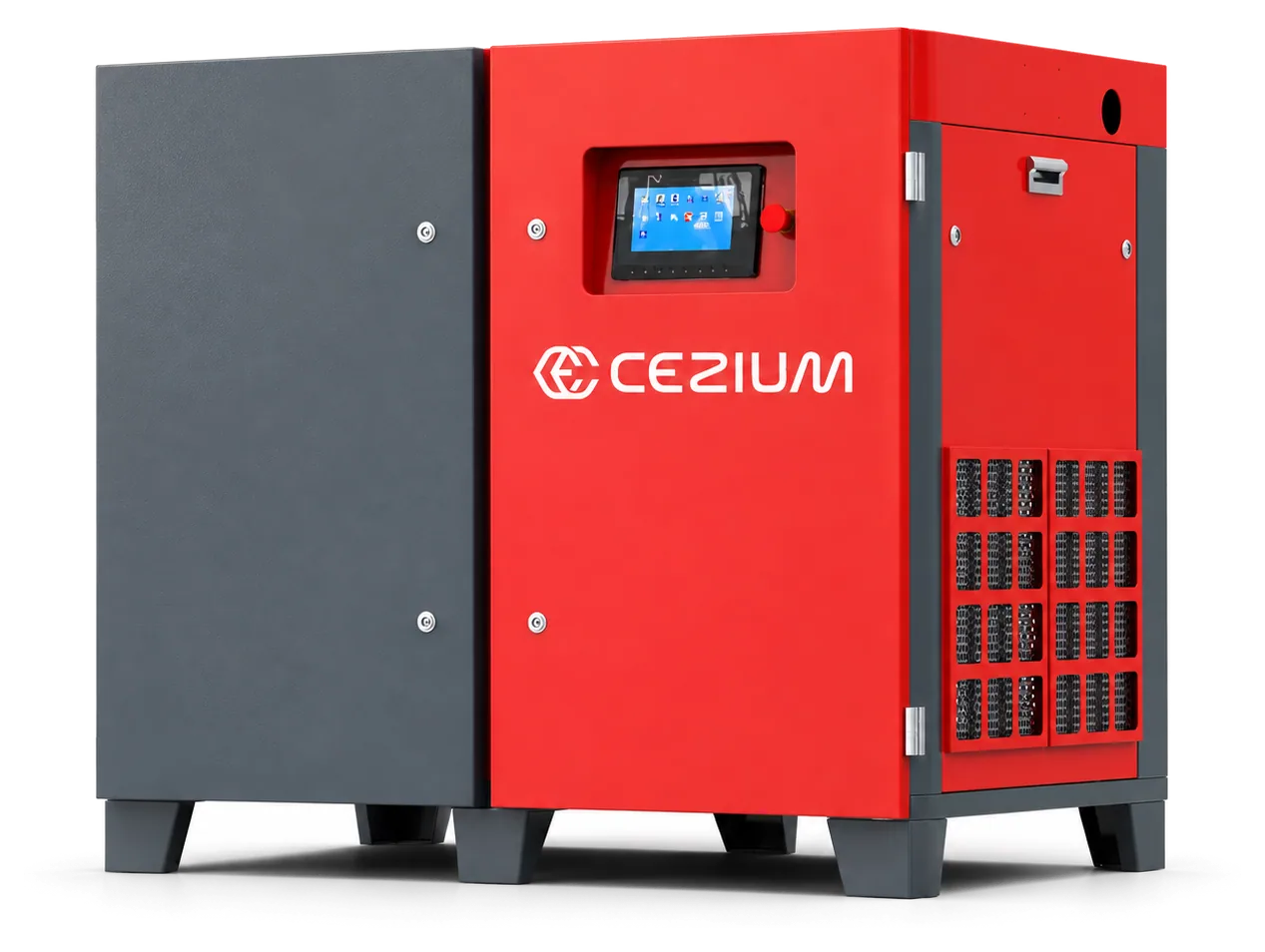
What is a fixed-speed lubricated screw compressor?
Two helical rotors compress the air in a chamber into which oil is injected to seal, cool and lubricate. At fixed speed the motor runs at full load or stops: it is the simplest screw and the cheapest to buy, made for a workshop that uses roughly the same amount of air all day.
Swipe to see the whole drawing
Made for
- Steady consumption, long running hours
- General industry, engineering, joinery, surface treatment
- A site that wants the simplest machine to run
Not made for
- Demand that rises and falls during the dayPM VSD screw
- Air that touches the product (class 0)Oil-free compressor
Two series side by side: CZ-SLT and CZ-OPP. Compare flow, footprint and weight row by row; the quote prices both.
| Reference | kW | HP | Flow by pressure (m³/min) | dB(A) | Outlet | L × W × H (mm) | Weight |
|---|---|---|---|---|---|---|---|
| CZ-SLT-7.5F | 7.5 | 10 | 8 bar1.110 bar0.913 bar0.63 | 60 | DN20 | 950 × 687 × 930 | 213 kg |
| CZ-OPP-10F | 7.5 | 10 | 7 bar1.28 bar1.110 bar0.912 bar0.8 | 60 | DN15 | 930 × 620 × 820 | 185 kg |
| CZ-SLT-11F | 11 | 15 | 8 bar1.7510 bar1.6513 bar1.116 bar0.88 | 62 | DN20 | 1090 × 740 × 1085 | 317 kg |
| CZ-OPP-15F | 11 | 15 | 7 bar1.68 bar1.510 bar1.312 bar1.1 | 62 | DN20 | 1080 × 700 × 1060 | 245 kg |
| CZ-SLT-15F | 15 | 20 | 8 bar2.4410 bar2.213 bar1.8716 bar1.1 | 62 | DN20 | 1090 × 740 × 1085 | 317 kg |
| CZ-OPP-20F | 15 | 20 | 7 bar2.58 bar2.310 bar2.112 bar1.9 | 62 | DN20 | 1080 × 700 × 1060 | 245 kg |
| CZ-SLT-18.5F | 18.5 | 25 | 8 bar310 bar2.713 bar2.316 bar1.85 | 64 | DN25 | 1335 × 900 × 1170 | 470 kg |
| CZ-SLT-22F | 22 | 30 | 8 bar3.610 bar3.213 bar2.616 bar2.3 | 64 | DN25 | 1335 × 900 × 1170 | 470 kg |
| CZ-OPP-30F | 22 | 30 | 7 bar3.88 bar3.610 bar3.212 bar2.7 | 64 | DN25 | 1300 × 850 × 1150 | 380 kg |
| CZ-SLT-30F | 30 | 40 | 8 bar510 bar4.513 bar3.616 bar2.94 | 66 | DN40 | 1510 × 1037 × 1275 | 645 kg |
| CZ-OPP-40F | 30 | 40 | 7 bar5.38 bar510 bar4.512 bar4 | 66 | DN40 | 1500 × 950 × 1250 | 550 kg |
| CZ-SLT-37F | 37 | 50 | 8 bar6.310 bar5.613 bar4.6116 bar3.4 | 66 | DN40 | 1510 × 1037 × 1275 | 685 kg |
| CZ-OPP-50F | 37 | 50 | 7 bar6.88 bar6.210 bar5.612 bar5 | 66 | DN40 | 1500 × 950 × 1250 | 550 kg |
| CZ-SLT-45F | 45 | 60 | 8 bar7.4610 bar6.2513 bar5.5116 bar5.22 | 66 | DN40 | 1510 × 1037 × 1275 | 712 kg |
| CZ-OPP-60F | 45 | 60 | 7 bar7.48 bar710 bar6.212 bar5.6 | 66 | DN40 | 1500 × 950 × 1250 | 550 kg |
| CZ-SLT-55F | 55 | 75 | 8 bar9.2810 bar8.1713 bar7.2516 bar6.28 | 68 | DN50 | 1910 × 1270 × 1600 | 1,046 kg |
| CZ-OPP-75F | 55 | 75 | 7 bar108 bar9.210 bar8.512 bar7.6 | 68 | DN50 | 1600 × 1170 × 1520 | 895 kg |
| CZ-SLT-75F | 75 | 100 | 8 bar12.3510 bar11.213 bar9.816 bar8.05 | 68 | DN50 | 1910 × 1270 × 1600 | 1,156 kg |
| CZ-OPP-100F | 75 | 100 | 7 bar13.48 bar12.610 bar11.212 bar10 | 68 | DN50 | 1720 × 1220 × 1600 | 1,195 kg |
| CZ-SLT-90F | 90 | 120 | 8 bar15.210 bar13.313 bar12 | 70 | DN65 | 2460 × 1670 × 1700 | 1,775 kg |
| CZ-OPP-125F | 90 | 125 | 7 bar16.28 bar1510 bar13.812 bar12.3 | 70 | DN50 | 2480 × 1460 × 1850 | 1,720 kg |
| CZ-SLT-110F | 110 | 150 | 8 bar19.810 bar16.513 bar13.2 | 70 | DN65 | 2460 × 1670 × 1700 | 2,104 kg |
| CZ-OPP-150F | 110 | 150 | 7 bar218 bar19.810 bar17.412 bar14.8 | 70 | DN65 | 2480 × 1460 × 1850 | 1,960 kg |
| CZ-SLT-132F | 132 | 175 | 8 bar23.210 bar20.513 bar17.4 | 70 | DN65 | 2460 × 1670 × 1700 | 2,261 kg |
| CZ-OPP-175F | 132 | 175 | 7 bar24.58 bar23.210 bar20.512 bar17.4 | 70 | DN65 | 2480 × 1460 × 1850 | 2,000 kg |
| CZ-SLT-160F | 160 | 215 | 8 bar28.310 bar2513 bar20.43 | 75 | DN65 | 2700 × 1700 × 1800 | 3,380 kg |
| CZ-OPP-220F | 160 | 220 | 7 bar30.258 bar30.1510 bar26.912 bar23 | 75 | DN75 | 2970 × 1870 × 2350 | 2,150 kg |
| CZ-SLT-185F | 185 | 250 | 8 bar31.910 bar28.513 bar23.53 | 75 | DN100 | 3110 × 1940 × 2060 | 3,580 kg |
| CZ-OPP-270F | 185 | 270 | 7 bar33.158 bar32.1510 bar30.112 bar24.32 | 85 | DN75 | 2970 × 1870 × 2350 | 2,800 kg |
| CZ-SLT-220F | 220 | 294 | 8 bar36.7410 bar33.1713 bar29.75 | 75 | DN100 | 3970 × 2190 × 2270 | 4,500 kg |
| CZ-SLT-250F | 250 | 335 | 8 bar4410 bar36.613 bar32.16 | 78 | DN100 | 4182 × 2240 × 2340 | 4,600 kg |
| CZ-OPP-350F | 250 | 350 | 7 bar45.58 bar4310 bar38.912 bar36 | 85 | DN100 | 2760 × 1800 × 2100 | 3,500 kg |
Flows, pressures, noise levels and dimensions recorded model by model on the catalogue sheets. Flows given at 8 bar.
The fixed-speed lubricated screw is industry's base machine: a steady load, a workshop that consumes about the same all day, nothing to adjust. It is the cheapest screw to buy in the catalogue.
Against the neighbouring VSD range it loses as soon as demand rises and falls: an unloaded screw still draws 15 to 35% of its power while producing nothing, according to the US Department of Energy's Sourcebook. If your consumption curve looks like a saw, read the variable-speed range.
A lubricated screw compressor compresses air between two helical rotors, a male rotor and a female rotor, turning in opposite directions inside a sealed casing. As they turn, the volume of air trapped between the lobes and the casing decreases: the air is compressed mechanically, then discharged continuously, smoothly and without valves, unlike a piston compressor.
Oil is injected directly into the compression chamber. It lubricates the rotors, seals the gaps between the lobes, absorbs the heat of compression (a near-isothermal process) and dampens noise. At the outlet, a centrifugal air/oil separator recovers the oil (residual content below 3 ppm), which passes through the filter and then the cooler before being injected again, in a closed circuit.
In the fixed-speed version, the motor runs at a constant speed. The machine is controlled by load / off-load via the inlet valve: it delivers 100% of its flow when the network calls for it, then runs off-load and stops after a time delay. It is the simplest solution when air demand is stable and sustained.
The reference for the industrial workshop with a steady load: continuous production, assembly lines, maintenance (MRO), food processing, metalworking, surface treatment, joinery. Ideal when air consumption varies little and the machine runs several hours a day at a sustained load. For a highly variable demand, a VSD variable-speed version is preferred.
SKF bearings, 80,000 to 100,000 h
3rd-generation air-end with an asymmetric profile, mounted on reinforced SKF bearings rated for 80,000 to 100,000 hours: ten to twelve years of service at 8,000 hours a year before they are replaced.
Seventeen sizes, from 7.5 to 250 kW
From 1.1 to 44 m³/min, from 7 to 16 bar depending on the model. When the workshop consumes at full capacity all day, fixed speed is the simplest solution to operate.
Drive according to size
Up to 75 kW, direct or belt drive depending on the version. From 90 to 250 kW, the air-end is coupled directly to the motor: no belt to re-tension or replace.
PLC controller, 14 protections
Multilingual touchscreen, 14 protections (overload, short circuit, phase reversal, overtemperature). Regulates the discharge pressure within the set range.
IP55 motor, IE4 from 75 kW
Enclosed IP55 asynchronous motor, protected against the dust and water splashes of a compressor room. IE3 class up to 55 kW, IE4 from 75 to 250 kW, IE5 on request.
Worth reading on this technology
Lubricated screw or oil-free compressor: Class 0 describes the air, not the machine
Most comparisons set two machines against each other. The standard, however, judges the air at the point of use. A lubricated screw followed by a treatment chain can deliver oil-free air at the point of use, at a significantly lower purchase cost; class 0 itself remains that of an oil-free machine. Here is the order in which CEZIUM selects each technology.
Compressor heat recovery: up to 84% of the electricity can be reused
A screw compressor converts electricity into compressed air… and into heat. That heat accounts for 80 to 93% of the energy consumed, and 50 to 90% of that heat can be recovered to heat a building or a process. Method and calculation.