
Compressed air and Scope 3: decarbonising the forgotten utility in industrial climate plans
Compressed air accounts for up to 10% of European industrial electricity consumption. In a decarbonisation plan, it is a systemic source of Scope 2 reductions and an indirect Scope 3 lever through suppliers. Methodology and worked examples with figures.
Why compressed air is a serious climate issue
According to the EU reference document on energy efficiency (BREF, 2009), compressed air accounts for up to 10% of industrial electricity consumption, or over 80 TWh a year in the EU-15. In an industrial company's inventory, its share of electricity-related Scope 2 emissions follows its share of the site's electricity consumption, since every kWh carries the same emission factor.
But the climate angle goes beyond Scope 2. Compressed air also sits in upstream Scope 3 (equipment bought from a supplier whose manufacturing footprint counts) and in downstream Scope 3 (a machine sold with a compressor on board: GHG Protocol category 11, use of sold products, counts in the machine builder's inventory the use-phase emissions expected over the whole lifetime of the machines sold in the reporting year).
For an industrial company calculating its GHG inventory under Bilan Carbone (the French carbon accounting method), the GHG Protocol or ISO 14064, compressed air is the utility with the most favourable "impact / ease of action" ratio. The levers are well identified, technologically mature, and their gain grows with the hours the machines run.
A compressor's CO₂ footprint, quantified
The footprint of a compressor in service breaks down into two phases: the manufacturing footprint (upstream Scope 3: raw materials, transport, assembly) and the use-phase footprint (Scope 2: electricity consumed over its service life).
The EU ecodesign preparatory study on compressors (Lot 31, 2014) concludes that the main life-cycle impact occurs during the use phase, through energy consumption. Use is therefore what drives the result, and that brings in the emission factor of the electricity mix in the country of operation. On a very low-carbon mix such as France's, manufacturing therefore weighs relatively more in the total.
| Emission factor, France (Ember 2024, lifecycle) | 40.5 g CO₂eq/kWh |
|---|---|
| Emission factor, Germany (Ember 2024) | 336.4 g CO₂eq/kWh |
| Emission factor, Poland (Ember 2024) | 608.2 g CO₂eq/kWh |
| Emission factor, EU-27 average (Ember 2024) | 211.2 g CO₂eq/kWh |
| Footprint, 75 kW compressor · 4,000 h/year · 60% load · EU | ≈ 38 t CO₂eq/year, i.e. 570 t over 15 years |
| Manufacturing footprint | Ask the supplier: environmental product declaration (EPD) or manufacturing carbon assessment |
For the same use and power, a compressor in France emits about 15 times less CO₂ than one in Poland (40.5 versus 608.2 g CO₂eq/kWh in 2024): that is the effect of the electricity mix. The carbon intensity of the energy lever therefore varies with location.
Lever #1: the permanent magnet VSD (idle hours removed)
Moving from a fixed-speed screw with load/unload control to a permanent magnet drive removes the idle hours: according to the US Department of Energy's Sourcebook, an unloaded screw still draws 15 to 35% of its power while producing nothing. At 60% average demand, that is 6 to 14% of rated power over the whole running time. On the 75 kW compressor in the previous section, at 4,000 h a year, that is 18,000 to 42,000 kWh avoided every year; the calculation is detailed in the article on the permanent magnet VSD.
For a German or Polish site, the energy saved is the same, but in CO₂ terms the gain is larger, because every kWh avoided carries a heavier carbon weight.
| 75 kW compressor, VSD vs fixed speed (France) | ≈ −0.7 to −1.7 t CO₂eq/year avoided |
|---|---|
| 75 kW compressor, VSD vs fixed speed (Germany) | ≈ −6.1 to −14.1 t CO₂eq/year avoided |
| 75 kW compressor, VSD vs fixed speed (Poland) | ≈ −10.9 to −25.5 t CO₂eq/year avoided |
| Over 15 years (Germany) | ≈ −91 to −212 t CO₂eq cumulative |
On a carbon-intensive grid, every kWh avoided weighs more: in 2024, a kWh avoided in Germany avoided about 8 times as much CO₂ as one in France (336.4 versus 40.5 g CO₂eq/kWh). The same VSD therefore has a different climate value depending on the country where it runs.
Lever #2: heat recovery (40 to 84% of the electricity recoverable)
A compressor converts electricity into compressed air… and above all into heat. According to the US Department of Energy's Sourcebook, the available heat amounts to 80 to 93% of the electricity drawn, 50 to 90% of which can be recovered: 40 to 84% of the electricity, at a usable temperature (oil at 70-90 °C, final air at 30-50 °C).
If that heat replaces a gas boiler or a fossil-fuelled heat network, the climate impact is twofold: energy is recovered AND gas emissions are avoided. On a site that used gas to heat ambient air or domestic hot water, pairing the compressor with heat recovery covers part of the annual heating demand, a share calculated by setting the recoverable heat against the site's heating profile (hours, season).
| Recoverable thermal energy | 40 to 84% of the electricity drawn |
|---|---|
| 75 kW compressor · 4,500 h/year · 65% load | ≈ 175,500 kWh of recoverable heat (80%, the DOE worked example's assumption) |
| Heat actually used (60% of the recoverable heat) | ≈ 105,000 kWh/year |
| Gas not burnt (boiler at 92% on LHV) | ≈ 114,500 kWh LHV, i.e. ≈ 127,000 kWh HHV/year |
| CO₂ avoided (ADEME Base Carbone, natural gas 2022: 0.239 kg CO₂eq/kWh LHV) | ≈ 27 t CO₂eq/year avoided |
If you use gas to heat the workshop or the domestic hot water and have a compressor > 30 kW nearby, cost out heat recovery first: every kWh recovered replaces gas burnt on site, and so cuts both the bill and Scope 1.
Lever #3: the on-site nitrogen generator (vs cylinders)
Many sites use nitrogen in their processes (food and beverage, electronics, pharma, laser cutting). When the nitrogen is delivered, its CO₂ footprint includes the separation electricity at the producer, its liquefaction when it arrives liquid, and road transport.
An on-site PSA generator produces nitrogen from the existing compressed air, with a footprint limited to the additional electricity consumed by the PSA. The difference is calculated case by case: it depends on the purity required, the delivery mode and the electricity mix, and it widens with transport distance.
| Nitrogen in cylinders or bulk tanks | Electricity for air separation and, for liquid nitrogen, liquefaction, plus filling and road transport |
|---|---|
| Nitrogen produced on site by PSA | Electricity for the compressed air consumed by the generator, at the site's emission factor |
| To ask the gas supplier for | Footprint per kg delivered, established with the European Industrial Gases Association method (EIGA, Doc 167) |
| To read on the generator's datasheet | Compressed air consumption per Nm³ of nitrogen at the target purity, to convert into kWh |
Beyond CO₂, a PSA generator removes the dependency on a gas supplier (delivery failures, sudden price rises) and makes the site more self-sufficient. A carbon footprint argument and a resilience argument.
Accounting methodology: where it shows up in your reporting
To account correctly for compressed air gains in a Bilan Carbone, ISO 14064 or CSRD report, four rules apply:
- The energy saving on the compressor itself is Scope 2 (market-based where possible: use the emission factor of your electricity contract, not the national average). The Ember factors quoted above are lifecycle values, designed for comparing countries: they also count the upstream part of generation, whereas Scope 2 only takes in combustion at the power plant, the extraction and transport of fuels falling under Scope 3 Category 3. For your report, use the factor of your reference framework (in France, ADEME's Base Carbone).
- Recovered heat that replaces gas is Scope 1 (avoided combustion) if the gas was burnt on site, or Scope 2 if the heat came from an external district heating network (purchased heat).
- Eliminating nitrogen cylinders reduces Scope 3: Category 1 (purchased goods and services) for producing the gas, Category 4 for transporting it to the site, while the electricity consumed by the generator is added to Scope 2.
- CEE (France's energy savings certificates) paid by obligated parties are NOT negative emissions: they are a financial transfer, not a carbon credit. But they fund the levers that genuinely reduce emissions.
CSRD reporting has applied since the 2024 financial year to the first companies in scope; Directive (EU) 2025/794 postponed the following waves by two years, and Directive (EU) 2026/470 limits the obligation to companies exceeding an average of 1,000 employees and a net turnover of 450 million euros. If yours is one of them, build these calculations in now. Auditors check the methodology, not just the figure. Document your assumptions (emission factor, service life, load profile).
A typical decarbonisation plan over 3 years
- Year 0, diagnostic: a data logger fitted to the compressors for seven days, measurement of actual consumption and load profile, calculation of the baseline footprint. This is the pre-study, and CEZIUM does not charge for it.
- Year 1, immediate gains: lowering the pressure set point (one bar represents about 7% of energy), repairing leaks (according to the US Department of Energy, they sometimes waste 20 to 30% of output, and a detection programme brings them below 10%), replacing clogged filters. No change of machine.
- Year 2, structural investment: permanent magnet VSD compressor, with heat recovery as an option if the site qualifies. Part of it funded by CEE (sheets IND-UT-102 or IND-UT-114, and IND-UT-103 for heat recovery). The gain follows the running hours.
- Year 3, system optimisation: continuous energy monitoring, drift alerts, energy efficiency contracts with the after-sales service installer.
The gains of these steps multiply, they do not add up: the year 2 VSD saves on a consumption already reduced by the pressure and leak work of year 1. The result is therefore measured against the year 0 baseline footprint: that measured figure, not a promise, is what finance and CSR departments will remember.
Beyond the compressor: the sales argument
For an industrial company selling to major prime contractors (automotive, aerospace, pharmaceuticals, retail), the production footprint is now one of the purchasing criteria. A supplier that can document a measured reduction in the compressed air footprint of its lines has a concrete argument against a competitor that has not started.
It is also a differentiator against imported goods. The EU CBAM regulation (Carbon Border Adjustment Mechanism, Regulation (EU) 2023/956), which entered into force on 17 May 2023, has applied under its definitive regime since 1 January 2026: importers of cement, iron and steel, aluminium, fertilisers, electricity and hydrogen declare the emissions embedded in these goods, and the corresponding certificates go on sale from 1 February 2027. In these sectors, the production footprint becomes a cost at the border, and documenting yours becomes an argument against a higher-emitting imported competitor.
Compressed air decarbonisation is no longer a peripheral CSR topic: it has become a commercial one. Document the gains, and include them in your tender responses and your CSRD reports.
Recommended models for this topic
Selected by our technical team
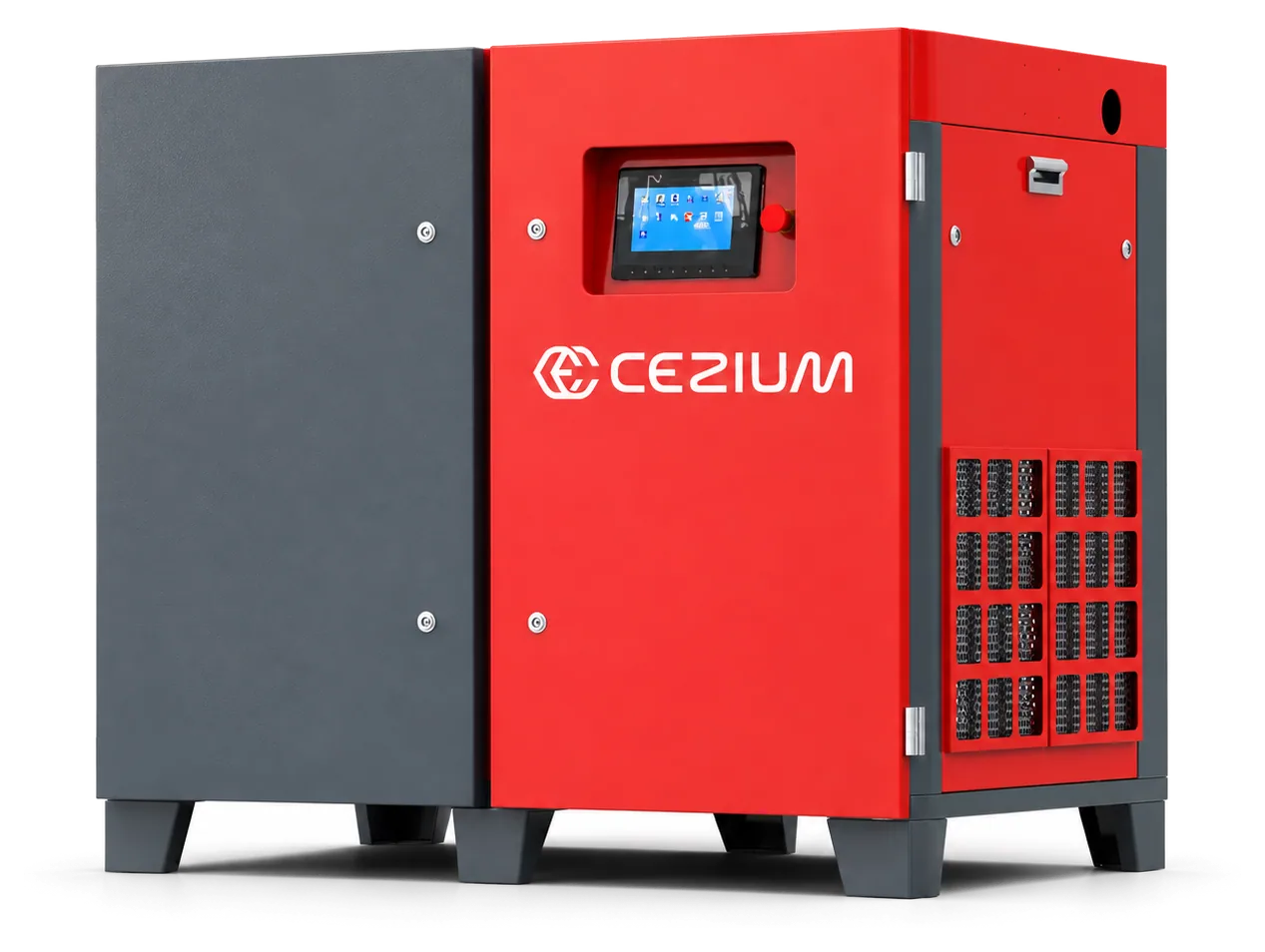
Compresseur VSD 37 kW (50 HP)
37 kW · 6.30 m³/min · 8-16 bar
Voir la fiche →Compresseur PM VSD 75 kW (100 HP)
75 kW · 12.35 m³/min · 8-16 bar
Voir la fiche →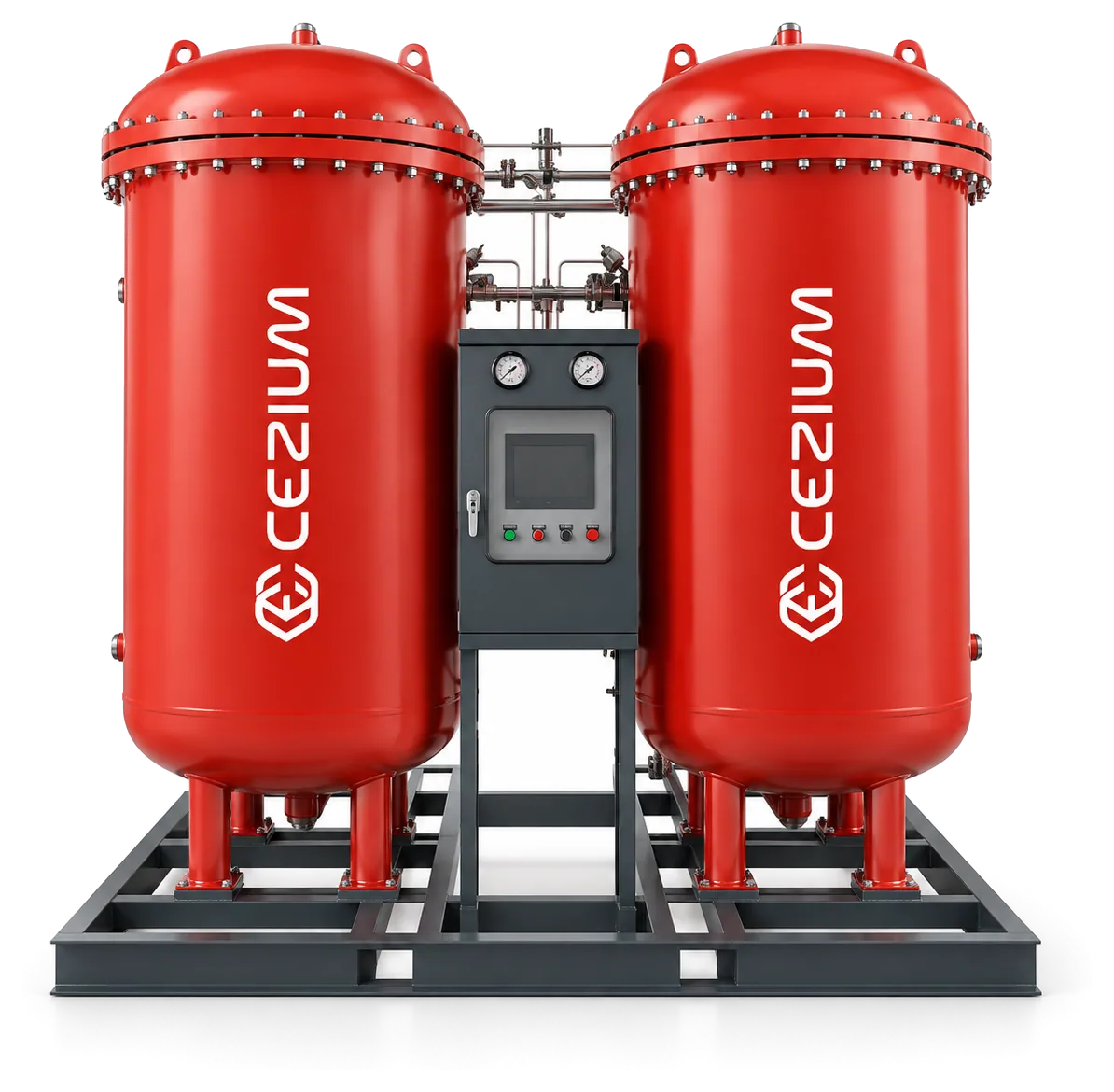
Générateur d'azote PSA 50 Nm³/h, pureté 98 %
6-10 bar
Voir la fiche →Générateur d'azote PSA 100 Nm³/h, pureté 98 %
6-10 bar
Voir la fiche →Refine the calculation with your figures
Enter your power, your running hours and your kWh price. Annual saving, current bill and CO₂ avoided in 30 seconds.
CEE 2026-2030: financing a VSD compressor with France's energy savings certificates
The CEE scheme (France's energy savings certificates) funds part of the extra cost of a variable speed compressor. You still need to know the right operation sheet, how to calculate kWh cumac and how to choose the right délégataire (the intermediary who handles the claim). Full method, worked example on 75 kW.
Costs and energyCompressor heat recovery: up to 84% of the electricity can be reused
A screw compressor converts electricity into compressed air… and into heat. That heat accounts for 80 to 93% of the energy consumed, and 50 to 90% of that heat can be recovered to heat a building or a process. Method and calculation.
Costs and energyPermanent magnet VSD: what the drive really saves
What a permanent magnet drive changes on a varying load: idle hours removed, and the annual gain to be worked out from your own load profile, across 6 typical power ratings.
Costs and energyPSA nitrogen generator vs cylinders: at what volume should you switch?
Producing your nitrogen on site or having it delivered in cylinders: the cost items to compare, and how to find the switch-over point for your profile.