
Heated adsorption dryer
Heated-regeneration adsorption dryer: 3% purge air at most, dew point down to −70 °C, for air stations that run continuously.
18 models in the catalogue, flow 6.96 - 83 m³/min, pressure 4.5 - 10 bar.
How it works ↓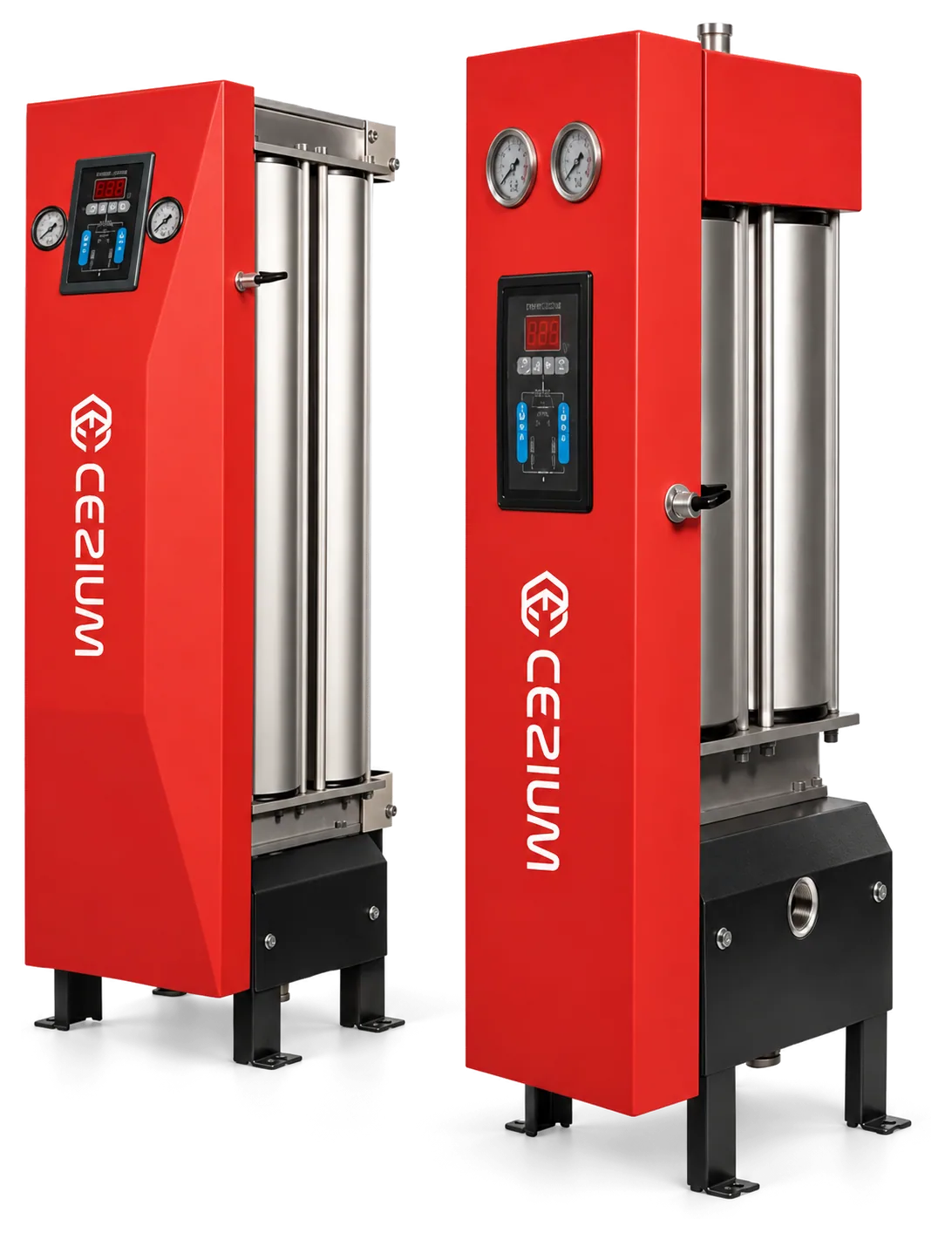
What is a heated adsorption dryer?
The same two-column principle, but regeneration is helped by an electric heater: purge air falls to 3% at most, against 6% heatless. Dew point down to −70 °C, for air stations that run continuously.
Swipe to see the whole drawing
Made for
- Air stations that run continuously
- Processes that call for −70 °C
- Reducing the compressed air lost to purge
Not made for
- A small flowHeatless adsorption dryer
| Reference | kW | m³/min | Pressures | Dew point | Outlet | L × W × H (mm) | Weight |
|---|---|---|---|---|---|---|---|
| CZ-MXD-0696 | 0.8 | 6.96 | 4.5-10 | −40 à −70 °C | G1-1/2" | 740 × 260 × 1750 | 178 kg |
| CZ-MXD-0875 | 1 | 8.75 | 4.5-10 | −40 à −70 °C | G1-1/2" | 865 × 260 × 1750 | 216 kg |
| CZ-MXD-1063 | 1 | 10.63 | 4.5-10 | −40 à −70 °C | G2" | 990 × 260 × 1750 | 254 kg |
| CZ-MXD-1276 | 1.2 | 12.76 | 4.5-10 | −40 à −70 °C | G2" | 1115 × 260 × 1750 | 272 kg |
| CZ-MXD-1428 | 1.4 | 14.28 | 4.5-10 | −40 à −70 °C | G2" | 1240 × 260 × 1750 | 310 kg |
| CZ-MXD-1796 | 1.6 | 17.96 | 4.5-10 | −40 à −70 °C | G2-1/2" | 1490 × 260 × 1750 | 386 kg |
| CZ-MXD-2088 | 2 | 20.88 | 4.5-10 | −40 à −70 °C | G2-1/2" | 1615 × 260 × 1750 | 462 kg |
| CZ-MXD-2465 | 2.4 | 24.65 | 4.5-10 | −40 à −70 °C | G2-1/2" | 1130 × 520 × 1750 | 560 kg |
| CZ-MXD-2853 | 2.8 | 28.53 | 4.5-10 | −40 à −70 °C | G3" | 1255 × 520 × 1750 | 636 kg |
| CZ-MXD-3462 | 3.2 | 34.62 | 4.5-10 | −40 à −70 °C | G3" | 1380 × 520 × 1750 | 714 kg |
| CZ-MXD-3836 | 3.6 | 38.36 | 4.5-10 | −40 à −70 °C | G3" | 1505 × 520 × 1750 | 792 kg |
| CZ-MXD-4258 | 4 | 42.58 | 4.5-10 | −40 à −70 °C | DN100 | 1630 × 520 × 1750 | 870 kg |
| CZ-MXD-4680 | 4.4 | 46.8 | 4.5-10 | −40 à −70 °C | DN100 | 1755 × 520 × 1750 | 948 kg |
| CZ-MXD-5100 | 4.8 | 51 | 4.5-10 | −40 à −70 °C | DN100 | 1880 × 520 × 1750 | 1,026 kg |
| CZ-MXD-5650 | 5.6 | 56.5 | 4.5-10 | −40 à −70 °C | DN100 | 1530 × 1340 × 1910 | 1,258 kg |
| CZ-MXD-6580 | 6.4 | 65.8 | 4.5-10 | −40 à −70 °C | DN125 | 1655 × 1340 × 1910 | 1,398 kg |
| CZ-MXD-7350 | 7.2 | 73.5 | 4.5-10 | −40 à −70 °C | DN125 | 1780 × 1340 × 1910 | 1,528 kg |
| CZ-MXD-8300 | 8 | 83 | 4.5-10 | −40 à −70 °C | DN125 | 1905 × 1340 × 1910 | 1,678 kg |
Flows, pressures, noise levels and dimensions recorded model by model on the catalogue sheets.
The adsorption dryer regenerated by heating: less purge air than the heatless version, at the price of an electric heater of 0.8 to 8 kW. From 7 to 83 m³/min, with a dew point down to -70 °C, class 1 for water.
On a small flow, the heatless version is simpler and its purge air weighs little.
The same alternation of two molecular sieve columns, but regeneration is assisted by a heater: the bed dries faster and with much less air.
The purge falls to 3% of the flow instead of 6%, in exchange for an electrical consumption of 0.8 to 8 kW depending on size. The calculation is made on running hours: purge air is compressed air, and therefore electricity already spent to produce it, while the heater only consumes when it is heating. The more the machine runs, the more the heated version holds its own.
The dew point goes down from -40 to -70 °C, i.e. class 2 to 1 for water: the level required by the driest processes.
Eighteen models from 6.96 to 83 m³/min, from 4.5 to 10 bar, with a heater of 0.8 to 8 kW. For air stations running continuously, and for processes that call for -70 °C rather than -40 °C.
Purge ≤ 3%
Half as much air devoted to regeneration as on a dryer with no heat input, at equal flow.
Down to -70 °C
Class 1 for water, the level of the most demanding processes. The heatless version stops at -40 °C.
Heater 0.8 to 8 kW
The trade-off, quantified and known in advance: it is weighed against the planned running hours before deciding.
Independent modules
The same sealed cartridges and the same screen controller as the heatless version, with dew point control as an option.
Worth reading on this technology
Refrigerant dryer vs adsorption dryer: when should you switch to adsorption?
A refrigerant dryer covers most industrial applications with a +3 °C pressure dew point. Adsorption goes down to −40 or −70 °C but consumes compressed air. When should you switch?
ISO 8573-1: the complete guide to compressed air quality classes
ISO 8573-1 grades compressed air quality against three criteria, particles, water and oil, each on its own scale starting at Class 0. Which class suits which application? Full table and examples.