
Heatless adsorption dryer
Heatless adsorption dryer - −40 °C dew point, two alternating desiccant towers, demanding process applications.
31 models in the catalogue, flow 0.5 - 83 m³/min, pressure 4.5 - 16 bar.
How it works ↓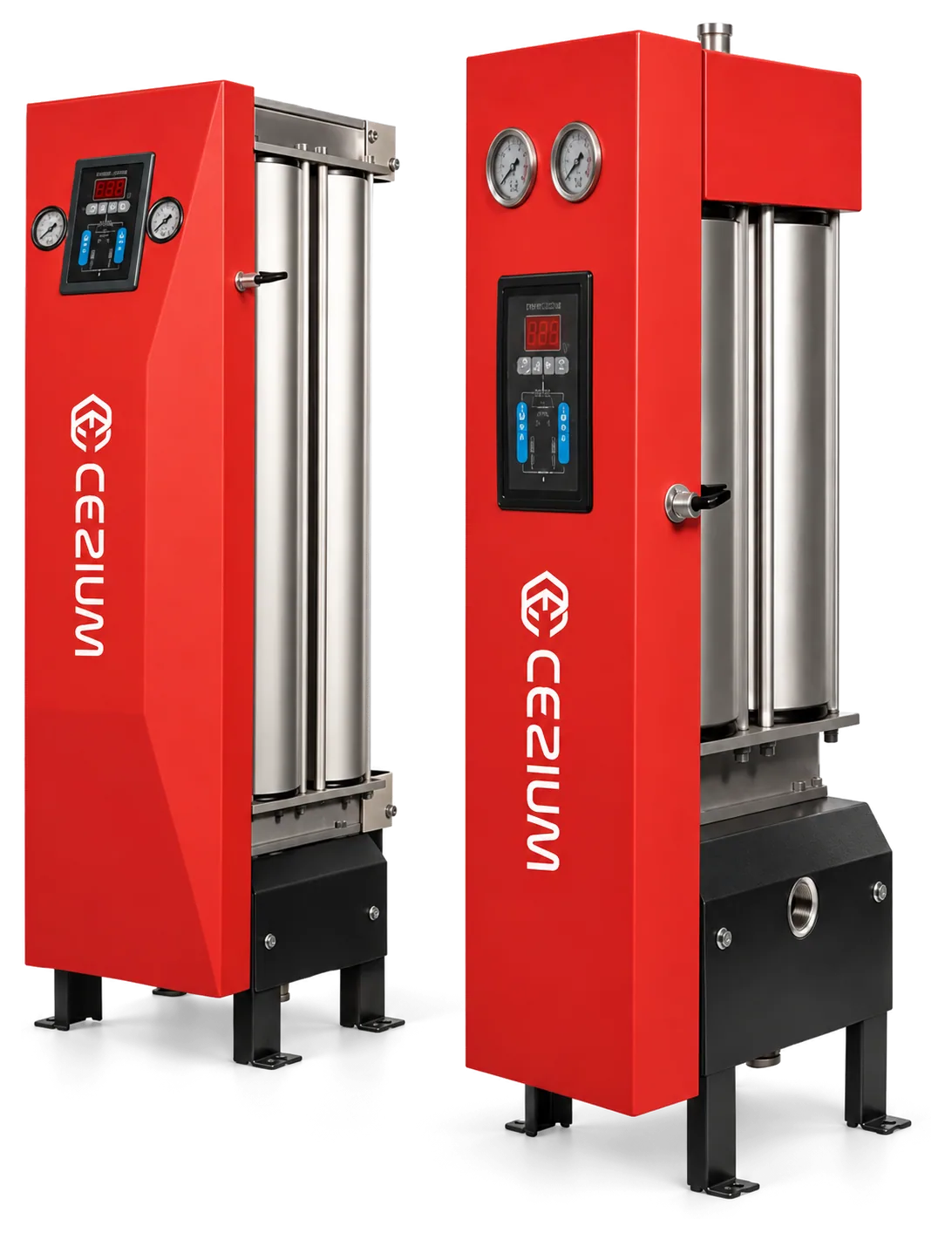
What is a heatless adsorption dryer?
Two columns filled with desiccant work in turn: one dries the air while the other regenerates with a small share of the dry air, 6% at most. Dew point of −40 °C: the air no longer condenses, even outdoors in winter.
Swipe to see the whole drawing
Made for
- Outdoor networks exposed to frost
- Pharmaceuticals, electronics, processes that fear moisture
- An isolated point of use as well as a central station
Not made for
- A large flow in continuous duty: the heated version uses less airHeated adsorption dryer
- An ordinary indoor workshopRefrigerated dryer (air)
| Reference | m³/min | Pressures | Dew point | Outlet | L × W × H (mm) | Weight |
|---|---|---|---|---|---|---|
| CZ-ST050 | 0.5 | 4.5-10 | −40 °C | G1/2" | 388 × 300 × 920 | 34 kg |
| CZ-ST080 | 0.8 | 4.5-10 | −40 °C | G1/2" | 388 × 300 × 1110 | 40 kg |
| CZ-ST100 | 1 | 4.5-10 | −40 °C | G1/2" | 388 × 300 × 1280 | 46 kg |
| CZ-MAD-1 | 1.5 | 12-16 | −40 °C | DN20 | 346 × 255 × 675 | 25 kg |
| CZ-ST150 | 1.5 | 4.5-10 | −40 °C | G1/2" | 388 × 300 × 1480 | 54 kg |
| CZ-MT156 | 1.56 | 4.5-10 | −40 °C | G1" | 590 × 300 × 1150 | 72 kg |
| CZ-MT246 | 2.46 | 4.5-10 | −40 °C | G1" | 600 × 300 × 1310 | 85 kg |
| CZ-MAD-2 | 2.5 | 12-16 | −40 °C | DN20 | 355 × 255 × 1010 | 35 kg |
| CZ-MAD-3 | 3.8 | 12-16 | −40 °C | DN20 | 355 × 255 × 1254 | 45 kg |
| CZ-MT426 | 4.26 | 4.5-10 | −40 °C | G1" | 720 × 300 × 1310 | 125 kg |
| CZ-MAD-5 | 5 | 12-16 | −40 °C | DN25 | 452 × 314 × 970 | 65 kg |
| CZ-MXW-0696 | 6.96 | 4.5-10 | −40 °C | G1-1/2" | 740 × 260 × 1750 | 178 kg |
| CZ-MAD-7 | 7.5 | 12-16 | −40 °C | DN40 | 500 × 320 × 1230 | 80 kg |
| CZ-MXW-0875 | 8.75 | 4.5-10 | −40 °C | G1-1/2" | 865 × 260 × 1750 | 216 kg |
| CZ-MXW-1063 | 10.63 | 4.5-10 | −40 °C | G2" | 990 × 260 × 1750 | 254 kg |
| CZ-MAD-10 | 11 | 12-16 | −40 °C | DN40 | 703 × 385 × 1294 | 115 kg |
| CZ-MXW-1276 | 12.76 | 4.5-10 | −40 °C | G2" | 1115 × 260 × 1750 | 272 kg |
| CZ-MXW-1428 | 14.28 | 4.5-10 | −40 °C | G2" | 1240 × 260 × 1750 | 310 kg |
| CZ-MXW-1796 | 17.96 | 4.5-10 | −40 °C | G2-1/2" | 1490 × 260 × 1750 | 386 kg |
| CZ-MXW-2088 | 20.88 | 4.5-10 | −40 °C | G2-1/2" | 1615 × 260 × 1750 | 462 kg |
| CZ-MXW-2465 | 24.65 | 4.5-10 | −40 °C | G2-1/2" | 1130 × 520 × 1750 | 560 kg |
| CZ-MXW-2853 | 28.53 | 4.5-10 | −40 °C | G3" | 1255 × 520 × 1750 | 636 kg |
| CZ-MXW-3462 | 34.62 | 4.5-10 | −40 °C | G3" | 1380 × 520 × 1750 | 714 kg |
| CZ-MXW-3836 | 38.36 | 4.5-10 | −40 °C | G3" | 1505 × 520 × 1750 | 792 kg |
| CZ-MXW-4258 | 42.58 | 4.5-10 | −40 °C | DN100 | 1630 × 520 × 1750 | 870 kg |
| CZ-MXW-4680 | 46.8 | 4.5-10 | −40 °C | DN100 | 1755 × 520 × 1750 | 948 kg |
| CZ-MXW-5100 | 51 | 4.5-10 | −40 °C | DN100 | 1880 × 520 × 1750 | 1,026 kg |
| CZ-MXW-5650 | 56.5 | 4.5-10 | −40 °C | DN100 | 1530 × 1340 × 1910 | 1,258 kg |
| CZ-MXW-6580 | 65.8 | 4.5-10 | −40 °C | DN125 | 1655 × 1340 × 1910 | 1,398 kg |
| CZ-MXW-7350 | 73.5 | 4.5-10 | −40 °C | DN125 | 1780 × 1340 × 1910 | 1,528 kg |
| CZ-MXW-8300 | 83 | 4.5-10 | −40 °C | DN125 | 1905 × 1340 × 1910 | 1,678 kg |
Flows, pressures, noise levels and dimensions recorded model by model on the catalogue sheets.
Two desiccant towers alternating: one dries the air while the other regenerates with part of the dried air. Dew point -40 °C, from 0.5 to 83 m³/min: class 2 for water, for outdoor networks and processes that fear moisture.
Regeneration consumes compressed air, hence energy: above a few tens of m³/min, the heated version of the neighbouring family consumes less air.
An adsorption dryer does not cool the air: it takes its water. Two columns filled with molecular sieve work alternately: one dries the air passing through it while the other regenerates.
With no heat input, regeneration uses a fraction of the already dried air, expanded to atmospheric pressure: it sweeps the saturated bed and carries the water outside. This purge costs up to 6% of the flow, and that is the price of the dew point.
The result is a pressure dew point of -40 °C, i.e. class 2 for water within the meaning of ISO 8573-1: water no longer forms, even on a network that runs outdoors in winter.
From 0.5 to 83 m³/min, from 4 to 16 bar depending on the model. The most compact units dry an isolated point of use; the modular units go up to 83 m³/min. On a machine running continuously, the heated version uses less air for the same result.
Dew point -40 °C
Class 2 for water: the network can run outdoors, the air will not condense.
Purge ≤ 6%
The share of the flow devoted to regeneration. It is the main expense of this type of dryer, and it should be compared before purchase.
Replaceable modules
Independent sealed cartridges: a module is changed without removing the whole column or emptying the desiccant.
Pressure drop ≤ 0.2 bar
What the dryer takes from the network. Every tenth of a bar lost has to be made up on the compressor pressure, and therefore on its consumption.
Worth reading on this technology
Refrigerant dryer vs adsorption dryer: when should you switch to adsorption?
A refrigerant dryer covers most industrial applications with a +3 °C pressure dew point. Adsorption goes down to −40 or −70 °C but consumes compressed air. When should you switch?
ISO 8573-1: the complete guide to compressed air quality classes
ISO 8573-1 grades compressed air quality against three criteria, particles, water and oil, each on its own scale starting at Class 0. Which class suits which application? Full table and examples.