
Refrigerated dryer (air)
Air-cooled refrigerated dryer - +2 to +10 °C dew point, two series side by side. From 0.7 to 110 m³/min.
30 models in the catalogue, flow 0.7 - 110 m³/min, pressure 2 - 16 bar.
How it works ↓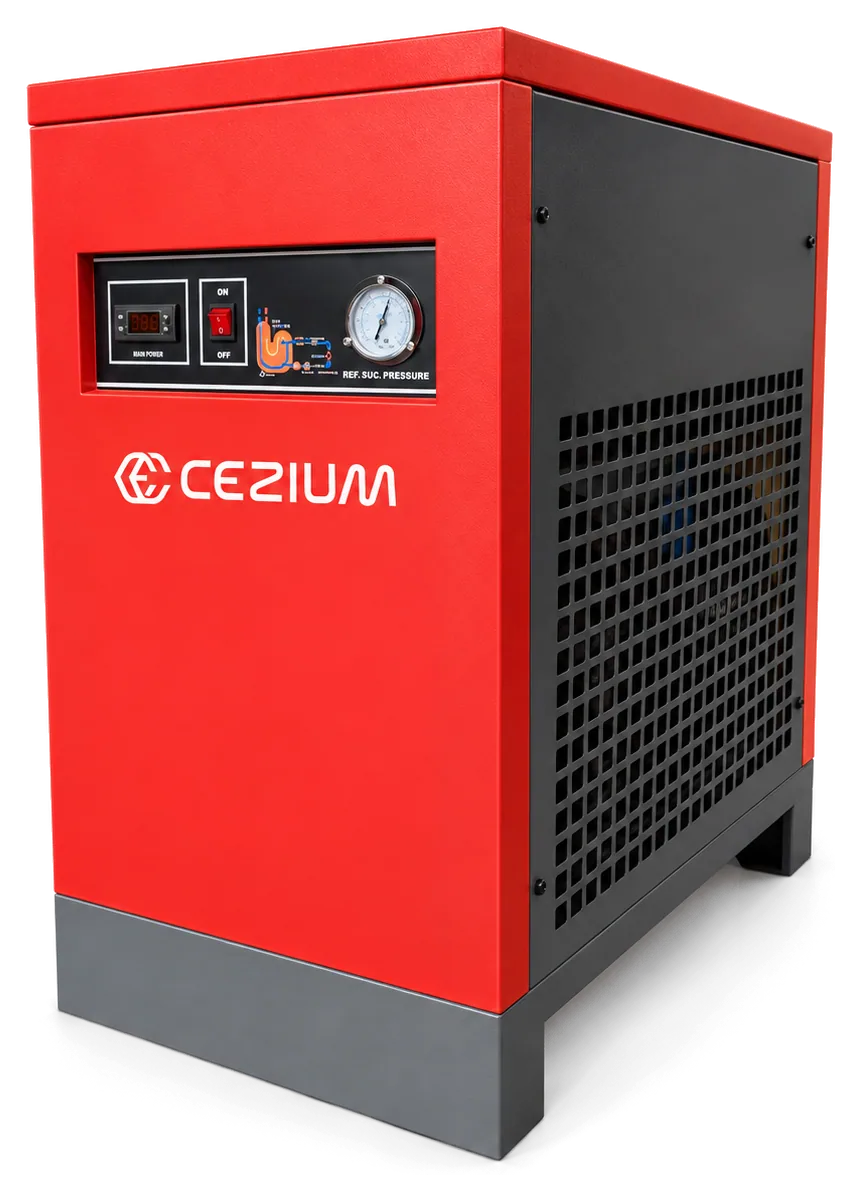
What is a refrigerated dryer?
It cools the compressed air through a refrigeration circuit: the water vapour condenses, the dryer drains it, then the air warms up again before leaving. Dew point of +2 to +10 °C depending on the model: the indoor network stays dry. It is the dryer of most workshops.
Swipe to see the whole drawing
Made for
- Workshops and general industry
- An indoor network, safe from frost
- Air for tools, automation and everyday blowing
Not made for
- A network that runs outdoors in winter, or very dry airHeatless adsorption dryer
- Air that reaches the dryer hotHigh-temp refrigerated dryer
Two series side by side: CZ-DM and CZ-OFD. Compare flow, footprint and weight row by row; the quote prices both.
| Reference | HP | m³/min | Pressures | Dew point | Outlet | L × W × H (mm) | Weight |
|---|---|---|---|---|---|---|---|
| CZ-DM007NF | 1 | 0.7 | 6-10 | +2 à +10 °C | Rp1 | 630 × 375 × 670 | 50 kg |
| CZ-OFD-1 | 1.2 | 2-16 | +2 à +10 °C | DN20 | 480 × 380 × 665 | 34 kg | |
| CZ-DM015NF | 1 | 1.5 | 6-10 | +2 à +10 °C | Rp1 | 650 × 400 × 690 | 58 kg |
| CZ-OFD-2 | 2.4 | 2-16 | +2 à +10 °C | DN20 | 520 × 410 × 725 | 42 kg | |
| CZ-DM026NF | 1 | 2.6 | 6-10 | +2 à +10 °C | Rp1 | 750 × 450 × 730 | 75 kg |
| CZ-OFD-3 | 3.6 | 2-16 | +2 à +10 °C | DN25 | 640 × 520 × 850 | 50 kg | |
| CZ-DM040NF | 1 | 4 | 6-10 | +2 à +10 °C | Rp1-1/2 | 800 × 450 × 800 | 95 kg |
| CZ-DM065NF | 2 | 6.5 | 6-10 | +2 à +10 °C | Rp1-1/2 | 950 × 500 × 880 | 115 kg |
| CZ-OFD-6 | 6.5 | 2-16 | +2 à +10 °C | DN40 | 700 × 540 × 950 | 63 kg | |
| CZ-DM085NF | 2 | 8.5 | 6-10 | +2 à +10 °C | Rp2 | 1050 × 500 × 950 | 130 kg |
| CZ-OFD-8 | 8.5 | 2-16 | +2 à +10 °C | DN50 | 770 × 590 × 990 | 88 kg | |
| CZ-DM110NF | 3 | 11 | 6-10 | +2 à +10 °C | Rp2 | 1180 × 630 × 1050 | 165 kg |
| CZ-OFD-10 | 11 | 2-16 | +2 à +10 °C | DN50 | 770 × 590 × 990 | 85 kg | |
| CZ-OFD-13 | 13.5 | 2-16 | +2 à +10 °C | DN50 | 800 × 610 × 1030 | 94 kg | |
| CZ-DM138NF | 4 | 13.8 | 6-10 | +2 à +10 °C | Rp2 | 1180 × 670 × 1050 | 215 kg |
| CZ-DM150NF | 4 | 17 | 6-10 | +2 à +10 °C | DN65 | 1240 × 670 × 1188 | 265 kg |
| CZ-OFD-15 | 17 | 2-16 | +2 à +10 °C | DN50 | 1000 × 850 × 1100 | 180 kg | |
| CZ-DM200NF | 5 | 23 | 6-10 | +2 à +10 °C | DN80 | 1420 × 790 × 1340 | 320 kg |
| CZ-OFD-20 | 23 | 2-16 | +2 à +10 °C | DN65 | 1100 × 900 × 1160 | 210 kg | |
| CZ-DM250NF | 6 | 27 | 6-10 | +2 à +10 °C | DN80 | 1650 × 820 × 1370 | 360 kg |
| CZ-OFD-25 | 27 | 2-16 | +2 à +10 °C | DN80 | 1215 × 950 × 1230 | 350 kg | |
| CZ-DM300NF | 8 | 35 | 6-10 | +2 à +10 °C | DN80 | 1650 × 820 × 1370 | 420 kg |
| CZ-OFD-30 | 35 | 2-16 | +2 à +10 °C | DN80 | 1300 × 1000 × 1480 | 420 kg | |
| CZ-DM400NF | 10 | 45 | 6-10 | +2 à +10 °C | DN100 | 1850 × 920 × 1500 | 580 kg |
| CZ-OFD-40 | 45 | 2-16 | +2 à +10 °C | DN100 | 1575 × 1100 × 1640 | 550 kg | |
| CZ-DM500NF | 12 | 55 | 6-10 | +2 à +10 °C | DN125 | 1980 × 930 × 1800 | 678 kg |
| CZ-OFD-50 | 55 | 2-16 | +2 à +10 °C | DN100 | 1630 × 1150 × 1760 | 680 kg | |
| CZ-OFD-60 | 65 | 2-16 | +2 à +10 °C | DN125 | 1650 × 1200 × 1700 | 780 kg | |
| CZ-OFD-80 | 90 | 2-16 | +2 à +10 °C | DN125 | 1850 × 1350 × 1850 | 920 kg | |
| CZ-OFD-100 | 110 | 2-16 | +2 à +10 °C | DN150 | 2485 × 1500 × 1960 | 1,150 kg |
Flows, pressures, noise levels and dimensions recorded model by model on the catalogue sheets.
The air-cooled refrigerated dryer brings compressed air down to a +2 to +10 °C dew point: water condenses, the dryer drains it, and the indoor network stays dry. From 0.7 to 110 m³/min, it is the dryer of most workshops.
It suits neither a network that runs outdoors in winter, nor a class 2 or class 1 requirement for water: there, adsorption is required. For hot inlet air or a hot room, see the high-temperature version.
A refrigerated dryer does not remove water, it forces the air to release it. The air enters hot and saturated, and passes through an exchanger that brings it down to a few degrees above zero: the vapour it can no longer hold condenses into droplets, which a gas/liquid separator removes and a drain discharges.
The air leaves cold, and it is reheated by the incoming air in a second exchanger. Two effects: the downstream pipework does not sweat, and the dryer recovers part of the energy instead of throwing it away.
The pressure dew point obtained is +2 to +10 °C depending on the model and the load: the air no longer condenses as long as it does not fall below that temperature. It is the right choice in a heated workshop, and the wrong one for a network that runs outdoors.
The dryer of the great majority of workshops: from 0.7 to 110 m³/min, air-cooled, from 2 to 16 bar depending on the series. Above 110 m³/min, or in a room too hot to reject the heat through the air, the water-cooled version takes over. When the air arrives hot, it is the high-temperature version.
Dew point +2 to +10 °C
Class 4 to 6 for water within the meaning of ISO 8573-1: enough to protect an indoor network, tools and automation included.
Counter-flow exchanger
The dry air leaves by warming the incoming air: no condensation on the downstream pipework, and part of the energy recovered.
Separation above 99%
Gas/liquid separator independent of the exchanger: the droplets formed really leave the network instead of being re-entrained.
Refrigerant specified in the quotation
Several refrigerants are possible depending on the model; the one selected appears in the quotation, not in a brochure.
Worth reading on this technology
Refrigerant dryer vs adsorption dryer: when should you switch to adsorption?
A refrigerant dryer covers most industrial applications with a +3 °C pressure dew point. Adsorption goes down to −40 or −70 °C but consumes compressed air. When should you switch?
ISO 8573-1: the complete guide to compressed air quality classes
ISO 8573-1 grades compressed air quality against three criteria, particles, water and oil, each on its own scale starting at Class 0. Which class suits which application? Full table and examples.