
High-temp refrigerated dryer
High-temperature air-cooled refrigerated dryer - inlet up to 80 °C, designed for hot climates and air straight from the compressor. 1 to 65 Nm³/min.
15 models in the catalogue, flow 1 - 65 m³/min, pressure 6 - 10 bar.
How it works ↓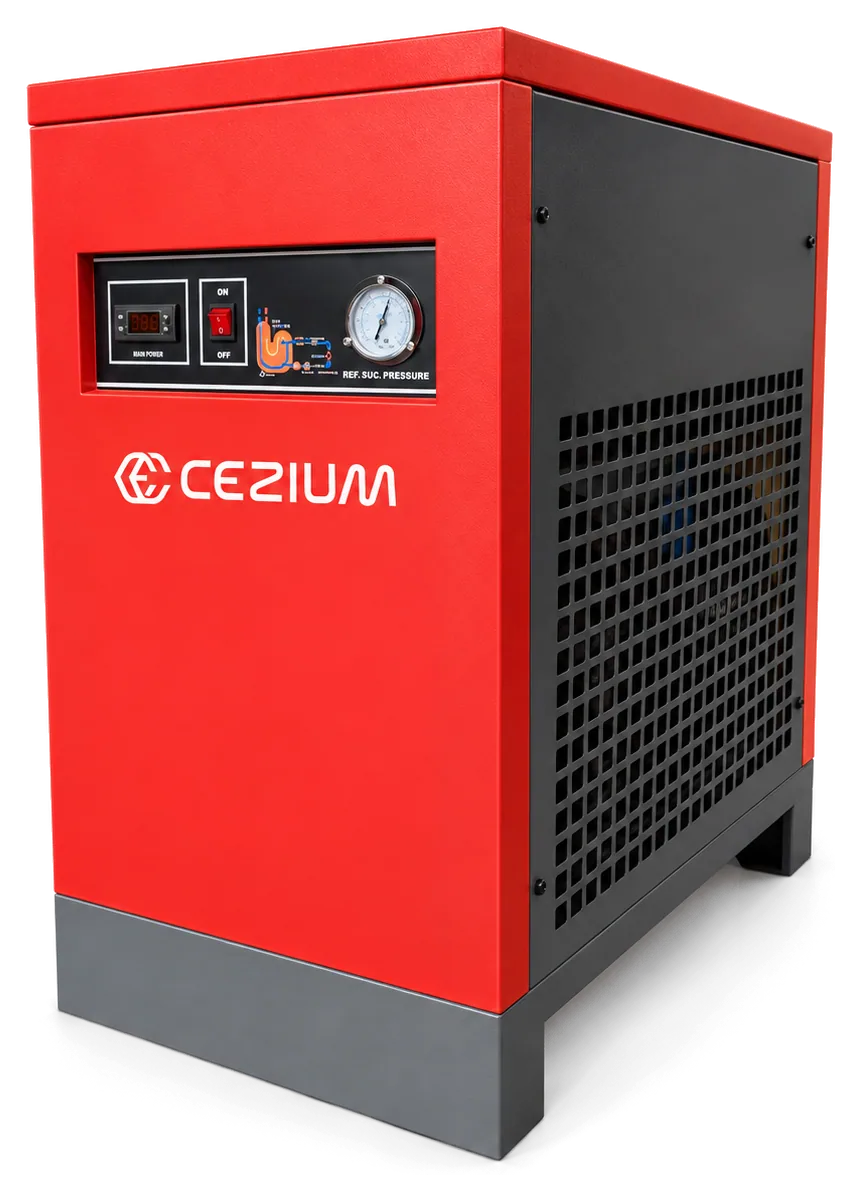
What is a high-temperature refrigerated dryer?
The same refrigerated dryer, designed for inlet air up to 80 °C and a hot room: straight from the compressor with no aftercooler, hot climates, poorly ventilated plant rooms.
Swipe to see the whole drawing
Made for
- A hot or poorly ventilated plant room
- Air that reaches the dryer with no aftercooler
- Hot climates
Not made for
- A temperate room and normal inlet airRefrigerated dryer (air)
| Reference | HP | m³/min | Pressures | Dew point | Outlet | L × W × H (mm) | Weight |
|---|---|---|---|---|---|---|---|
| CZ-DM010GF | 1 | 1 | 6-10 | +2 à +10 °C | Rp1 | 720 × 375 × 670 | 50 kg |
| CZ-DM015GF | 1 | 1.5 | 6-10 | +2 à +10 °C | Rp1 | 750 × 400 × 700 | 60 kg |
| CZ-DM026GF | 1 | 2.6 | 6-10 | +2 à +10 °C | Rp1 | 800 × 450 × 730 | 80 kg |
| CZ-DM040GF | 1 | 4 | 6-10 | +2 à +10 °C | Rp1-1/2 | 850 × 475 × 800 | 105 kg |
| CZ-DM065GF | 2 | 6.5 | 6-10 | +2 à +10 °C | Rp1-1/2 | 950 × 500 × 880 | 136 kg |
| CZ-DM085GF | 2 | 8.5 | 6-10 | +2 à +10 °C | Rp2 | 1060 × 560 × 983 | 165 kg |
| CZ-DM110GF | 3 | 11 | 6-10 | +2 à +10 °C | Rp2 | 1180 × 630 × 1092 | 195 kg |
| CZ-DM138GF | 4 | 13.8 | 6-10 | +2 à +10 °C | Rp2 | 1180 × 630 × 1086 | 255 kg |
| CZ-DM150GF | 4 | 17 | 6-10 | +2 à +10 °C | DN65 | 1240 × 670 × 1188 | 300 kg |
| CZ-DM200GF | 5 | 23 | 6-10 | +2 à +10 °C | DN80 | 1420 × 790 × 1340 | 385 kg |
| CZ-DM250GF | 6 | 27 | 6-10 | +2 à +10 °C | DN80 | 1650 × 820 × 1370 | 400 kg |
| CZ-DM300GF | 8 | 35 | 6-10 | +2 à +10 °C | DN80 | 1650 × 820 × 1370 | 550 kg |
| CZ-DM400GF | 10 | 45 | 6-10 | +2 à +10 °C | DN100 | 1850 × 920 × 1550 | 630 kg |
| CZ-DM500GF | 12 | 55 | 6-10 | +2 à +10 °C | DN125 | 1980 × 930 × 1826 | 680 kg |
| CZ-DM600GF | 15 | 65 | 6-10 | +2 à +10 °C | DN125 | 2080 × 930 × 1834 | 720 kg |
Flows, pressures, noise levels and dimensions recorded model by model on the catalogue sheets.
The same refrigerated dryer, designed for inlet air up to 80 °C and a hot room: direct compressor outlet without aftercooler, hot climate, poorly ventilated machine room. From 1 to 65 m³/min.
In a temperate room with normal inlet air, the standard version reaches the same dew point for less.
Same principle as the standard refrigerated dryer, but sized to receive air that arrives hot, up to 80 °C at the inlet.
A standard dryer fed with air that is too hot does not hold its dew point: the refrigeration unit spends its time cooling air instead of condensing water, and the moisture passes through. The high-temperature version places a first exchanger that absorbs this heat ahead of the refrigeration circuit.
It is the answer to three situations: a compressor without an aftercooler, a very hot compressor room, or a summer that exceeds what the standard machine accepts.
Fifteen models from 1 to 65 m³/min, air-cooled, inlet up to 80 °C, dew point +2 to +10 °C. To be chosen when the air temperature measured at the dryer inlet, and not that of the room, exceeds the range of the standard model.
Inlet up to 80 °C
The hot air is absorbed ahead of the refrigeration circuit: the dew point holds, where a standard dryer lets moisture through.
From 1 to 65 m³/min
Fifteen air-cooled sizes, from workshop to air station, with no water circuit to provide.
Dew point +2 to +10 °C
The same result as a standard dryer, obtained in conditions where the latter would not obtain it.
Simple diagnosis
If the air enters above the range of the standard model, no setting will recover the dew point: it is the machine that has to change.
Worth reading on this technology
Refrigerant dryer vs adsorption dryer: when should you switch to adsorption?
A refrigerant dryer covers most industrial applications with a +3 °C pressure dew point. Adsorption goes down to −40 or −70 °C but consumes compressed air. When should you switch?
ISO 8573-1: the complete guide to compressed air quality classes
ISO 8573-1 grades compressed air quality against three criteria, particles, water and oil, each on its own scale starting at Class 0. Which class suits which application? Full table and examples.