
Condensate drain
Automatic condensate drains - timed electronic, zero air-loss or float-type. Remove water at the network's low points without wasting compressed air.
14 models in the catalogue, flow 25 - 350 m³/min, pressure 0.8 - 50 bar.
How it works ↓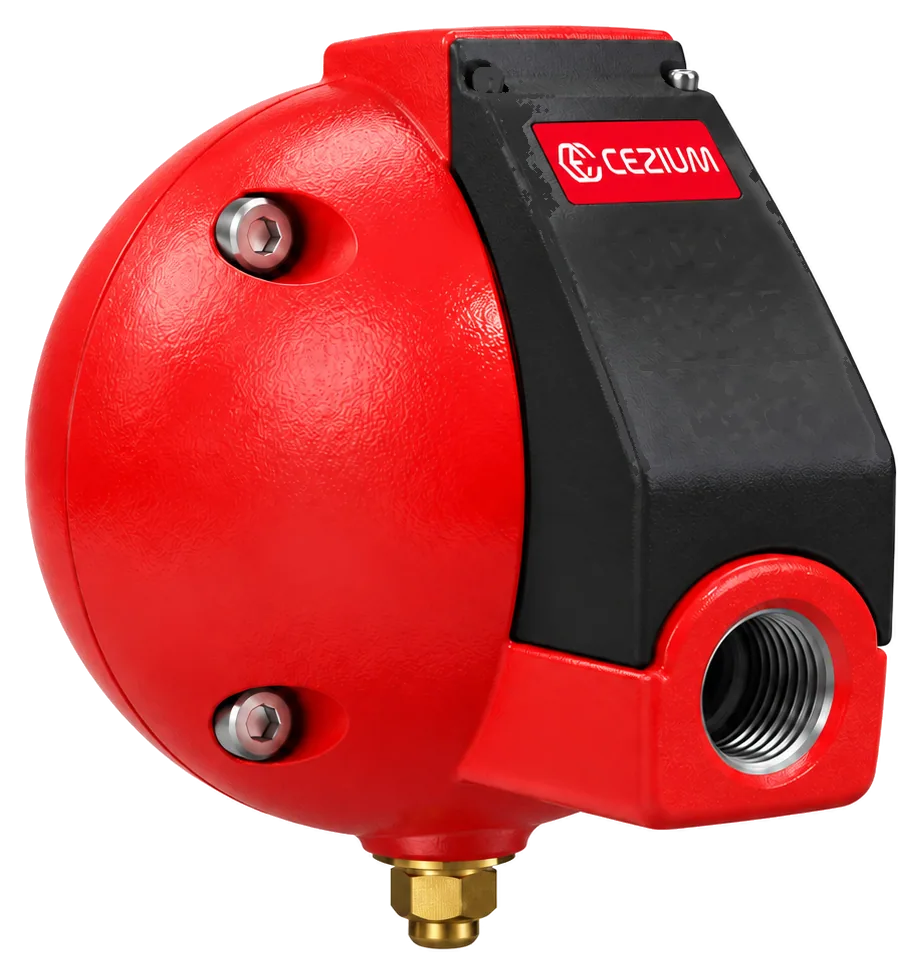
What is a condensate drain?
The drain removes water from the low points of the network, the receiver, the dryer and the filters. With level sensing, it releases no compressed air; timed, it is simpler but loses some at every cycle. A low point without a drain ends up sending the water back into the network.
Made for
- Every low point: receiver, dryer, filters
- Replacing a timed drain that leaks all day long
- Networks up to 50 bar
Not made for
- Treating the oil in the condensate before dischargeOil-water separator
| Reference | m³/min | Pressures | Outlet | L × W × H (mm) | Weight |
|---|---|---|---|---|---|
| CZ-LM25 | 25 | 0.8-16 | G1/2" | 162 × 84 × 169 | 1 kg |
| CZ-LMH40 | 40 | 0.8-50 | R1/2" | 183 × 110 × 153 | 3 kg |
| CZ-LM45 | 45 | 0.8-16 | G1/2" | 183 × 90 × 186 | 2 kg |
| CZ-LM85 | 85 | 0.8-16 | G1/2" | 228 × 90 × 186 | 2 kg |
| CZ-LM150 | 150 | 0.8-16 | G1/2" | 263 × 90 × 186 | 4 kg |
| CZ-LM350 | 350 | 0.8-16 | G1/2" | 360 × 90 × 186 | 5 kg |
| CZ-DRAIN-HAD20A | 16 | ZG1/2" | |||
| CZ-DRAIN-SRPT-16B | 16 | ZG1/2" | |||
| CZ-DRAIN-SRPT-40B | 40 | ZG1/2" | |||
| CZ-DRAIN-SWD20B | 16 | ZG1/2" | |||
| CZ-DRAIN-SWD30B | 16 | ZG1/2" | |||
| CZ-DRAIN-SWD40B | 16 | ZG1/2" | |||
| CZ-DRAIN-WK-10 | 16 | ZG1/2" | |||
| CZ-DRAIN-WK-58 | 16 | ZG3/8" |
Flows, pressures, noise levels and dimensions recorded model by model on the catalogue sheets.
Drains evacuate water at the low points of the network, the receiver, the dryer, the filters: electronic with level sensing, with no air loss, or timed. A low point without a drain ends up sending water back into the network.
The level-sensing drain releases no compressed air at each cycle; the timed one is simpler and loses a little.
Every low point of a compressed air network collects water: compressor outlet, air receiver, cooler, filter, dryer. The drain removes it without anyone having to think about it, and it is what is not done by hand that protects the network.
Three principles, and they are not equal. The float drain opens when the liquid lifts a ball: simple, no electricity, sensitive to fouling. The timed drain opens for a set duration, at a set interval, whether or not there is condensate: it releases air at every opening. The capacitive level-sensing drain opens only when liquid is present and closes as soon as it has gone: it does not lose air.
The catalogue runs from 0.8 to 50 bar. Above 16 bar, the high-pressure version in a 304 stainless steel housing is the only one that belongs there: a standard drain is outside its range.
One drain per low point, without exception. A timed drain set too wide releases air continuously, day and night: it is a leak nobody looks for, because it is intended. Fourteen references, float, timed or capacitive, from 0.8 to 50 bar.
Zero air loss
Capacitive level sensing only opens when liquid is present: the compressed air stays in the network, unlike with a timed drain.
Contactless sensor
The capacitive sensor does not dip into the condensate: nothing fouls, nothing seizes, unlike a mechanical float.
From 0.8 to 50 bar
High-pressure version in a 304 stainless steel housing for networks above 16 bar, where a standard drain is no longer within its range.
It reports itself
The electronic models count their openings and raise an alarm when discharge fails, instead of letting the network fill up.
Worth reading on this technology
ISO 8573-1: the complete guide to compressed air quality classes
ISO 8573-1 grades compressed air quality against three criteria, particles, water and oil, each on its own scale starting at Class 0. Which class suits which application? Full table and examples.
Refrigerant dryer vs adsorption dryer: when should you switch to adsorption?
A refrigerant dryer covers most industrial applications with a +3 °C pressure dew point. Adsorption goes down to −40 or −70 °C but consumes compressed air. When should you switch?