
C/T/A filters
Particle, coalescing and activated carbon line filters for large flows, 400 m³/min at 16 bar: filtration for site air stations.
5 models in the catalogue, flow 400 m³/min, pressure 16 bar.
How it works ↓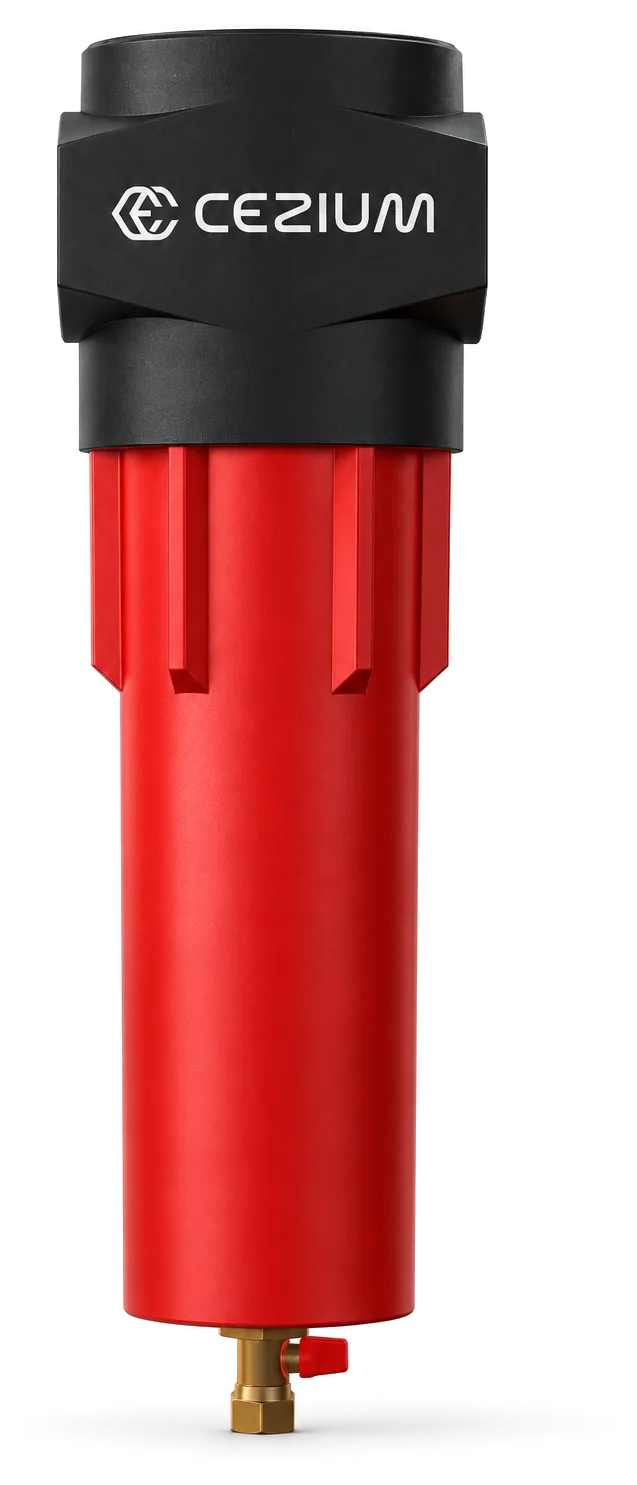
What is a C, T or A line filter?
Compressed air filtration works in stages, from coarse to fine: particle filters, coalescing filters that capture oil and water aerosols, activated carbon for vapours. These models handle the large flows of site air stations, after the dryer and before the network.
Made for
- Large-flow site air stations
- Protecting tools, automation and sensitive processes
- Reaching the targeted ISO 8573-1 class
Not made for
- An ordinary workshop flowFilter elements
| Reference | m³/min | Pressures | Purity |
|---|---|---|---|
| CZ-FILTER-A | 400 | 16 | ≤ 0,01 ppm |
| CZ-FILTER-AA | 400 | 16 | ≤ 0,001 ppm |
| CZ-FILTER-C | 400 | 16 | ≤ 5 ppm |
| CZ-FILTER-H | 400 | 16 | ≤ 0,003 ppm |
| CZ-FILTER-T | 400 | 16 | ≤ 1 ppm |
Flows, pressures, noise levels and dimensions recorded model by model on the catalogue sheets.
Line filters for large flows, 400 m³/min, at 16 bar: the filtration of site air stations, placed after the dryer and before the network.
For usual workshop flows, the standard filter elements cover 1.5 to 40 m³/min.
Compressed air filtration is organised in several complementary stages, designated by the standard: particulate filters (hold back solid dust), coalescing filters (capture oil and water aerosols by making them merge into droplets) and activated carbon filters (adsorb oil vapours and odours).
Placed in cascade, from coarsest to finest, these filters progressively refine the air quality up to the level required by the process. They are the last line of defence before the point of use.
Any compressed air network that requires controlled quality: protection of tools and automation, sensitive processes, final stage before a critical point of use. The filtration level is chosen according to the target ISO 8573-1 quality class.
Cascade filtration
Particulate → coalescing → activated carbon stages: each filter refines what the previous one let through, up to the target quality.
Oil and aerosol removal
Coalescing filters capture fine droplets of water and oil; activated carbon adsorbs residual vapours and odours.
Low pressure drop
Filter media with high retention capacity and low resistance: air quality without penalising network pressure.
Network protection
The last barrier before the point of use: protects tools, automation and products, and extends the service life of downstream equipment.
Worth reading on this technology
ISO 8573-1: the complete guide to compressed air quality classes
ISO 8573-1 grades compressed air quality against three criteria, particles, water and oil, each on its own scale starting at Class 0. Which class suits which application? Full table and examples.
Refrigerant dryer vs adsorption dryer: when should you switch to adsorption?
A refrigerant dryer covers most industrial applications with a +3 °C pressure dew point. Adsorption goes down to −40 or −70 °C but consumes compressed air. When should you switch?