
Membrane dryer
Membrane air dryer - selective-permeation drying, dew point down to −40 °C, no electricity or consumables. Compact, ideal for point of use and instrumentation.
12 models in the catalogue, flow 0.05 - 3 m³/min, pressure 7 - 16 bar.
How it works ↓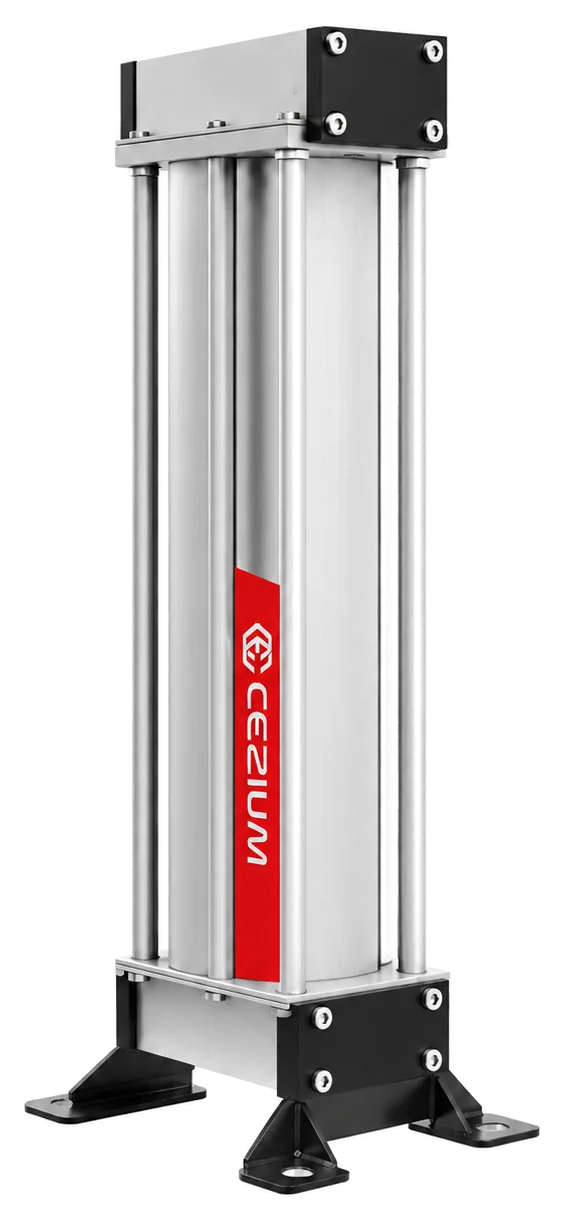
What is a membrane dryer?
Hollow fibres let water vapour through and hold the air back: no electricity, no moving parts, no consumables. It is the dryer for a point of use, a machine or a workstation, down to a −40 °C dew point.
Made for
- Instrumentation, laboratories, pneumatic cabinets
- An isolated machine, or a station without electricity
- Drying at the point of use rather than at the central station
Not made for
- Drying a whole networkRefrigerated dryer (air)
| Reference | m³/min | Pressures | Dew point | Outlet |
|---|---|---|---|---|
| CZ-TM-50 | 0.05 | 7-16 | +15 °C at rated flow, down to −40 °C at reduced flow | ZG1/4" |
| CZ-TM-100 | 0.1 | 7-16 | +15 °C at rated flow, down to −40 °C at reduced flow | ZG1/4" |
| CZ-TM-150 | 0.15 | 7-16 | +15 °C at rated flow, down to −40 °C at reduced flow | ZG1/4" |
| CZ-TM-200 | 0.2 | 7-16 | +15 °C at rated flow, down to −40 °C at reduced flow | ZG1/4" |
| CZ-TM-300 | 0.3 | 7-16 | +15 °C at rated flow, down to −40 °C at reduced flow | ZG1/2" |
| CZ-TM-400 | 0.4 | 7-16 | +15 °C at rated flow, down to −40 °C at reduced flow | ZG1/2" |
| CZ-TM-600 | 0.6 | 7-16 | +15 °C at rated flow, down to −40 °C at reduced flow | ZG1/2" |
| CZ-TM-800 | 0.8 | 7-16 | +15 °C at rated flow, down to −40 °C at reduced flow | ZG1/2" |
| CZ-TM-1050 | 1.05 | 7-16 | +15 °C at rated flow, down to −40 °C at reduced flow | ZG1/2" |
| CZ-TM-1500 | 1.5 | 7-16 | +15 °C at rated flow, down to −40 °C at reduced flow | ZG1/2" |
| CZ-TM-2050 | 2.05 | 7-16 | +15 °C at rated flow, down to −40 °C at reduced flow | ZG1/2" |
| CZ-TM-3000 | 3 | 7-16 | +15 °C at rated flow, down to −40 °C at reduced flow | ZG1" |
Flows, pressures, noise levels and dimensions recorded model by model on the catalogue sheets.
The membrane dryer passes water vapour through hollow fibres, with no electricity, no moving part, no consumable: from 0.05 to 3 m³/min, it is the dryer of an isolated point of use, a machine or a workstation, down to a -40 °C dew point.
To dry a whole network, its flow is not enough: that is the job of the refrigerated or the adsorption dryer.
A membrane dryer cools nothing and regenerates nothing. The air passes through a bundle of hollow fibres whose wall lets water vapour through much faster than the air itself: the moisture leaves through the wall, and the dry air continues on its way.
A fraction of the dry air is diverted to sweep the outside of the fibres and carry this vapour away. That is the price of this drying, and its only consumption: no electricity, no moving parts, no noise, no maintenance other than prefiltration.
Its field is small flows, from 0.05 to 3 m³/min, and isolated points of use. To dry a whole air station, refrigerant or adsorption drying remain the right answers.
Drying at the point of use rather than at the air station: instrumentation, laboratory, pneumatic cabinet, isolated machine, workstation with no electrical supply available. Twelve sizes, from 50 to 3,000 L/min, from 7 to 16 bar.
No electricity
Nothing to connect: the dryer runs on network pressure alone, including where no socket is available.
No moving parts
No refrigeration compressor, no cycle valve, no timer: nothing that wears, nothing to adjust.
Silent
No noise of its own: it can be installed in a laboratory, a measurement room or close to a workstation.
The price is the sweep air
Part of the dry air is used to carry the vapour away. That is why the membrane stays reserved for small flows and points of use.
Worth reading on this technology
Refrigerant dryer vs adsorption dryer: when should you switch to adsorption?
A refrigerant dryer covers most industrial applications with a +3 °C pressure dew point. Adsorption goes down to −40 or −70 °C but consumes compressed air. When should you switch?
ISO 8573-1: the complete guide to compressed air quality classes
ISO 8573-1 grades compressed air quality against three criteria, particles, water and oil, each on its own scale starting at Class 0. Which class suits which application? Full table and examples.