
Water-cooled refrigerated dryer
Water-cooled refrigerated dryer, dew point +2 to +10 °C: drying for large-flow air stations, independent of the room temperature.
15 models in the catalogue, flow 17 - 400 m³/min, pressure 6 - 10 bar.
How it works ↓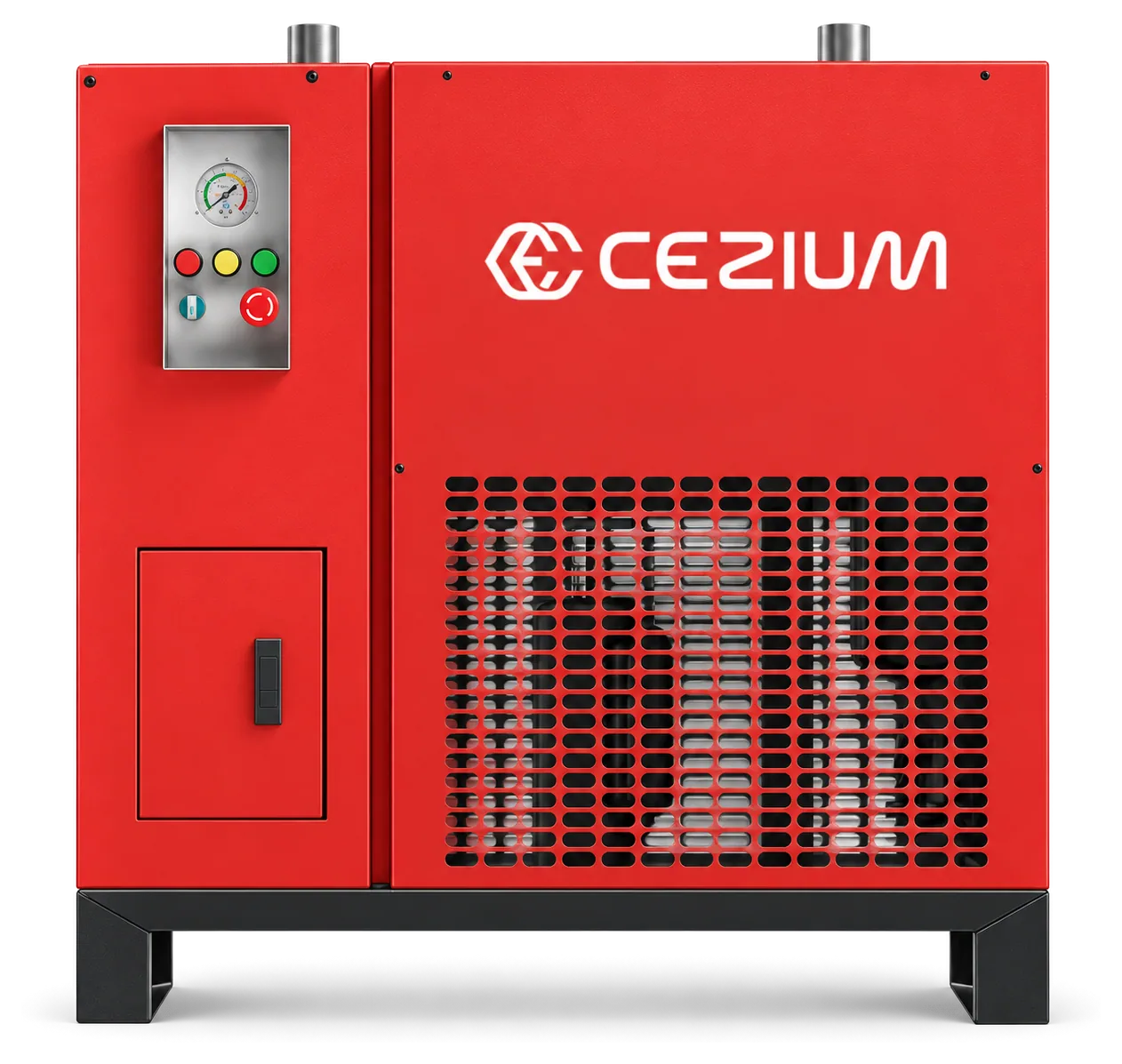
What is a water-cooled refrigerated dryer?
A refrigerated dryer whose condenser is cooled by the site's water rather than by the room air: its performance no longer depends on the room temperature. It is the version for large-flow air stations.
Swipe to see the whole drawing
Made for
- Large-flow air stations
- Closed or hot compressor rooms
- Sites with an industrial water network or a cooling tower
Not made for
- A small flow, or no water availableRefrigerated dryer (air)
| Reference | HP | m³/min | Pressures | Dew point | Outlet | L × W × H (mm) | Weight |
|---|---|---|---|---|---|---|---|
| CZ-DM150NW | 4 | 17 | 6-10 | +2 à +10 °C | DN65 | 1240 × 670 × 1180 | 300 kg |
| CZ-DM200NW | 5 | 23 | 6-10 | +2 à +10 °C | DN80 | 1420 × 790 × 1338 | 385 kg |
| CZ-DM250NW | 6 | 27 | 6-10 | +2 à +10 °C | DN80 | 1650 × 820 × 1370 | 500 kg |
| CZ-DM300NW | 8 | 35 | 6-10 | +2 à +10 °C | DN80 | 1650 × 820 × 1410 | 595 kg |
| CZ-DM400NW | 10 | 45 | 6-10 | +2 à +10 °C | DN100 | 1850 × 920 × 1550 | 660 kg |
| CZ-DM500NW | 12 | 55 | 6-10 | +2 à +10 °C | DN125 | 1980 × 920 × 1670 | 710 kg |
| CZ-DM600NW | 15 | 65 | 6-10 | +2 à +10 °C | DN125 | 2080 × 930 × 1834 | 943 kg |
| CZ-DM800NW | 20 | 85 | 6-10 | +2 à +10 °C | DN125 | 2200 × 1250 × 1850 | 1,450 kg |
| CZ-DM1000NW | 25 | 100 | 6-10 | +2 à +10 °C | DN150 | 2450 × 1350 × 1850 | 2,150 kg |
| CZ-DM1200NW | 30 | 120 | 6-10 | +2 à +10 °C | DN150 | 2450 × 1440 × 1900 | 2,360 kg |
| CZ-DM1500NW | 37 | 150 | 6-10 | +2 à +10 °C | DN200 | 2650 × 1550 × 2193 | 2,550 kg |
| CZ-DM1800NW | 45 | 180 | 6-10 | +2 à +10 °C | DN200 | 2720 × 1650 × 2260 | 3,000 kg |
| CZ-DM2000NW | 50 | 200 | 6-10 | +2 à +10 °C | DN200 | 3450 × 1725 × 2380 | 3,200 kg |
| CZ-DM3000NW | 80 | 300 | 6-10 | +2 à +10 °C | DN250 | 3800 × 1980 × 2580 | 3,860 kg |
| CZ-DM4000NW | 100 | 400 | 6-10 | +2 à +10 °C | DN300 | 4200 × 2150 × 2670 | 4,200 kg |
Flows, pressures, noise levels and dimensions recorded model by model on the catalogue sheets.
The water-cooled refrigerated dryer, from 17 to 400 m³/min: for air stations that already have a water circuit, a stable efficiency whatever the room temperature. It is the large-flow version.
For a flow below 17 m³/min or without water available, the air-cooled version is the normal route.
Same condensation principle, but the heat from the refrigeration unit goes into a water circuit instead of being blown into the room.
Two reasons to choose this version. Flow first: from 17 to 400 m³/min, air cooling would require fans and a volume of air that few plant rooms can supply. The environment next: in a compressor room that is already hot, an air-cooled dryer adds its heat to the heat it is trying to fight.
In exchange, a water circuit is needed: water flow, temperature and quality are part of the sizing, just as the air flow is.
Compressed air stations from 17 to 400 m³/min, closed or already hot compressor rooms, sites with an industrial water network or a cooling tower. Dew point +2 to +10 °C, like the air-cooled versions.
From 17 to 400 m³/min
The range of air stations: fifteen sizes where air cooling can no longer keep up.
The heat leaves the room
It leaves with the water instead of being blown into the compressor room, which stays cooler for all the machines.
Unaffected by room temperature
Performance depends on the water, not on the temperature of the room air: the dew point holds in summer too.
A water circuit to plan for
Water flow, temperature and quality are part of the sizing. Without an available water network, the air-cooled version is the one needed.
Worth reading on this technology
Refrigerant dryer vs adsorption dryer: when should you switch to adsorption?
A refrigerant dryer covers most industrial applications with a +3 °C pressure dew point. Adsorption goes down to −40 or −70 °C but consumes compressed air. When should you switch?
ISO 8573-1: the complete guide to compressed air quality classes
ISO 8573-1 grades compressed air quality against three criteria, particles, water and oil, each on its own scale starting at Class 0. Which class suits which application? Full table and examples.