
Water separator
Cyclonic water/air separator - removes 99% of liquid water before filtration and drying. Two-stage cyclone, to be placed after the compressor, aftercooler or tank.
16 models in the catalogue, flow 1.4 - 65 m³/min, pressure 16 bar.
How it works ↓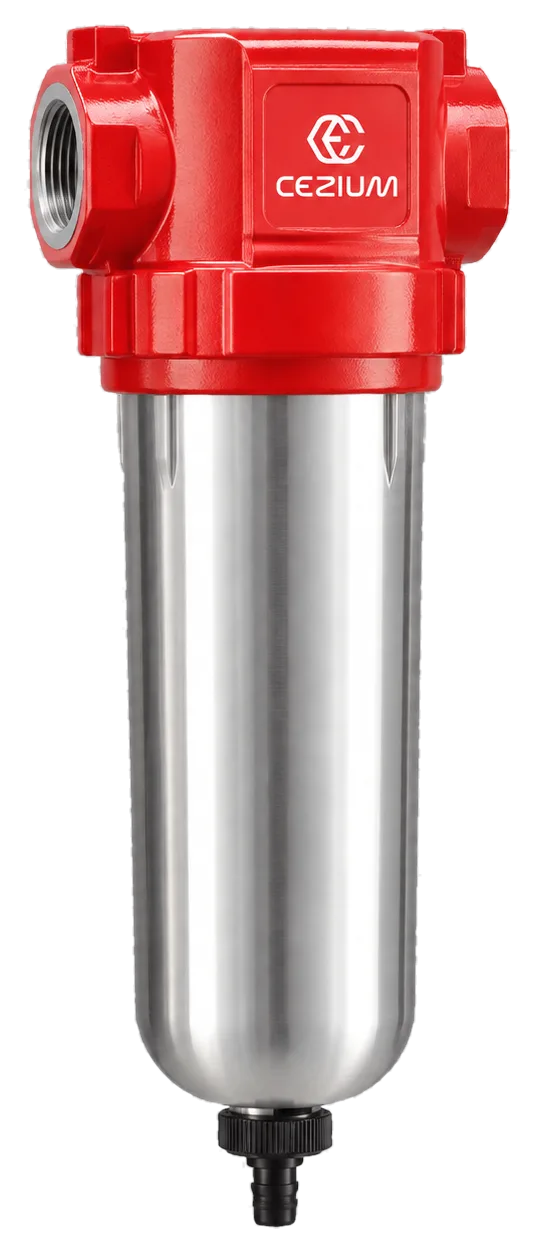
What is a water separator?
A cyclonic separator that removes liquid water by centrifugal force, with no element to change. Placed right after the compressor or the aftercooler, it relieves the dryer and the filters. It removes droplets, not vapour: it does not replace a dryer.
Made for
- Almost every installation: the air leaves hot and saturated
- Protecting the dryer and the filter cartridges
- A network where water reaches the tools
Not made for
- Drying the airRefrigerated dryer (air)
| Reference | m³/min | Pressures | Outlet | L × W × H (mm) | Weight |
|---|---|---|---|---|---|
| CZ-SWS-001 | 1.4 | 16 | ZG1" | 117 × 87 × 294 | 2 kg |
| CZ-SWS-002 | 2.4 | 16 | ZG1" | 117 × 87 × 294 | 2 kg |
| CZ-SWS-003 | 3.8 | 16 | ZG1-1/2" | 134 × 85 × 330 | 3 kg |
| CZ-SWS-006 | 6.5 | 16 | ZG1-1/2" | 134 × 85 × 428 | 4 kg |
| CZ-SWS-008 | 8.5 | 16 | ZG1-1/2" | 134 × 85 × 428 | 5 kg |
| CZ-SWS-010 | 10.7 | 16 | ZG2" | 160 × 108 × 555 | 6 kg |
| CZ-SWS-013 | 13.5 | 16 | ZG2" | 160 × 108 × 555 | 7 kg |
| CZ-SWS-015 | 18 | 16 | ZG2-1/2" | 170 × 115 × 590 | 12 kg |
| CZ-SWS-020 | 25 | 16 | ZG3" | 205 × 180 × 620 | 12 kg |
| CZ-SWS-020F | 25 | 16 | DN80 | 370 × 159 × 1006 | 44 kg |
| CZ-SWS-025 | 28 | 16 | ZG3" | 205 × 180 × 620 | 13 kg |
| CZ-SWS-030 | 35 | 16 | ZG3" | 205 × 180 × 810 | 14 kg |
| CZ-SWS-030F | 35 | 16 | DN100 | 449 × 219 × 1164 | 65 kg |
| CZ-SWS-040F | 45 | 16 | DN100 | 449 × 219 × 1164 | 68 kg |
| CZ-SWS-050F | 55 | 16 | DN125 | 513 × 273 × 1218 | 96 kg |
| CZ-SWS-060F | 65 | 16 | DN125 | 513 × 273 × 1218 | 98 kg |
Flows, pressures, noise levels and dimensions recorded model by model on the catalogue sheets.
The cyclonic separator removes liquid water by centrifugal force, with no element to change: placed right after the compressor or the aftercooler, to relieve the dryer and the filters. From 1.4 to 65 m³/min.
It does not replace a dryer: it removes droplets, not vapour.
A cyclonic separator removes the liquid water that air carries at the compressor outlet. The air enters the body tangentially and starts to spin: the droplets, much heavier than air, are thrown against the wall, run down and leave the network through the drain. The air itself leaves through the centre.
It is placed after the aftercooler or after the air receiver, before the filters and the dryer. At that point the air comes out saturated and a good part of its moisture has already condensed: two-stage cyclonic separation removes 99% of that liquid water, with no media to replace and no pressure drop that rises with fouling.
A separator does not dry the air: it removes water that has already condensed, not water that is still vapour. Dew point is dealt with by a dryer, refrigerant or adsorption, and the separator is there precisely to avoid sending it liquid water.
Any installation whose air comes out hot and saturated, which means almost all of them. It protects the dryer and the filter cartridges, which cost more than it does. Sixteen sizes, from 1.4 to 65 m³/min, connections ZG1" to DN125, 16 bar. On a network where water reaches the tools, it is the first component to check.
99% of liquid water
Two-stage cyclonic separation: water that has already condensed leaves the network before filtration and drying.
No consumables
No cartridge to replace: pressure drop does not rise over time, and maintenance is limited to checking the drain.
Protects what is expensive
Liquid water saturates a coalescing filter in a few days and passes through a refrigerated dryer untreated. The separator removes it beforehand.
From 1.4 to 65 m³/min
Sixteen sizes, threaded connections ZG1" to ZG3" then DN80 to DN125 flanges, 16 bar working pressure.
Worth reading on this technology
ISO 8573-1: the complete guide to compressed air quality classes
ISO 8573-1 grades compressed air quality against three criteria, particles, water and oil, each on its own scale starting at Class 0. Which class suits which application? Full table and examples.
Refrigerant dryer vs adsorption dryer: when should you switch to adsorption?
A refrigerant dryer covers most industrial applications with a +3 °C pressure dew point. Adsorption goes down to −40 or −70 °C but consumes compressed air. When should you switch?