
VSD rotary vane
Inverter-driven rotary vane compressor - speed adapts to demand, savings under variable load and stable pressure. 15 to 55 kW, 72-76 dB(A).
7 models in the catalogue, flow 2.7 - 11 m³/min, pressure 8 - 13 bar, noise level 72 - 76 dB(A).
How it works ↓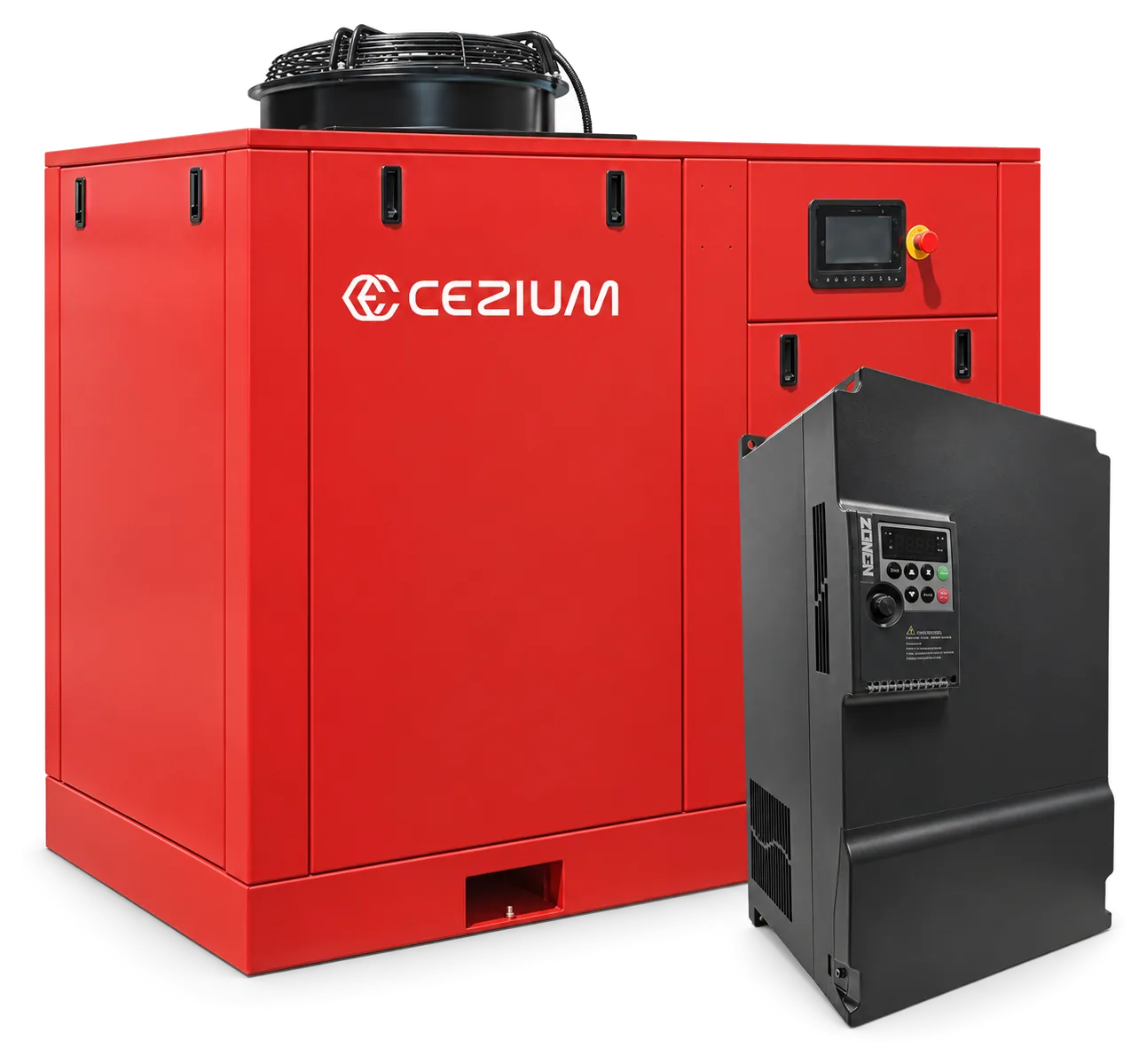
What is a variable speed rotary vane compressor?
Rotary vane mechanics with a drive that matches rotor speed to demand: pressure stays stable and the machine no longer runs off-load. The same logic as the variable speed screw.
Swipe to see the whole drawing
Made for
- Demand that varies with workstations or shifts
- Two- or three-shift production
- The robustness of vanes with the savings of variable flow
Not made for
- A flat loadStandard rotary vane
- The best efficiency at low speedPM VSD rotary vane
| Reference | kW | HP | Flow by pressure (m³/min) | dB(A) | Outlet | L × W × H (mm) | Weight |
|---|---|---|---|---|---|---|---|
| CZ-VANE-V15 | 15 | 20 | 8 bar2.710 bar2.213 bar1.8 | 72 | DN25 | 1500 × 620 × 1300 | 500 kg |
| CZ-VANE-V18.5 | 18.5 | 25 | 8 bar3.210 bar2.613 bar2.2 | 72 | DN25 | 1500 × 620 × 1300 | 540 kg |
| CZ-VANE-V22 | 22 | 30 | 8 bar3.710 bar3.213 bar2.5 | 72 | DN25 | 1500 × 620 × 1300 | 600 kg |
| CZ-VANE-V30 | 30 | 40 | 8 bar5.610 bar4.6513 bar3.66 | 74 | DN50 | 1750 × 1050 × 1595 | 810 kg |
| CZ-VANE-V37 | 37 | 50 | 8 bar6.810 bar5.6613 bar4.7 | 76 | DN50 | 1750 × 1050 × 1595 | 900 kg |
| CZ-VANE-V45 | 45 | 60 | 8 bar8.2510 bar713 bar5.83 | 76 | DN50 | 1750 × 1050 × 1595 | 975 kg |
| CZ-VANE-V55 | 55 | 75 | 8 bar10.510 bar8.913 bar7 | 76 | DN50 | 1750 × 1050 × 1595 | 1,020 kg |
Flows, pressures, noise levels and dimensions recorded model by model on the catalogue sheets. Flows given at 8 bar.
The drive matches the rotor speed to demand, from 15 to 55 kW: pressure stays stable and the machine no longer runs unloaded. Same logic as the VSD screw, with the rotary vane mechanics.
The permanent-magnet version of the family goes further in efficiency; this one remains the usual compromise when demand varies without being extreme.
The same vane air-end (off-centre rotor, self-sealing vanes), but driven through a variable frequency drive (inverter) that varies the rotational speed continuously.
Instead of working on an all-or-nothing basis, the machine adjusts its speed to the network's actual demand: pressure stays stable within a narrow band, without the load / off-load cycles that waste energy. Start-up is progressive, with no inrush current peak.
The Venus series offers the savings of variable flow at a lower cost than the PM-VSD permanent magnet version, while keeping the longevity and quietness of the vane air-end.
Sites with fluctuating air demand (two-shift or three-shift production, consumption varying by station) that want the savings of variable flow and the robustness of rotary vanes. Electricity accounts for 76% of a compressor's cost over ten years on two shifts (US Department of Energy, 2000): the drive is the first lever for savings.
Savings under variable load
The drive removes unproductive off-load cycles and adapts the flow to actual demand: marked energy savings as soon as consumption fluctuates.
Stable pressure
Continuous control within a narrow band: network pressure can be lowered to the strict minimum, which reduces consumption further.
Soft start
Inrush current limited to rated current, no electrical or mechanical jolt: longer service life, electrical supply spared.
Rotary vane quietness
72 to 76 dB(A) depending on size, reduced further at low speed thanks to the drive.
Efficiency that does not drop
The vanes slide towards the stator as they wear and keep their seal: efficiency does not degrade with the hours.
Worth reading on this technology
Permanent magnet VSD: what the drive really saves
What a permanent magnet drive changes on a varying load: idle hours removed, and the annual gain to be worked out from your own load profile, across 6 typical power ratings.
Two-stage screw compressor: around 10% less energy than a standard screw
A two-stage screw compressor compresses air in two steps with intercooling in between, close to the theoretical isothermal cycle. Around 10% less energy than a standard screw at constant load; with a permanent magnet drive, on a variable load, the two gains combine.